
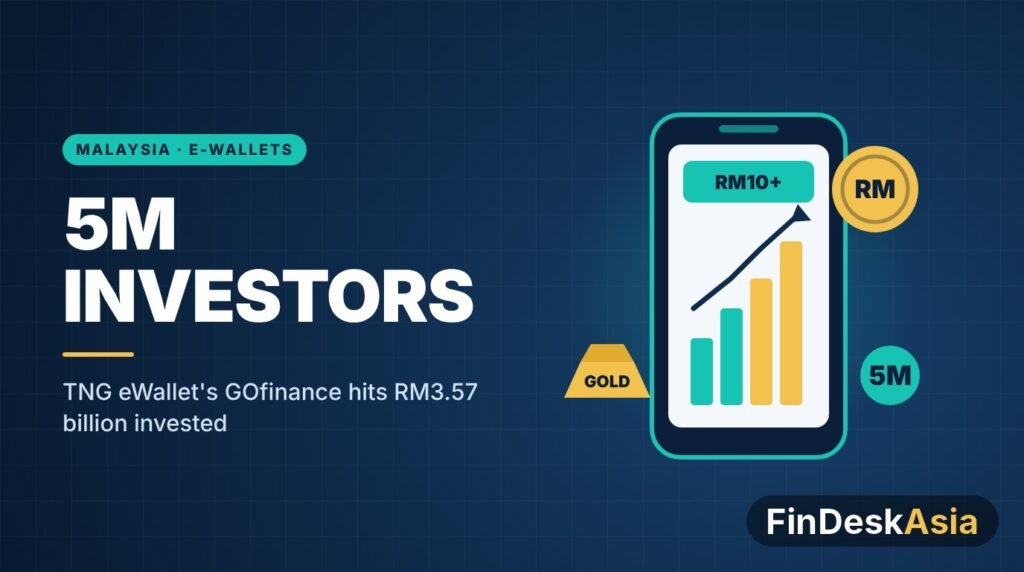
Touch ‘n Go’s GOfinance Passes 5 Million Investors and RM3.57 Billion Invested
More than five million people have now used GOfinance, the investment section inside Malaysia’s Touch ‘n Go (TNG) eWallet, to put money into products ranging from digital gold to shares. TNG Digital, the company behind the app, says these users had invested a combined RM3.57 billion as of 30 September 2026.
The milestone shows how a payments app that most Malaysians first downloaded for tolls, parking and paying at the pasar malam (night market) is turning into an everyday gateway for saving and investing.
Key facts
- 5 million+ users have accessed at least one investment product through GOfinance. A person who uses several products is counted once.
- RM3.57 billion in total investment value has been processed across TNG eWallet’s wealth products, as of 30 September 2026.
- GO+ is the biggest draw: more than 4.7 million users have invested in it.
- Digital gold is growing: over 700,000 users have bought or sold gold through e-Mas.
- Some products can be started with as little as RM10.
What GOfinance is, in plain terms
GOfinance is not a bank or a fund manager. It works as an open platform: the app is the shop window, while the actual products come from regulated financial institutions and specialist partners. Users can choose money market funds, Amanah Saham funds, unit trusts, retirement solutions, digital gold, and Malaysian and international shares.
The best-known product is GO+, where users park spare e-wallet cash in a money market fund that pays daily returns while the money stays easy to spend. That explains why almost every GOfinance user has touched GO+. The newest addition is a partnership with the trading platform Webull, which widens access to local and global stocks from inside the same app.
Desmond Teoh, Chief Financial Services Officer at TNG Digital, said that opening up investing is about more than a low minimum amount. He added that trust matters when people make decisions about their money, and that users should be able to explore different options in one place.
What it means for Malaysians
- For consumers: starting to invest no longer needs a branch visit, a broker account or a large lump sum. With RM10 entry points, first-time investors can try gold, funds or shares in small amounts. The flip side is that these are investments, not deposits: values can go up or down, and returns are not guaranteed the way a fixed deposit’s interest is.
- For banks and fund houses: the e-wallet has become a powerful distribution channel. Partners plug into millions of existing users instead of building their own apps and marketing to each customer. That also puts pressure on banks whose own apps offer fewer choices.
- For the e-wallet market: payments alone earn thin margins, so wallets are competing to hold their users’ savings. ShopeePay recently raised the limit on its Money+ feature, and the race to be the place where Malaysians keep their spare cash is clearly heating up.
The bigger picture
Malaysia’s e-wallets grew on the back of QR payments and DuitNow, the national real-time payment network run by PayNet. The next step is “super app” finance: one login for paying, saving, investing and, increasingly, borrowing. GOfinance’s numbers suggest Malaysians are willing to use their wallet app this way, especially when products are simple and start small.
It also raises the bar on protection. As more first-time investors arrive through a phone app, clear risk warnings, suitability checks and scam defences become as important as the user interface.
What to watch
- Whether the Webull tie-up turns more GO+ savers into share investors, and how often they trade.
- How rival wallets such as ShopeePay, GrabPay and Boost answer with their own savings and investment features.
- Whether Malaysia’s regulators, Bank Negara Malaysia and the Securities Commission, tighten guidance on how investments are marketed inside payment apps.
Read more: ShopeePay Raises Money+ Limit to RM30,000, Above Touch ‘n Go’s GO+ Cap and The Malaysian E-Wallet War.
Sources: Fintech News Malaysia (October 2026); DagangNews (October 2026); New Straits Times (October 2026).
