
Thailand: Bank of Thailand Drafts Baht Stablecoin Rules With 1:1 Reserves and No Interest
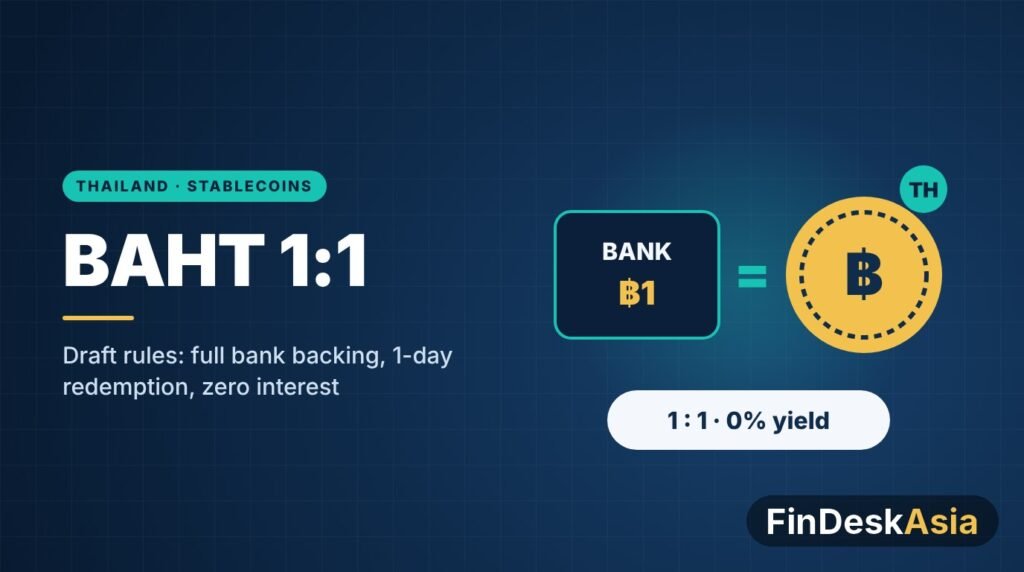
The Bank of Thailand (BOT), the country’s central bank, has published draft rules for stablecoins pegged to the Thai baht and opened them to public comment. Under the plan, every token would have to be backed one-for-one by baht held at banks, could be cashed out within one business day, and could never pay holders interest.
The message is clear: Thailand wants baht stablecoins to work as a payment tool, not as a savings product.
Key facts
- Each baht stablecoin must be fully backed 1:1 by baht. At first, all reserves must be held as deposits in commercial bank accounts.
- In a later phase, the BOT may allow other high-quality liquid assets, such as short-term government bonds, as reserves.
- Holders must be able to redeem tokens for baht within one business day, subject to set conditions.
- Issuers may not pay interest or returns, or offer any incentive linked to how much or how long someone holds the tokens.
- The BOT has recommended that the Ministry of Finance treat issuers and wallet operators as licensed payment service businesses under BOT supervision. It also wants the power to cap the number of issuers.
What the draft rules say
A stablecoin is a digital token designed to keep a steady value, usually by tracking a national currency. The BOT’s draft answers the main question regulators everywhere face: what stands behind each token? Its answer is simple and conservative. For every baht token in circulation, one real baht must sit in a bank deposit. Only later might issuers be allowed to hold safe, easy-to-sell assets such as short-dated government bonds.
The one-business-day redemption rule is meant to give users confidence that a token can always be turned back into ordinary money quickly. The ban on interest and holding rewards goes further than a simple “no interest” rule: issuers also cannot offer indirect perks tied to balances or holding time. The BOT says the role of a digital payment tool should be clearly separated from financial products that pay returns.
On licensing, the central bank wants the Ministry of Finance to designate both token issuers and custodial wallet providers as payment service businesses. They would need a licence and BOT supervision before offering services. The BOT is also asking for legal power to limit how many issuers are licensed. Its concern is fragmentation: many competing corporate tokens could split liquidity and make stablecoins less useful as a way to pay.
Issuers and wallet providers would also need anti-money laundering controls, including know-your-customer (KYC) and know-your-merchant (KYM) checks, monitoring for suspicious transactions, and cybersecurity safeguards.
Why it matters
Thailand already has a popular instant payment system, PromptPay, which lets people send money and pay merchants with a phone number or QR code. The BOT says it does not expect stablecoins to replace PromptPay, which already meets most everyday retail needs. Instead, it sees a role in specific cases where today’s systems fall short.
The examples it gives are “programmable” payments, where money moves automatically when a condition is met. One case is an escrow-style payment that is released only after a buyer confirms the goods have arrived. Another is settling trades in digital assets. In some cases, the BOT says, this could also mean lower fees and faster processing.
For the region, the draft adds Thailand to a growing list of Asian regulators writing their own stablecoin rulebooks. The common thread is tight reserve rules and a focus on payments rather than speculation. There is also a link to Malaysia: the BOT and Bank Negara Malaysia recently joined BLOOM, a Monetary Authority of Singapore-led initiative on cross-border payments using digital money such as regulated stablecoins. Clear national rules on what a baht token must look like could make that kind of cross-border work easier to plan.
For businesses, the zero-yield rule matters. Companies holding baht stablecoins for settlement would earn nothing on those balances, so the tokens would make sense mainly where speed or automation is worth more than interest income.
What to watch
- Final recommendations: After the consultation, the BOT is expected to send formal recommendations to the Ministry of Finance, which would designate the licensed businesses.
- How many issuers: Whether the BOT gets the power to cap issuer numbers, and how tight that cap would be.
- Reserve rules in phase two: When, and on what terms, assets such as short-term government bonds could be added to reserves.
Related on FinDeskAsia: Bank Negara Joins Singapore-Led BLOOM to Shape Cross-Border Digital Money Rules and Hong Kong: HSBC Rolls Out RedCoin Stablecoin to 3.3 Million PayMe Users.
Sources: Retail News Asia (October 2026); ASEAN NOW (October 2026); Fintech News Singapore, on BLOOM (October 2026).
