
Hong Kong: HSBC Rolls Out RedCoin Stablecoin to 3.3 Million PayMe Users
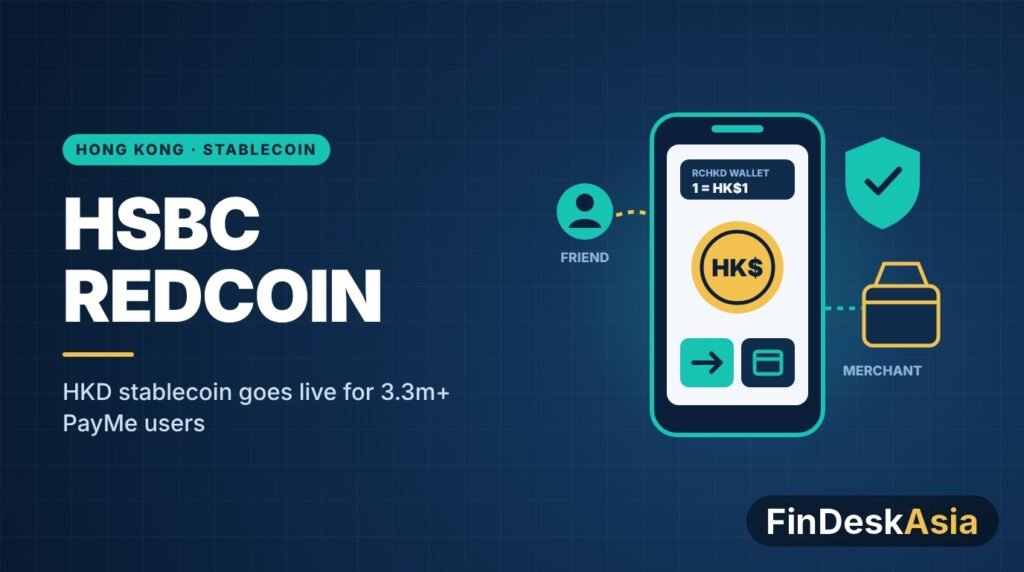
HSBC has started rolling out RedCoin, a stablecoin pegged to the Hong Kong dollar, to users of its PayMe app. From Friday, 23 October 2026, more than 3.3 million PayMe users can begin switching on a RedCoin wallet and use it to send money to friends and pay merchants. It is the first retail rollout of a stablecoin licensed under Hong Kong’s new rules.
Key facts
- What launched: HSBC RedCoin (ticker RCHKD), a Hong Kong dollar stablecoin, began a phased rollout on 23 October 2026 through PayMe, HSBC’s popular payments app in Hong Kong.
- Who can use it: more than 3.3 million PayMe users can activate a RedCoin wallet in the app over the coming days, with no minimum balance and no separate account to open.
- What it does first: person-to-person transfers and payments to merchants that accept PayMe.
- How it is backed: HSBC says each RedCoin is fully backed by high-quality, liquid assets held separately, and can be redeemed one-for-one for Hong Kong dollars.
- The licence: the Hong Kong Monetary Authority (HKMA), the city’s central bank and banking regulator, granted HSBC and Anchorpoint Financial the first stablecoin issuer licences in April 2026.
How RedCoin works
A stablecoin is a digital token designed to hold a steady value, usually by tracking a normal currency such as the US dollar or, in this case, the Hong Kong dollar (HKD). One RedCoin is meant to always be worth HK$1, and HSBC promises to swap it back into ordinary dollars at that rate.
For users, the bank has tried hard to make the new wallet feel familiar. After updating the app, PayMe customers can switch on a RedCoin wallet that looks and works much like the PayMe they already know, with instant transfers. Lawrence Li, head of PayMe, told the South China Morning Post that the priority in the first phase is stable service, no extra burden for customers and winning their trust.
RedCoin runs on HSBC’s own distributed ledger, a shared digital record of who owns what, and the tokens are held by HSBC Digital Assets Custody. Later this year, HSBC plans to let customers use RedCoin in its HSBC HK mobile banking app to invest in a new share class of a Hong Kong dollar money market fund, a low-risk fund that holds short-term deposits and debt. The bank says more products are on the way, including uses for large companies and institutions.
Why it matters
Hong Kong’s Stablecoins Ordinance took effect in August 2025 and set up a licensing regime for anyone issuing tokens tied to a real currency. RedCoin is the first big test of that regime in the retail market. The other licence holder, Anchorpoint Financial, a joint venture of Standard Chartered, telecoms group HKT and Animoca Brands, began a phased rollout of its HKDAP stablecoin in August, but only for eligible institutions and professional investors.
By building on PayMe, HSBC skips the hardest part of any new payment product: getting people to download something new. Millions of users already split bills and pay shops through the app, so the stablecoin arrives inside a habit that already exists. HSBC is also one of the three commercial banks that issue Hong Kong’s paper banknotes, which adds weight to its claim that a bank-issued token can be as trusted as cash.
For the wider region, the launch shows one way stablecoins may enter everyday life: issued by a regulated bank, backed one-for-one, and wrapped in an app people already use, rather than through crypto exchanges. Regulators across Asia, from Singapore to Japan and South Korea, are working on their own rules for digital money, and many will be watching how Hong Kong’s model handles real consumer use. Elsewhere in the region, Japanese and Korean firms are testing yen stablecoin payments for travellers, and Bank Negara Malaysia has joined a Singapore-led effort to set common rules for cross-border digital money.
What to watch
- Take-up: how many of PayMe’s 3.3 million-plus users actually activate a RedCoin wallet, and whether HSBC publishes those numbers.
- Reserve checks: the first independent attestation of the assets backing RedCoin, and how often HSBC reports them.
- New uses: the money market fund feature due later this year, and any move into corporate payments or cross-border transfers.
Related on FinDeskAsia: South Korea’s Shinhan Card and Japan’s SBI to test yen stablecoin payments for travellers and Bank Negara joins Singapore-led BLOOM to shape cross-border digital money rules.
Sources: South China Morning Post (Oct 2026); The Block (Oct 2026); Cointelegraph (Oct 2026); crypto.news (Oct 2026); HSBC Hong Kong (Oct 2026).
