
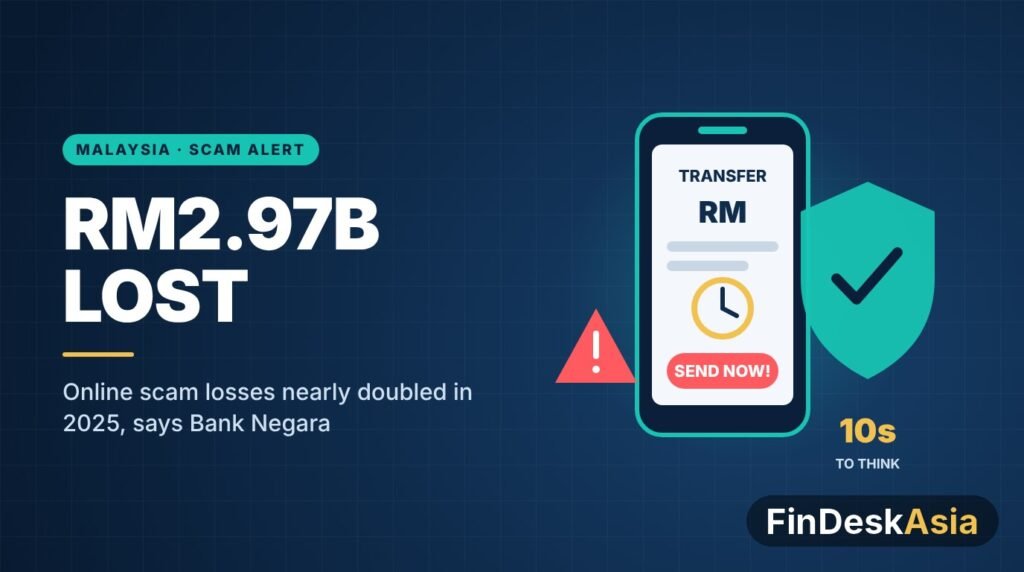
Malaysians Lost RM2.97 Billion to Online Scams in 2025, Bank Negara Governor Warns
Malaysians lost RM2.97 billion to online scams in 2025, almost double the RM1.57 billion lost a year earlier, according to Home Ministry figures shared by Bank Negara Malaysia (BNM) Governor Datuk Seri Abdul Rasheed Ghaffour. Speaking at the Selangor Financial Literacy Carnival 2026 on 24 October, he warned that instant digital transfers leave victims only seconds to think before their money is gone.
Key facts
- National online scam losses rose to RM2.97 billion in 2025, from RM1.57 billion in 2024.
- Selangor had the highest losses of any state at RM986.79 million, up from RM446.16 million, or nearly one-third of the national total.
- Kuala Lumpur followed with RM782.86 million, up from RM293.30 million. Together the two areas lost about RM1.77 billion and have been the worst hit for three years running.
- Fake investment schemes caused the biggest losses (RM1.46 billion), followed by telecommunications scams (RM802.47 million).
- The data comes from a written Home Ministry reply to Parliament in June, cited in the Governor’s slides.
Speed is now part of the risk
Malaysia’s payment rails have become very fast. A transfer through online banking or DuitNow, the national real-time transfer service run by Payments Network Malaysia (PayNet), can be completed in roughly 10 seconds. That is a convenience for shoppers and businesses, but the Governor pointed out that it also shrinks the window in which a person can stop and question a suspicious request.
He described a familiar script: a caller pretends to be from a bank or a government agency and claims the victim’s account will be blocked unless money is moved immediately. The pressure to act quickly is the scam. His advice was simple: when someone insists you must act now, pause and check through official channels before sharing any details or sending money.
Investment fraud, however, remains the single largest source of losses. Schemes that promise high returns from businesses or assets that do not exist accounted for almost half of the 2025 total on their own.
What BNM and the banks are doing
According to the Governor, BNM is working with financial institutions and enforcement agencies to trace stolen funds faster and to tighten security on online banking. He also called on banks and other financial institutions to strengthen their controls, make their fraud warnings clearer and act quickly when they see suspicious transactions.
He was careful to add that strong systems alone are not enough. Public alertness has to keep pace with the technology, especially because scammers rely on rushing their targets into decisions.
Artificial intelligence (AI) featured as both a help and a responsibility. The Governor said AI can help institutions spot unusual activity and send customers timely alerts, but it must come with proper protection of personal data and should support, not replace, people’s own judgement.
What it means for Malaysians
- Consumers: expect more warnings, extra checks and occasional delays on unusual transfers from your bank or e-wallet. Treat any call or message that demands an urgent transfer as a red flag, and call your bank on the number printed on your card or listed on its official website.
- Merchants and SMEs: businesses that pay suppliers by instant transfer should verify any change in bank details by phone with a known contact before paying. Staff handling payments are a common target for impersonation scams.
- Banks and e-wallet providers: the Governor’s message points to faster fund tracing, clearer in-app warnings and quicker action on suspicious transactions. Providers that use AI-based fraud monitoring will also need to show they protect customer data.
The figures also show the problem is concentrated in the Klang Valley, where digital payment use is highest. Financial literacy events such as the Selangor carnival are one way BNM is trying to reach people where losses are heaviest.
What to watch
- Whether 2026 loss figures show the rise slowing as banks add new fraud controls.
- Any new BNM requirements on fraud detection, fund tracing or transfer safeguards for banks and e-wallets.
- How quickly banks roll out AI-based monitoring, and how they handle the data protection concerns the Governor raised.
Related on FinDeskAsia: DuitNow explained · PayNet and the regulators
Sources: Bank Negara Malaysia, Governor’s speech at the Selangor Financial Literacy Carnival 2026 (October 2026) · The Vibes (October 2026) · MCI Group / Berita Harian (October 2026)
