
Indonesia: Bank Indonesia Plans to Use QRIS Payment Data to Credit-Score Small Firms
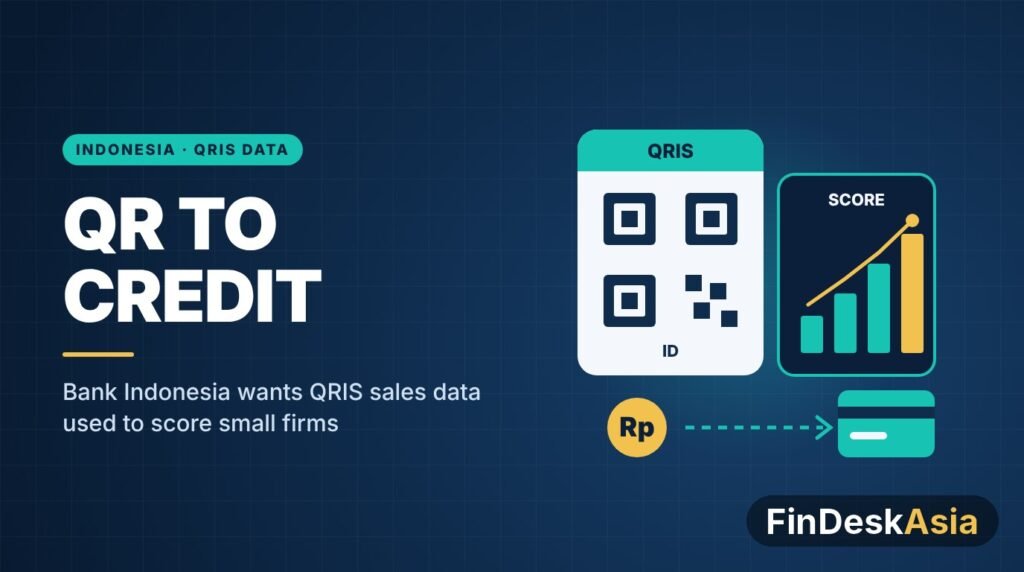
Indonesia’s central bank wants the QR codes on millions of small shop counters to do more than take payments. Bank Indonesia (BI) says data from QRIS transactions could one day help lenders judge whether a small business is creditworthy, giving traders who have never had a bank loan a way to prove they are a good risk.
BI Governor Destry Damayanti raised the plan again on Monday, 26 October, at a technology and investment forum in Jakarta. The idea has been discussed since 2025, but it has not yet been put into practice.
Key facts
- The plan: BI intends to use QRIS (Quick Response Code Indonesian Standard) transaction records as one reference for credit scoring of micro, small and medium enterprises (MSMEs).
- The reach: QRIS has about 71 million users and 49.4 million merchants, and 97% of those merchants are MSMEs.
- The growth: QRIS transaction volume rose 75.8% year on year in the third quarter of 2026, according to BI.
- Not live yet: No start date or rulebook has been announced. The Financial Services Authority (OJK), which supervises lenders, has welcomed the idea but says it needs more study.
What BI is proposing
QRIS is Indonesia’s national QR payment standard. One code at a warung, market stall or café accepts payments from any bank app or e-wallet in the country. Because every scan is recorded, a merchant who uses QRIS builds up a digital trail of daily sales: how much comes in, how often, and how steady it is over months.
That trail is what BI wants lenders to use. Many small traders in Indonesia run on cash, keep no formal accounts and have no credit history, so banks and finance companies struggle to assess them. Speaking to reporters, Destry said that in the future this merchant data could become “a kind of credit scoring.” In plain terms, a stall owner with a long record of regular QRIS sales could use that record as evidence of income when applying for a loan.
This kind of information is often called alternative data: anything other than a traditional credit report, such as payment flows, utility bills or mobile phone usage, that helps a lender understand a borrower.
Why it matters
Access to credit is one of the biggest problems for Indonesia’s small businesses, which make up the bulk of the country’s merchants. If QRIS data can be used safely, it could open the door to cheaper, faster loans from banks, digital lenders and peer-to-peer lending platforms, and reduce reliance on informal borrowing.
It would also give merchants a fresh reason to keep using QRIS rather than cash, because every digital sale would help build their financial record. With user numbers rising quickly (about 71 million in October, up from 67 million a month earlier, according to CNBC Indonesia), the pool of data is already large.
There are open questions. OJK has said any rollout must protect personal data, make sure the data is accurate, and keep lending prudent. Merchants will also want to know who can see their transaction history and whether they must give consent first. Sales data alone does not show a business’s costs or debts, so lenders are likely to treat it as one input among several rather than a full replacement for normal checks.
For the wider region, the plan is worth watching. Several Southeast Asian countries have built national QR systems, and Indonesia’s QRIS is already linked to Malaysia’s DuitNow QR and other ASEAN networks for cross-border payments. If Indonesia shows that QR data can safely support small-business lending, other central banks may consider similar steps.
What to watch
- Whether BI and OJK issue formal rules on how lenders may access and use QRIS data, and what consent merchants must give.
- Which banks, digital lenders or e-wallet providers are first to offer loans based on QRIS sales history.
- How the plan fits with BI’s separate push to stop QRIS being misused for online gambling payments.
Related on FinDeskAsia: Bank Indonesia to trial cross-border QRIS with Hong Kong and Timor-Leste and ASEAN’s cross-border QR payments.
Sources: ANTARA News (October 2026); CNBC Indonesia (October 2026).
