
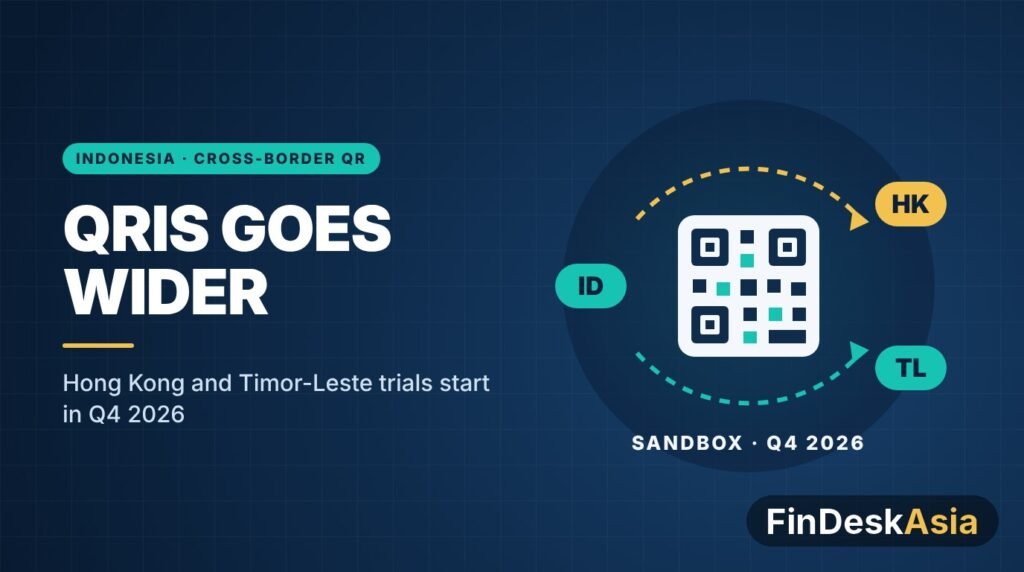
Indonesia: Bank Indonesia to Trial Cross-Border QRIS With Hong Kong and Timor-Leste
Indonesia’s national QR code, QRIS, is set to reach two more markets. Bank Indonesia (BI), the country’s central bank, will start sandbox trials of cross-border QRIS payments with Hong Kong and Timor-Leste in the fourth quarter of 2026, Governor Destry Damayanti said on 21 October after the bank’s monthly Board of Governors meeting.
Key facts
- BI will run sandbox (controlled trial) tests of QRIS payments in the Hong Kong and Timor-Leste corridors starting in Q4 2026, which runs from October to December.
- No launch date for full service, and no transaction or merchant targets, were given for either corridor.
- QRIS transactions grew 75.80% year on year in Q3 2026, slower than the 100.12% growth recorded in Q2 2026.
- QRIS now has 70.6 million users and 49.4 million merchants, according to BI.
- Total digital payment transactions in Indonesia reached 18.09 billion in Q3 2026, up 39.24% from a year earlier.
What BI announced
QRIS (Quick Response Code Indonesian Standard) is the single QR standard that lets Indonesians pay any merchant from any bank app or e-wallet. Its cross-border version, called QRIS Antarnegara in Indonesian, lets travellers scan a merchant’s local QR code abroad and pay from their home app, with the currency conversion handled in the background.
BI already lists six markets as connected to cross-border QRIS: Thailand, Malaysia, Singapore, Japan, South Korea and China. Hong Kong and Timor-Leste would be the next two. A sandbox is a limited test with selected banks and merchants, so ordinary users should not expect to scan QRIS codes in Hong Kong shops straight away.
The QRIS plan was one of several payment measures the governor listed under BI’s Indonesian Payment System Blueprint 2030. Others, also from Q4 2026, include online payments for the government segment of the Kartu Kredit Indonesia (Indonesia’s domestic credit card), a new BI regulation on payment system data in line with the country’s personal data protection law, and a reorganisation of how payment providers work with their supporting service providers.
Why it matters
The two new corridors are very different. Hong Kong is a major financial centre and a frequent destination for Indonesian travellers and workers, so a QRIS link there would add one of Asia’s busiest payment markets to the network. Timor-Leste is a small neighbour that recently became ASEAN’s newest member and uses the US dollar, so a QR link could make everyday payments simpler for people and traders moving between the two countries.
The latest numbers also show QRIS is maturing. Growth of 75.80% is still very fast, but it has cooled from triple-digit rates as the user base grows. With domestic adoption already wide, cross-border use is one of the clearer ways for BI to keep the network expanding.
For Malaysia, the link is direct: Malaysia is already one of the six QRIS cross-border markets, through the connection between QRIS and Malaysia’s DuitNow QR, which is run by PayNet. Every new corridor makes the regional QR web that Malaysian banks and e-wallets plug into a little denser, and adds pressure on other networks in the region to keep up.
What to watch
- Which banks, e-wallets and merchants take part in the Hong Kong and Timor-Leste sandboxes, and when BI sets a date for full launch.
- Whether QRIS growth keeps slowing in Q4 2026, and how much of the volume comes from cross-border use.
- BI’s new payment data regulation and its rules for how payment providers work with third-party service providers.
Related on FinDeskAsia: ASEAN’s cross-border QR payments set a record and DuitNow explained.
Sources: Kontan (October 2026); Infobanknews (October 2026); Bloomberg Technoz (October 2026); Jawa Pos (October 2026); Ezeelink (July 2026).
