
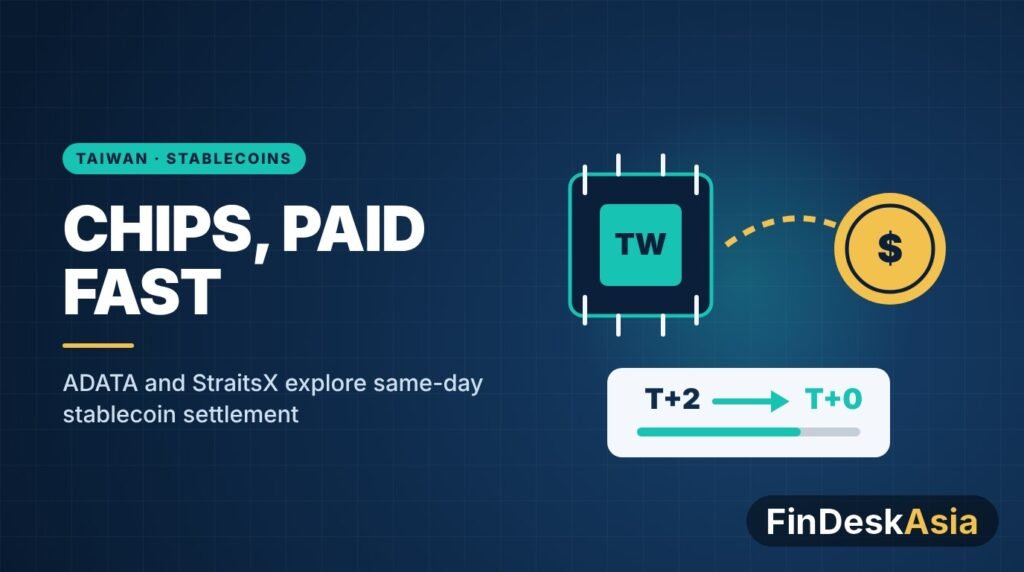
Taiwan: ADATA and StraitsX Explore Stablecoin Settlement for Chip Exports
ADATA Technology, a Taiwanese memory and storage maker, has signed a memorandum of understanding (MOU) with Singapore stablecoin issuer StraitsX to study paying for chip exports with regulated digital dollars. ADATA’s blockchain subsidiary, BaaS Innovation, is the third partner. The firms want to cut the time it takes to settle cross-border hardware payments from two working days to almost instant.
Key facts
- Who: StraitsX, ADATA Technology and BaaS Innovation, an ADATA subsidiary that builds blockchain tools for businesses.
- What: an MOU, announced on 19 November 2026, to explore using StraitsX’s XSGD (Singapore dollar) and XUSD (US dollar) stablecoins to settle semiconductor trade.
- Target: moving settlement from T+2 (two days after the trade) towards T+0 (the same day, close to instant).
- Supplier finance: approved ADATA invoices could be turned into digital tokens, so suppliers can get paid early by ADATA or by outside funders.
- Status: no live payments yet. The plan still needs technical, commercial and regulatory checks in each market.
What the three firms want to test
A stablecoin is a digital token designed to hold a steady value, usually by being backed one-to-one with a currency such as the US dollar. StraitsX, part of Fazz Financial Group, issues its tokens under a Major Payment Institution licence from the Monetary Authority of Singapore (MAS), the city-state’s central bank and financial regulator.
Under the MOU, each firm has a set role. StraitsX would supply the stablecoins and the payment rails. ADATA, which describes itself as the world’s second-largest maker of DRAM and branded SSD modules, is the “anchor” partner and would bring real payment flows from its import and export business. BaaS Innovation would act as system integrator, testing blockchain invoices, tokenised payables and tools for real-world assets.
The payables idea is the most practical part. Today, a supplier waiting weeks for an invoice to be paid often has to borrow to cover the gap. If ADATA’s approved invoices become tokens, a supplier could sell or pledge them for early cash, and settlement could run automatically when the invoice falls due. The partners also mention Purpose Bound Money, a MAS-backed design that lets digital money carry rules on how it can be used, and smart contracts, which are programs that run payments automatically.
Why it matters
Taiwan sits at the centre of the global chip supply chain, and its exporters move large sums across borders every day. Most of that still runs through correspondent banking, where a payment can hop through several banks, take days and cost fees at each step. A same-day, around-the-clock option could free up working capital for both buyers and sellers.
The deal also shows stablecoins moving from crypto trading towards ordinary business payments. StraitsX chief executive Tianwei Liu said the focus is shifting to how stablecoins can support everyday business operations at scale. ADATA chairman Simon Chen pointed to faster settlement, better supplier liquidity and more resilient financing.
It lands as Taiwan’s own rules are taking shape. The Financial Supervisory Commission, Taiwan’s financial regulator, has proposed draft stablecoin rules that would put banks in charge of local issuers. Using a Singapore-licensed token avoids that question for now, but any live pilot will still have to satisfy anti-money laundering and counter-terrorism financing rules in every market the money passes through.
What to watch
- Whether the partners name a first pilot, the trade corridor it uses and when it starts.
- How many ADATA suppliers sign up to tokenised payables, and who provides the early-payment funding.
- How Taiwan’s final stablecoin rules treat foreign-issued tokens used by local exporters.
Read more: our Taiwan coverage and ASEAN’s cross-border QR record.
Sources: StraitsX (Nov 2026); Fintech News Singapore (Nov 2026); Forbes (Nov 2026).
