
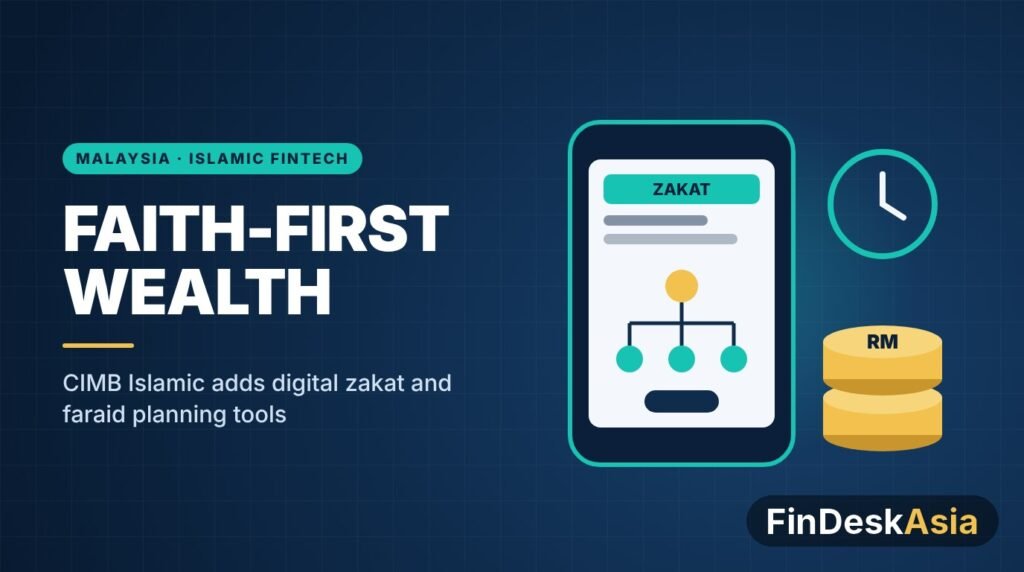
CIMB Islamic Rolls Out Digital Zakat and Faraid Tools Amid RM90bn Estate Backlog
CIMB Islamic Bank has launched a set of Islamic wealth management services that puts zakat estimates, inheritance planning and Shariah-compliant investing into digital tools for ordinary customers. The bank says the aim is to make planning simpler at a time when about RM90 billion in Muslim estates in Malaysia remains undistributed.
Key facts
- Launch: CIMB Islamic launched the suite on 17 November 2026, built around four pillars it calls Grow, Protect, Purify and Distribute.
- Investing in the app: MyWealth in the CIMB OCTO app now has a built-in Shariah selector with access to 57 Shariah-compliant funds, with unit trusts available from RM100.
- New tools: Zakat365 Lite estimates the zakat a customer owes, while Faraid360 simulates how an estate could be shared among heirs under Islamic inheritance rules.
- Advisers: The bank plans to have 100 certified Islamic financial planners by the first quarter of 2027.
- Target: Under its Forward30 plan, CIMB wants to more than double its Islamic wealth assets under management by 2030.
What the tools do
Zakat is the annual obligatory alms that Muslims pay on qualifying wealth. Zakat365 Lite works out an estimate based on eligible Shariah-compliant assets and balances. For now it only counts money held with CIMB, and the bank says it plans to extend it to other investments. Lowyat.NET reports the tool arrives in the OCTO app from December and supports payments to a small number of zakat institutions.
Faraid360 deals with faraid, the fixed Islamic rules that decide how a Muslim’s estate is divided among family members. Users can see how assets might be split, and then test how planning tools change the result. These include a wasiat (an Islamic will), hibah (a gift made during one’s lifetime), harta sepencarian (property built up jointly by a married couple) and hibah takaful, a form of Islamic insurance that pays a named beneficiary.
On the investment side, the Shariah selector in MyWealth gives asset allocation suggestions based on a customer’s risk profile. CIMB reminds users that unit trusts are not protected by Perbadanan Insurans Deposit Malaysia (PIDM), the agency that guarantees bank deposits. The takaful protection products are offered with Sun Life Malaysia Takaful.
What it means for Malaysians
The biggest problem the bank is pointing at is frozen family wealth. According to figures cited by CIMB, unclaimed Muslim estates have grown 135% since 2009 to around RM90 billion, and some 46,000 cases are still moving through the small estate distribution process. When a person dies without clear plans, families can wait a long time before they can touch bank balances, land or a family business.
- For households: a free simulator lets families see early who would inherit what, and prompts them to prepare a wasiat or name an administrator before problems arise.
- For first-time investors: a RM100 entry point and a Shariah filter lower the barrier for customers who are used to products like ASB or Tabung Haji and are cautious about market-linked funds.
- For the banking sector: CIMB’s consumer banking chief Haniz Nazlan said the bank can only reach beyond wealthy clients by scaling up through digital means. That puts pressure on rivals, including Islamic digital banks, to offer similar planning tools inside their apps.
The tools are estimates, not legal rulings. Faraid outcomes and zakat amounts can depend on a family’s exact situation and on state religious authorities, so customers will still need proper advice for final decisions.
What to watch
- Whether Zakat365 Lite expands beyond CIMB balances and adds more zakat bodies for direct payment.
- Whether other Malaysian banks and digital banks roll out similar faraid and estate-planning features in their apps.
- Progress towards 100 certified planners by early 2027, a test of how far CIMB can push advice beyond affluent customers.
Related on FinDeskAsia: MRL plans Malaysia’s first tokenised government-guaranteed sukuk with CIMB and Bank Negara sets a 2028 start for open finance.
Sources: Fintech News Malaysia (November 2026), The Rakyat Post (November 2026), Lowyat.NET (November 2026), BigGo Finance (November 2026).
