
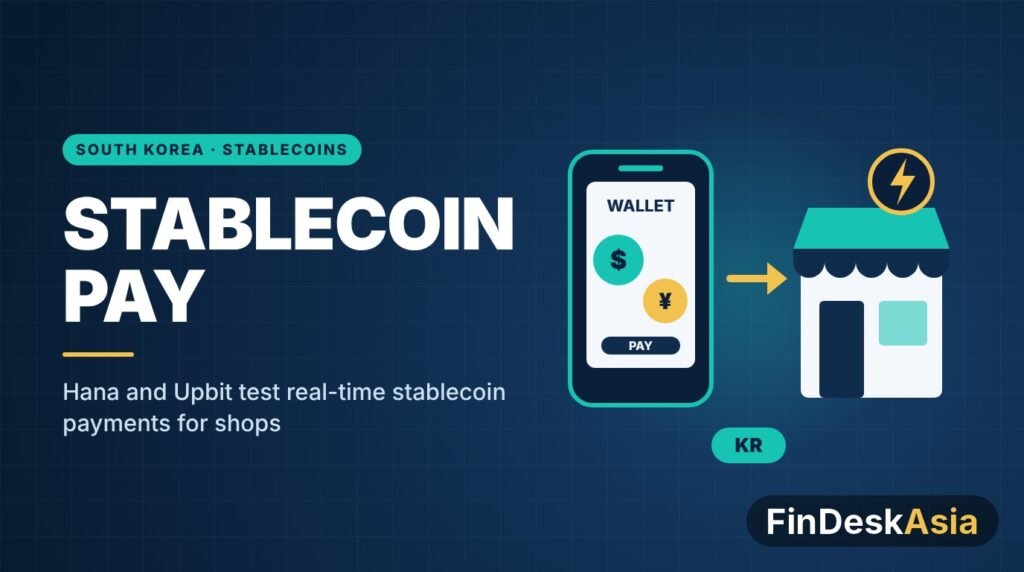
South Korea: Hana Financial and Upbit’s Dunamu Test Stablecoin Payments for Merchants
South Korea’s Hana Financial Group and Dunamu, the company behind the country’s biggest crypto exchange Upbit, are testing a system that lets shoppers pay with stablecoins held in their Upbit wallet. Card unit Hana Card is part of the trial, and the partners say the biggest change could be for merchants, who would be paid almost instantly instead of waiting days.
Key facts
- Hana Financial Group and Dunamu announced a proof of concept (a technical trial) on 23 October 2026 for stablecoin payments and merchant settlement.
- The test links a customer’s Upbit wallet to a payment method, using Dunamu’s GIWA Wallet as the base, so people can pay at online and offline shops.
- A “multi-stablecoin” feature is also being tested: a card linked to Upbit and used abroad would spend US-dollar stablecoins USDT or USDC first, then switch to the yen stablecoin JPYC if the balance runs short.
- Hana Card and Dunamu plan premium services and partner benefits for Dunamu’s VIP customers from January 2027.
- The trial builds on Hana’s deal, announced in May 2026, to buy a 6.55% stake in Dunamu for just over 1 trillion won.
How the trial works
A stablecoin is a digital token designed to hold a steady value, usually by being backed one-for-one with a currency such as the US dollar or the Japanese yen. Crypto exchanges such as Upbit let users hold these tokens, but spending them in a shop has usually meant first selling them and moving the money back into a bank account.
The Hana–Dunamu test aims to remove that step. The customer’s Upbit wallet is connected to a payment method, and the stablecoin is used directly at the checkout. Hana has said it wants to pair this with travel-focused cards such as its Travelog card, which already offers free currency exchange and waives overseas fees. In that case, a traveller in Japan could spend dollar stablecoins first and have the system fall back automatically to a yen token when needed.
The second half of the trial is on the merchant side. On traditional card networks, a shop can wait several days before money from a sale reaches its account. Settling on a blockchain could cut that to near real time. Both Korean reports on the trial point to small merchants, for whom faster access to sales money can ease day-to-day cash flow.
After the trial, Hana plans to standardise the payment and settlement setup and open it up to fintech firms and retailers. A Hana official described the goal as a payment process that ordinary users can actually feel and use, built on a wallet many people already have.
Why it matters
South Korea is still writing its rules for stablecoins, including who may issue a token backed by the Korean won and what role exchanges and fintech firms can play. The reports on this trial note that real-world use would follow once that legal framework is in place. Banks are not waiting: KB Financial has tested won-stablecoin payments and remittances, and Shinhan Card has run pilots with global card networks and, more recently, with Japan’s SBI on yen stablecoins for travellers.
Hana’s approach stands out because it ties a large bank group directly to the country’s biggest exchange. That gives it a ready base of crypto users and a wallet they already trust, while the bank brings card acceptance, foreign exchange and compliance. In a separate project, Dunamu subsidiary Lambda256 is working with Hana to link Dunamu’s GIWA Chain blockchain to Hana’s foreign exchange and account systems for cross-border transfers.
For the wider region, the trial is another sign that stablecoin payments are moving from crypto platforms into mainstream banking. Hong Kong, Japan, Singapore and Thailand have all moved to set stablecoin rules, and banks across Asia are testing how tokens could plug into the card and QR systems shoppers already use.
What to watch
- When South Korea passes its stablecoin law, and whether banks such as Hana are allowed to issue won-backed tokens.
- Whether the real-time merchant settlement in the trial moves into live use for small businesses.
- Which fintechs and retailers sign up once Hana opens its stablecoin payment setup to outside partners.
Related on FinDeskAsia: South Korea’s Shinhan Card and Japan’s SBI to test yen stablecoin payments for travellers and Bank of Thailand drafts baht stablecoin rules.
Sources: eToday (October 2026), Herald Business (October 2026), The Korea Herald (May 2026), Ledger Insights (May 2026).
