
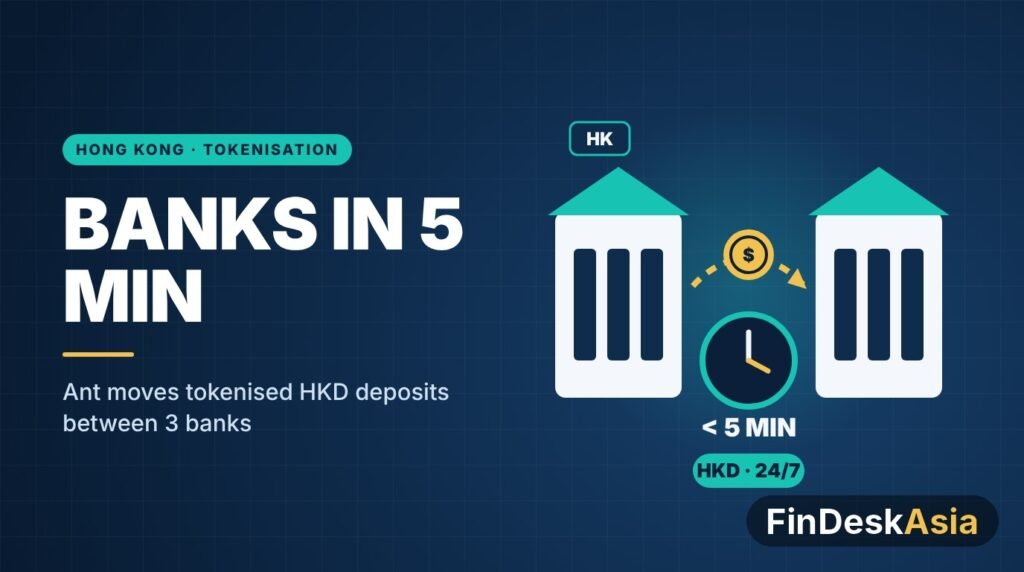
Hong Kong: Ant International Settles Tokenised Deposits Across 3 Banks Within 5 Minutes
Ant International has moved real Hong Kong dollars between three of the city’s biggest banks using tokenised deposits, with each transfer reaching the receiving bank within five minutes. The live transactions, run under the Hong Kong Monetary Authority’s EnsembleTX pilot, settled in central bank money rather than through a private token.
Key facts
- Who: Ant International, the Singapore-headquartered company behind Alipay+ and other cross-border payment services, worked with Bank of China (Hong Kong), China Construction Bank (Asia) and HSBC.
- What: live Hong Kong dollar interbank transfers, from BOCHK to CCB (Asia) and between CCB (Asia) and HSBC, carried out between September and October 2026.
- Speed: each transfer went from payment instruction to final receipt within five minutes, and the set-up gives Ant round-the-clock access to its liquidity.
- How: Ant sent the instructions through WhaleRTP, its blockchain-based wholesale settlement platform, and the transfers settled in the HKMA’s central bank money.
- Background: Ant has been in the Ensemble sandbox since 2024 and joined the Project Ensemble Architecture Community in 2025.
What actually happened
A tokenised deposit is an ordinary bank deposit recorded as a digital token on a blockchain. The money is still a regulated liability of a licensed bank, which makes it different from a stablecoin issued by a non-bank. The token form means it can be moved and programmed with software, and in theory at any hour of the day.
The HKMA is Hong Kong’s central bank and banking regulator. Its Project Ensemble is a long-running effort to test how tokenised money and tokenised assets could work together, and EnsembleTX is the pilot stage in which participants handle real-value transactions instead of test money. Ant’s announcement on 3 November is one of the early examples of a non-bank company using that pilot to move its own funds between banks.
The important detail is how the transfers were finished. Instead of the two banks simply updating their own token ledgers, the final settlement happened in central bank money, the safest form of money in the system. That is the same principle that sits under normal interbank payments, now applied to a tokenised, always-on setting.
Why it matters
For a large payments firm, cash is constantly spread across many bank accounts. Today, companies often pre-fund accounts, parking money in advance so payouts do not fail when banks are closed or batches run late. Ant says moving deposits in near real time, around the clock, can reduce that pre-funding and cut the working capital it needs to hold idle. It also lets the company automate transfers and see its cash position in Hong Kong in real time.
For Hong Kong, the test shows that the HKMA’s tokenisation work is moving beyond banks talking to banks. Corporate treasurers, not just traders, are starting to use the rails. That is the kind of practical use case regulators across Asia want to see before they decide how far to open tokenised money to the wider economy.
There is a regional thread too. Several Asian central banks are studying the same idea. In Malaysia, Bank Negara Malaysia (BNM) has been running pilots on ringgit stablecoins and tokenised deposits ahead of a policy decision, and Ant International already connects Malaysia’s DuitNow QR to overseas wallets through Alipay+. How Hong Kong handles settlement in central bank money is likely to be watched closely by regulators elsewhere.
What comes next
Ant plans to build what it calls “agentic treasury” on top of EnsembleTX. In this model, software agents decide on and carry out treasury moves on their own. Its FalconTST tool would forecast foreign exchange exposure and cash flow, while WhaleRTP would execute the resulting transfers. “The agent decides, and WhaleRTP executes,” said Kelvin Li, General Manager of Platform Tech and Senior Vice President at Ant International.
The company did not disclose how many transfers it made or their value, so the scale of the test is not yet clear.
What to watch
- Whether more corporates and payment firms join EnsembleTX for live transactions, and whether other Hong Kong banks are added to the network.
- How the HKMA sets rules for AI agents that move money automatically, including who is responsible when an automated transfer goes wrong.
- Whether tokenised deposit settlement spreads to cross-border corridors, including links with other Asian markets.
Related on FinDeskAsia: Hong Kong: Standard Chartered-Backed Anchorpoint to Issue HKDAP Stablecoin on Solana · Ringgit Stablecoin and Tokenised Deposit Pilots Near BNM’s End-2026 Policy Call
Sources: Fintech News Hong Kong (November 2026); TNGlobal (November 2026); The Paypers (November 2026)
