
Hong Kong: Bill Would License Crypto Dealers, Advisers, Managers and Custodians
Hong Kong has published a bill that would bring crypto dealers, advisers, fund managers and custodians under formal licensing for the first time. The draft law, gazetted on 20 November 2026, extends the city’s existing rules for crypto exchanges to four more types of business, and goes to the Legislative Council (LegCo) for its first reading on 2 December.
The move fills one of the last big gaps in the city’s framework for virtual assets, which already covers trading platforms and, since 2025, issuers of stablecoins.
Key facts
- The Virtual Asset Services Legislation (Amendment) Bill 2026 was published in the Government Gazette on 20 November 2026.
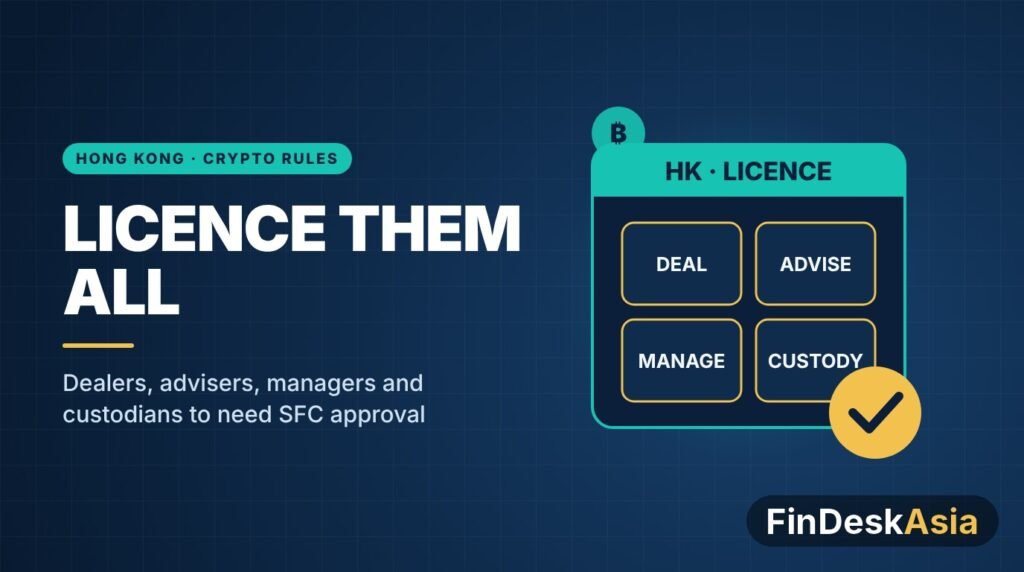
- It covers four services: dealing, advisory, management and custody of virtual assets. Anyone offering them as a business in Hong Kong would need a licence from, or registration with, the Securities and Futures Commission (SFC).
- Banks and stored value facility (e-wallet) operators supervised by the Hong Kong Monetary Authority (HKMA) would have to register with the SFC before offering any of these services.
- The bill amends the Anti-Money Laundering and Counter-Terrorist Financing Ordinance (AMLO), the same law that already governs licensed crypto trading platforms.
- Its first reading in LegCo is set for 2 December 2026. No start date for the new regime has been announced.
What the bill does
Until now, Hong Kong’s crypto rules have focused on exchanges. A firm could, in practice, hold customers’ digital tokens, trade on their behalf or give buy-and-sell recommendations without a licence aimed at that specific activity. The new bill changes this by treating each service as its own regulated activity.
Firms in all four groups would have to pass a fit-and-proper test, a standard check on the owners’ and managers’ honesty, competence and finances, and meet other regulatory requirements set by the SFC. Officials described the guiding idea as “same activity, same risks, same regulation”, meaning crypto firms should face rules similar to those for traditional securities businesses doing the same thing.
The four categories in plain terms:
- Dealing: buying and selling crypto for clients, for example over-the-counter (OTC) desks.
- Advisory: giving recommendations on which tokens to buy or sell.
- Management: running crypto portfolios with discretion on a client’s behalf.
- Custody: safekeeping clients’ tokens and the private keys that control them.
The Financial Services and the Treasury Bureau (FSTB) and the SFC first consulted the industry on dealing and custody in June 2025. Advisory and management were later split out as separate categories after feedback from the market.
Why it matters
For customers, custody is the most important piece. When a crypto firm fails or is hacked, the key question is whether clients’ assets were held safely and kept apart from the firm’s own money. Licensing custodians gives the regulator direct powers over how keys are stored and protected.
For banks and e-wallet operators, the bill sets a clear route. Lenders supervised by the HKMA that want to offer crypto services, such as custody for wealthy clients, would register with the SFC rather than work in a grey area. That matters as Hong Kong’s banks move further into tokenised products: the first two licensed stablecoin issuers, HSBC and Anchorpoint Financial, were approved in April 2026.
For the region, Hong Kong is positioning itself as a fully regulated crypto hub alongside Singapore, where the Monetary Authority of Singapore (MAS) already licenses digital payment token services. A complete rulebook covering exchanges, stablecoins and now intermediaries can attract institutional players that need legal certainty before they commit capital. The SFC’s chief executive, Julia Leung, called the bill an important milestone in completing the city’s framework.
What to watch
- The LegCo debate after the 2 December first reading, and how long the bill takes to pass.
- The start date and any transition period, especially for custodians, which the SFC has urged to begin pre-application talks early.
- Detailed SFC rules on capital, client-asset protection and conduct for each of the four new licence types.
Related on FinDeskAsia: HSBC lets savers buy a tokenised money fund with RedCoin · MAS issues S$100 million of tokenised bills
Sources: Asia Fintech (November 2026) · crypto.news (November 2026) · CoinMarketCap Academy (November 2026)
