
India: RBI Says ₹10 Lakh Export Form Limit Applies Per Payment, Freelancers Exempt
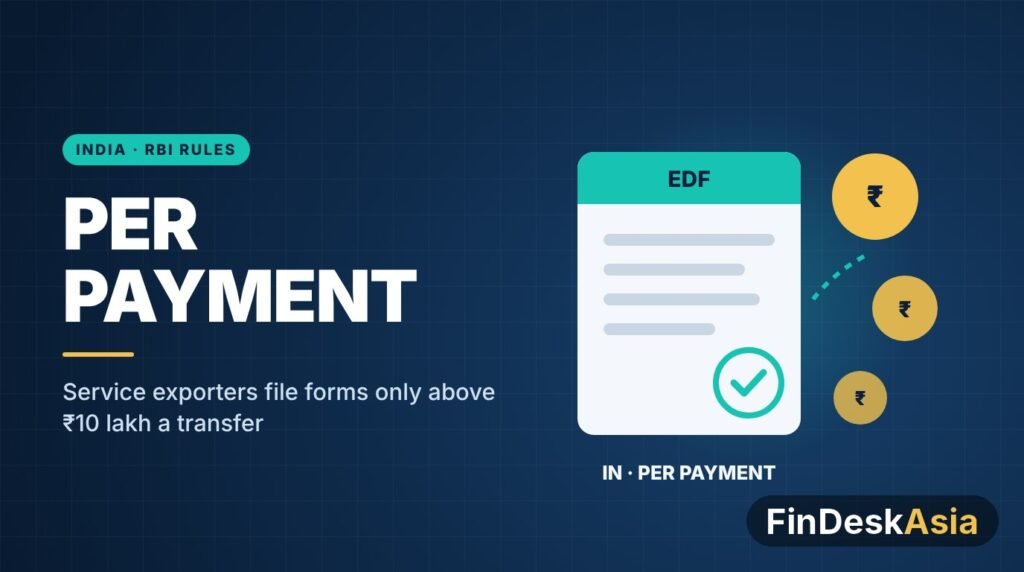
India’s central bank has cleared up a question that was worrying the country’s service exporters. The Reserve Bank of India (RBI) says the ₹10 lakh (₹1 million) limit that triggers an Export Declaration Form applies to each payment received from abroad, not to a company’s total receipts. Freelancers and other individuals do not need to file a separate form at all.
Key facts
- In FAQs published on 20 November, the RBI said non-individual service exporters must file an Export Declaration Form (EDF) only when a single inward remittance exceeds ₹10 lakh or its foreign-currency equivalent.
- Resident individuals who export services, such as freelancers and independent consultants, are treated as having filed the EDF once they give their bank the payment details, whatever the amount.
- For service imports, no separate import declaration is needed when the invoice or contract value is up to ₹10 lakh.
- The SOFTEX form for software exports was discontinued from 1 October, and invoices raised before that date do not need an EDF even if the money arrives later.
What changed, and why it needed explaining
India rewrote its foreign exchange rules for trade in goods and services under the Foreign Exchange Management Act (FEMA). The new regulations were issued on 13 January 2026 and took effect on 1 October. After feedback from industry, the RBI notified a second amendment on 2 November and made it apply retrospectively from 1 October.
The amendment introduced a ₹10 lakh threshold so that small transactions would not need heavy paperwork. What it did not spell out clearly was whether the threshold applied to each payment or to everything a business received. That gap left banks and exporters unsure whether a firm collecting many small client payments would eventually be pulled into filing. The FAQs answer that: payments below the threshold are not added together.
The RBI also made clear that authorised dealer (AD) banks, the commercial banks licensed to handle foreign exchange, cannot insist on an EDF before crediting payments of up to ₹10 lakh to non-individual exporters, or any amount received by resident individuals. Where a single payment does exceed the limit, the form must be filed before the money is credited, unless the payment is an export advance.
Deadlines and the end of SOFTEX
For service exports, the EDF is generally due within 30 days from the end of the month in which the invoice is raised. Exporters of services other than software can also file on or before receiving payment, and banks can extend the deadline after looking at an exporter’s reasons.
Software exporters lose a familiar form. SOFTEX has been replaced by the EDF from 1 October. Firms in the Domestic Tariff Area, meaning outside special economic zones, can submit the EDF to any AD bank or to Software Technology Parks of India (STPI). Firms in Special Economic Zones file with their zone’s development commissioner.
Banks still have to report the transactions in the RBI’s two monitoring systems for exports and imports, EDPMS and IDPMS, so oversight of cross-border money flows continues behind the scenes.
Why it matters
India is one of the world’s largest exporters of services, from IT and software to design, consulting and remote freelance work. Much of that income arrives as many separate payments through banks and payment platforms. Paperwork for every inbound transfer slows down how fast exporters get their money and adds cost for small firms that do not have finance teams.
The RBI said the framework is meant to promote ease of doing business, especially for small exporters and importers, and to help banks serve customers faster. For the cross-border payments industry, simpler rules on the receiving side make it easier for banks and payment firms to credit overseas funds quickly. It also shows how regulators in the region are trying to balance capital-flow monitoring with faster, cheaper payments for small businesses.
What to watch
- Whether banks update their onboarding and crediting processes quickly, so exporters stop being asked for forms they no longer need.
- How cross-border payment platforms that serve Indian freelancers and small agencies reflect the change in their own checks.
- Any further FAQs or tweaks from the RBI as the new FEMA trade framework beds in.
Related on FinDeskAsia: India: UPI Payments Between Businesses Set for Flat ₹5 Fee Instead of Up to ₹300 and Pakistan: Freelancers Earn a Record US$210 Million a Month, but Still Can’t Use PayPal or Stripe.
Sources: Business Standard (November 2026), The Sunday Guardian (November 2026), PGurus (November 2026).
