
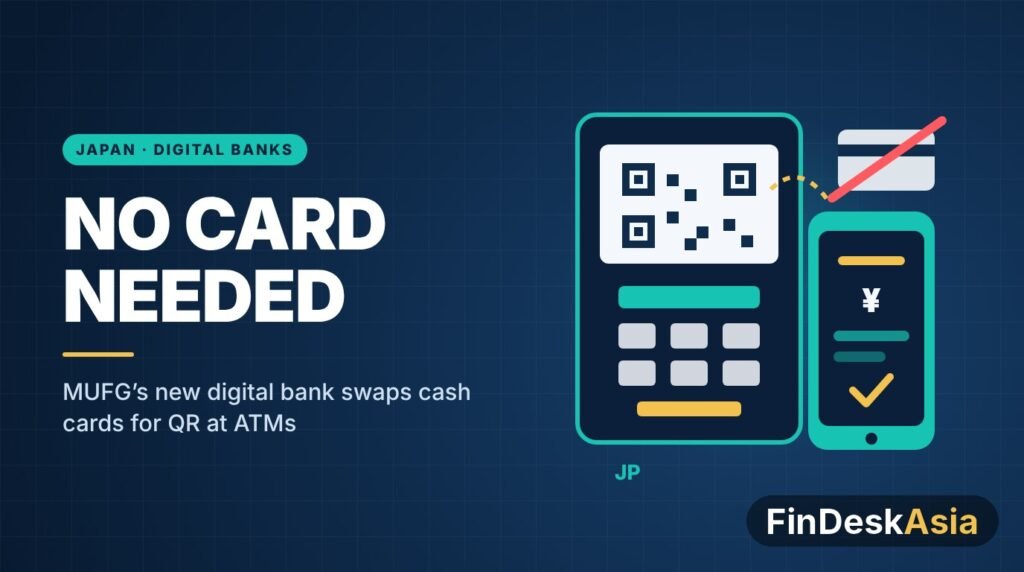
Japan: MUFG’s New Digital Bank Will Drop Cash Cards for Phone QR Withdrawals at ATMs
Mitsubishi UFJ Financial Group (MUFG), Japan’s largest financial group, plans to open a new digital bank that will not issue physical cash cards at all. Customers will instead use their smartphone to take out cash at ATMs. The bank wants to cut the risk of stolen or copied cards as hacking and phishing attacks rise in Japan.
Key facts
- MUFG’s new branchless digital bank is due to open in early 2027, by the end of March.
- The bank will not issue cash cards. Customers will prove who they are through a smartphone app instead of a plastic card and a PIN.
- To withdraw cash, a customer enters the amount in the app and uses a QR code to complete the transaction at the ATM.
- The service will start at Seven Bank ATMs, the machines found in 7-Eleven stores, which number about 28,000 across Japan.
- According to reports, the move is meant to strengthen defences against cybercrime after a wave of hacking and phishing incidents.
How cardless cash will work
In Japan, the kyasshu kaado (cash card) has been the standard way to get money out of a bank account for decades. It works much like an ATM card elsewhere in Asia: insert the card, type a PIN and take the money. The weakness is that anyone holding the card and the PIN can empty the account, and cards can be stolen, skimmed or cloned.
MUFG’s new bank replaces that with several steps on the phone. According to reports, the customer unlocks the handset, logs into the banking app, sets the amount and then scans or presents a QR code at the ATM. Even if a criminal learns an account number or a password, they would still need the customer’s unlocked phone and app login to get cash. Deposits will also be possible at the same ATMs.
Seven Bank, the banking arm of the 7-Eleven retail group, developed the underlying QR technology. Using its national network gives MUFG’s new bank wide cash access without building or renting its own machines. Reports say ATMs run by other convenience-store chains could be added later, but this has not been confirmed. Existing MUFG Bank customers keep their current cards.
Why it matters
Japan is still one of Asia’s most cash-heavy economies, so ATMs remain important even for a digital bank. What changes here is the security model. By dropping the card, MUFG removes a physical item that can be lost, stolen or copied, and moves all identity checks to a device the customer already guards closely.
The move also says something about where digital banking in Asia is heading. Many new digital banks still send out a debit card by default. MUFG is betting that for most people the phone can do the job of both card and PIN. Japanese media expect other banks to watch the experiment closely, and some may follow if customers accept it.
There are trade-offs. Customers without a smartphone, or older users who are less comfortable with apps, may find a card-free account harder to use. A lost or broken phone could also mean no cash access until it is replaced. How MUFG handles these cases will shape whether the model spreads.
For readers in Malaysia, the direction is familiar. Bank Negara Malaysia (BNM), the central bank, has already pushed local banks to move away from SMS one-time passwords and towards in-app approval tied to a single device, as part of its fight against online scams. MUFG’s plan takes that logic one step further by applying the same phone-based checks to cash at the ATM.
What to watch
- The exact launch date and full product line-up of MUFG’s new digital bank in early 2027.
- Whether ATM networks beyond Seven Bank, including MUFG’s own machines, add support for QR withdrawals.
- Whether other Japanese megabanks follow and start phasing out cash cards for new digital accounts.
Related on FinDeskAsia: Malaysians Lost RM2.97 Billion to Online Scams in 2025, Bank Negara Governor Warns and Japan: Town E-Wallets on TOPPAN’s Regional Pay Can Now Be Topped Up From 369 Banks.
Sources: Nikkei Asia (November 2026); BigGo Finance (November 2026); Segye Ilbo (November 2026); News On Japan / FNN (November 2026).
