
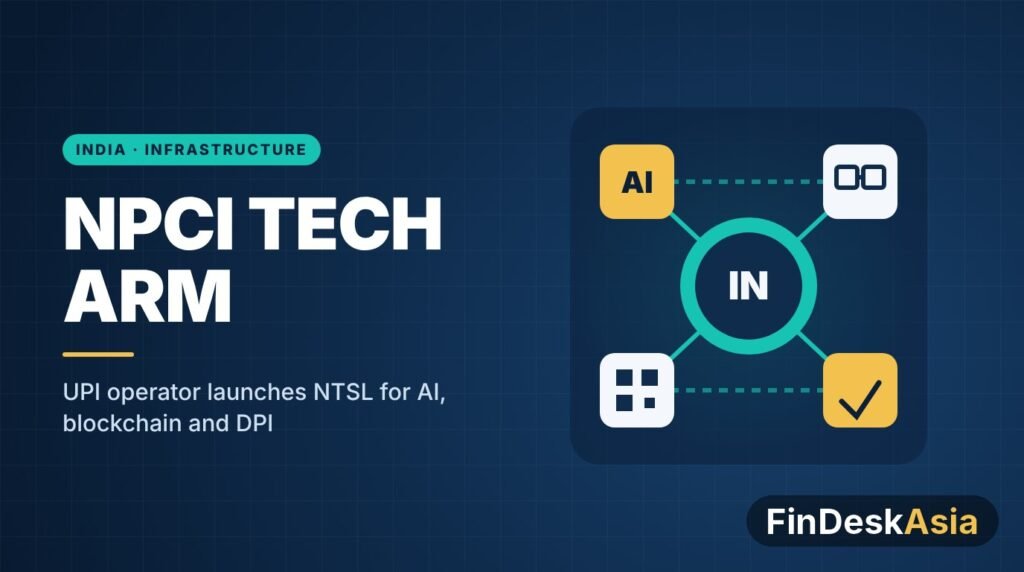
India: NPCI, the Operator Behind UPI, Sets Up New Arm for AI and Blockchain
The National Payments Corporation of India (NPCI), the not-for-profit body that runs India’s Unified Payments Interface (UPI), has set up a new company to work on artificial intelligence (AI), blockchain and wider digital financial infrastructure. The unit, NPCI Tech Solutions Limited (NTSL), takes the group beyond its core job of moving money between bank accounts.
Key facts
- NPCI announced on 4 November 2026 that it has formed NPCI Tech Solutions Limited (NTSL) as a wholly owned subsidiary.
- NTSL will act as the group’s technology and innovation arm, focusing on AI, blockchain, digital financial infrastructure and global capability centre (GCC) services.
- Its first work will be technology services for eKYC Setu, the Unified Ticketing Platform and other digital public infrastructure programmes.
- Vishal Kanvaty, NPCI’s chief technology officer, who has been with the organisation for nearly a decade, becomes NTSL’s managing director and CEO.
- NTSL is NPCI’s fourth wholly owned subsidiary. No investment amount, revenue target or rollout timeline has been disclosed.
What NTSL will do
NPCI is best known for UPI, the real-time system that lets Indians pay by scanning a QR code or entering a phone-linked ID. Over the years it has spun out separate companies for specific jobs: NPCI International Payments takes UPI and RuPay abroad, NPCI Bharat BillPay runs the national bill-payment network, and NPCI BHIM Services looks after the BHIM payments app. NTSL is different. Rather than running one payment product, it is meant to build technology that other programmes can use.
Two of its first projects show the direction. eKYC Setu is a service that helps regulated firms verify a customer’s identity electronically, a basic step for opening accounts or wallets. The Unified Ticketing Platform aims to bring transport ticketing onto a shared digital system. Both fall under what India calls digital public infrastructure (DPI): shared, government-backed digital rails that private companies can build on.
NTSL will also offer GCC services. In India, a global capability centre is an in-house technology or operations hub that large companies set up to serve their wider group. For NTSL, this suggests a role as a technology service provider, not just an internal research team.
NPCI chief executive Dilip Asbe said advances in AI and other emerging technologies are opening up new possibilities across digital infrastructure and financial services, and that NTSL was created to pursue them.
Why it matters
UPI has become one of the most closely watched payment systems in the world, and NPCI’s technology choices tend to shape how banks, wallets and fintechs across India build their products. Putting AI and blockchain work into a dedicated company gives NPCI a clearer structure to develop and sell these capabilities without mixing them into the operation of UPI itself, which has to stay stable and highly available.
For the region, the move is worth watching because several Asian central banks and payment operators are studying India’s DPI model as they build their own instant payment and digital identity systems. A dedicated NPCI technology arm could, over time, become one more channel through which Indian payment know-how is packaged and offered to partners.
There are open questions. NPCI has not said how much it is investing in NTSL, how many people it will employ, or when services will launch. It has also not said which blockchain use cases it will pursue, or how the unit will handle risks around AI in financial services, such as model errors or data privacy.
What to watch
- Whether NTSL names specific AI or blockchain products, and whether any of them plug directly into UPI.
- Details on funding, staffing and the first external clients for its GCC and technology services.
- How quickly eKYC Setu and the Unified Ticketing Platform scale under the new company.
Related on FinDeskAsia: India: RBI Gives Non-Bank Payment Firms Six Hours to Report Cyber Incidents and India: Half of Street Vendors May Cut UPI Use if 0.4% Merchant Fee Arrives.
Sources: Inc42 (November 2026); Reuters via Deccan Chronicle (November 2026); Fintech News Singapore (November 2026).
