
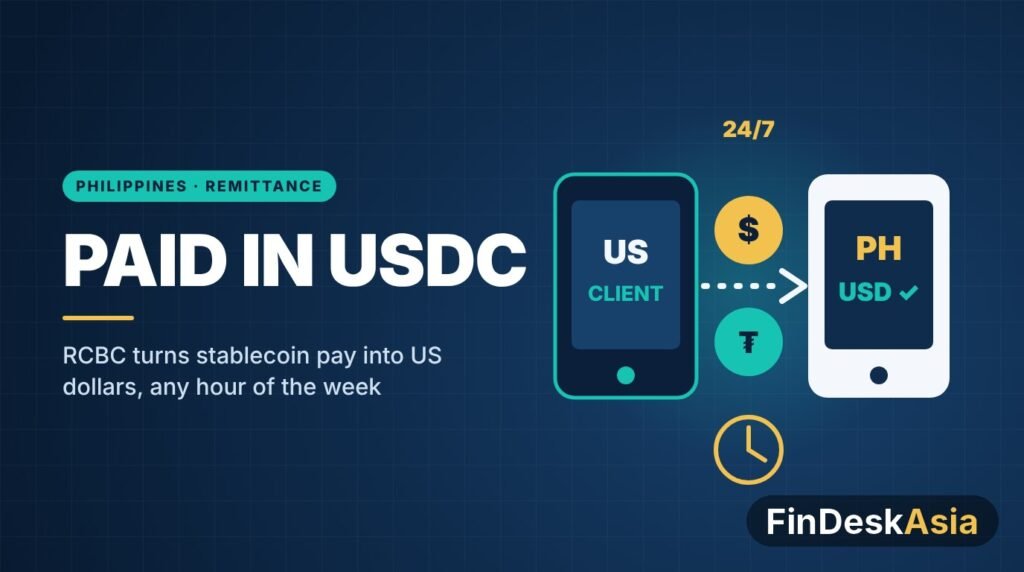
Philippines: RCBC Lets US Clients Pay Freelancers in USDC and USDT, Credited as Dollars
Filipino freelancers who work for American clients can now be paid in stablecoins that land in their bank app as ordinary US dollars. Rizal Commercial Banking Corporation (RCBC), one of the Philippines’ larger banks, has teamed up with US payments network Meridian to let its RCBC Pulz US Virtual Account accept USDC and USDT transfers, which arrive at any hour, including weekends and US holidays.
Key facts
- The RCBC Pulz US Virtual Account now accepts incoming transfers in two dollar-pegged stablecoins, USDC and USDT, sent on the Ethereum, Polygon and Base blockchain networks.
- Meridian and its US partners convert the stablecoins into US dollars before crediting the account, so users never hold or manage crypto themselves.
- Users can keep the balance in US dollars or convert it to Philippine pesos and deposit it into a linked RCBC account.
- The US Virtual Account first went live on the RCBC Pulz app in November 2025; RCBC says thousands of professionals have signed up since.
- RCBC and Meridian say more blockchain networks will be added later.
How the service works
A “virtual account” here is a US dollar account number that a Filipino can give to a US employer or client, without needing a US address, a US social security number or US residency. Until now, money reached it through the two standard American bank rails: ACH, the US batch-payment network used for payroll and bills, and Fedwire, the US central bank’s wire system. Both follow US banking hours, so a payment sent on a Friday evening in New York may not move until Monday.
Stablecoins are digital tokens designed to hold a steady value, in this case one US dollar each. USDC is issued by Circle and USDT by Tether. Because blockchain networks run around the clock, a client can send USDC or USDT at any time. Meridian, which describes itself as a US-regulated clearing network, receives the tokens, turns them into dollars and passes the dollars to the worker’s RCBC Pulz balance.
From the user’s side, the experience stays the same as a normal dollar payment. RCBC executive vice-president and chief innovation and inclusion officer Lito Villanueva said the bank is giving freelancers and remote workers “another way to receive their earnings”. Meridian chief executive Will Haering said the money can now arrive at any hour of any day and land as dollars in the worker’s account.
Why it matters
Many Filipinos work online as freelancers and virtual assistants for US companies, which is exactly the group RCBC designed the account for. For them, payment timing and conversion costs matter as much as the headline fee. A bank-run option that accepts stablecoins removes the need to open a crypto exchange account, move tokens to a wallet and then cash out to a bank, steps that add cost and risk for less technical users.
The move also fits a wider pattern in Asia: regulated banks are starting to use stablecoins as a back-end payment rail while hiding the tokens from customers. Users get faster settlement, and the bank keeps the customer relationship and its usual identity checks. RCBC says salaries and professional fees from the US remain subject to account verification and service requirements.
For US clients, the change is mainly about choice. Companies that already pay contractors in USDC or USDT can now send to a Philippine bank account instead of a personal crypto wallet, which may make record-keeping simpler on both sides.
What to watch
- Whether RCBC publishes fees, limits and exchange rates for stablecoin-funded transfers compared with ACH and Fedwire.
- Which additional blockchain networks RCBC and Meridian add, and how quickly.
- Whether rival Philippine banks and e-wallets launch similar stablecoin-to-dollar accounts for overseas earners.
Related on FinDeskAsia: ASEAN’s cross-border QR payment record
Sources: Fintech News Philippines (November 2026); BitPinas (November 2026)
