
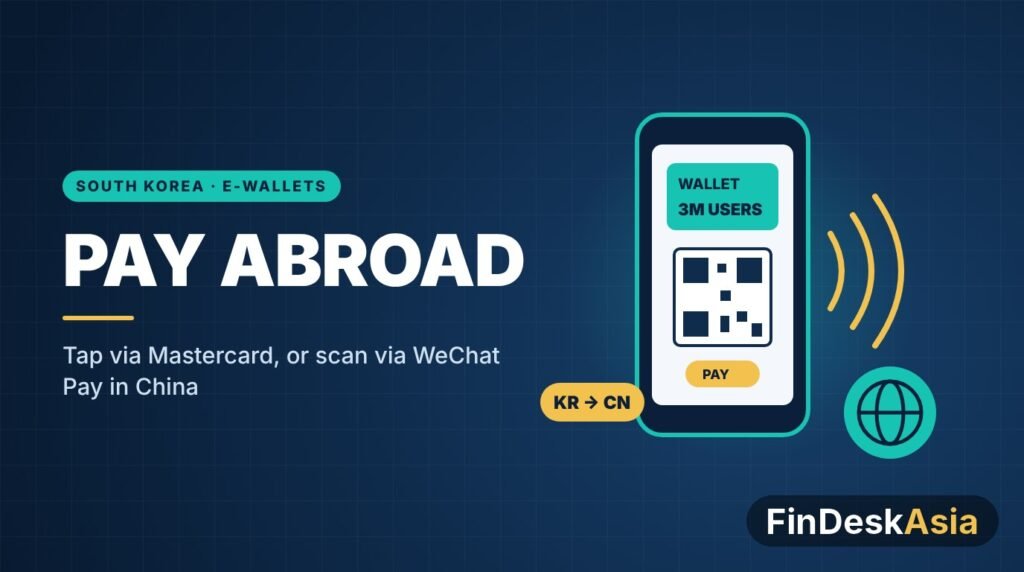
South Korea: Samsung Wallet Money Goes Abroad via Mastercard and WeChat Pay in China
South Korean travellers with a Samsung Galaxy phone can now pay abroad straight from their prepaid wallet balance. Woori Bank and Samsung Electronics have taken Samsung Wallet Money overseas, using Mastercard’s card network for tap-to-pay in most of the world and Tencent’s WeChat Pay for QR payments in China.
Key facts
- Samsung Wallet Money is a prepaid payment service run by Woori Bank with Samsung Electronics. It launched in South Korea in October 2025 and has passed 3 million users.
- Abroad, users can tap their phones at about 150 million Mastercard merchants in roughly 210 countries and territories, including North America, Europe and Japan.
- In China, the wallet works with QR codes at WeChat Pay merchants after a three-way deal between Woori Bank, Samsung and Tencent, announced on 26 October.
- Users do not need a physical card, cash exchanged in advance, or a local app such as WeChat Pay or Alipay.
- Woori Bank accounts make up 42% of the bank accounts used to top up the wallet, the largest share of any bank.
How it works
A user links a Korean bank account to Samsung Wallet, the payment app built into Galaxy phones, and tops up a prepaid balance in Korean won. Before travelling, the user switches on overseas payments. Purchases abroad are then paid from that balance.
The wallet picks the payment method based on where the user is. In markets where Mastercard is accepted, the phone works like a contactless card using NFC (near-field communication, the short-range radio behind tap-to-pay). In mainland China, where shops rely heavily on QR codes, the wallet shows WeChat Pay-linked QR payments instead. At a press briefing in Seoul, Woori Bank chief executive Jung Jin-wan described the wallet using tap-to-pay in Hong Kong, switching to QR payments after crossing into Shenzhen, and switching back to tap on the return trip.
The bank sums up the pitch as “no card, no cash, no app”. It also says the service supports QR table ordering at restaurants, where diners scan a code to see the menu and order.
On security, the partners say overseas merchants and networks receive only encrypted identifiers, not customers’ personal details. Each payment uses a one-time token, and a lost phone cannot be used without biometric checks or a payment password. Woori Bank also runs a second fraud-monitoring system dedicated to the wallet, on top of its usual one.
Why it matters
Paying in China has long been a headache for foreign visitors, because most shops expect WeChat Pay or Alipay and signing up for them can be difficult for tourists. By plugging into WeChat Pay directly, Woori and Samsung let Korean travellers skip that step. Tap-to-pay through Mastercard covers most other destinations without a separate travel card.
The move also shows a wider trend across Asia: domestic wallets are going global by linking to big networks rather than building their own. Samsung Wallet Money faces strong home rivals in Naver Pay and Kakao Pay, and an overseas offer gives it a reason for Galaxy owners to load and keep money in the wallet. For Woori Bank, more overseas spending means more foreign-exchange and settlement business.
Malaysian e-wallets have taken a similar route. Earlier today, DuitNow QR users gained access to merchants in several markets, including China and South Korea, through Ant International’s Alipay+ network.
What to watch
- More markets and partners: Woori Bank says it plans to add more countries and local payment partners.
- Transport and ride-hailing: the bank is looking at overseas taxi-hailing and transit services, a common pain point for travellers.
- Uptake and pricing: whether rewards and exchange rates are competitive enough to pull users away from travel cards and rival wallets.
Related on FinDeskAsia: ASEAN’s cross-border QR record and Malaysia’s e-wallet war.
Sources: The Korea Times (October 2026), The Korea Herald (October 2026), Korea JoongAng Daily (October 2026), Seoul Economic Daily (October 2026).
