
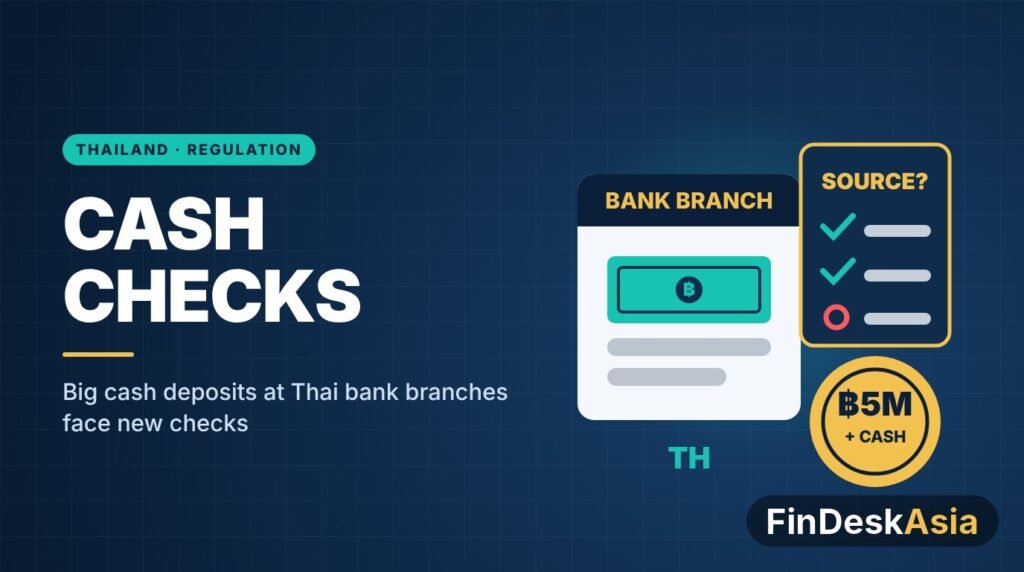
Thailand: Bank of Thailand Extends 5 Million Baht Cash Checks to Deposits From 1 November
From 1 November 2026, anyone in Thailand who walks into a bank branch to deposit 5 million baht (about US$148,000) or more in cash in a single day may be asked where the money came from and what it is for. The Bank of Thailand (BOT), the country’s central bank, is widening rules that already apply to large cash withdrawals, as part of a broader push against scams, money laundering and the “grey economy”.
Key facts
- The new rules take effect on 1 November 2026 and cover cash transactions of 5 million baht or more in a day.
- They cover cash deposits, exchanges of Thai baht banknotes, cheque and draft deposits, cash paid to issue cheques or drafts, foreign currency deals, and cash payments for insurance premiums, investment products and derivatives.
- Banks may ask for the source and purpose of the funds, or supporting documents, and can refuse a transaction if the checks cannot be completed.
- The rules apply only to transactions at bank branches; mobile and online banking are not affected.
- A similar rule for cash withdrawals of 5 million baht or more has applied since April 2026, and the BOT says large cash withdrawals fell by about 35% afterwards.
What is changing at the bank counter
Since April, Thai banks have treated daily cash dealings of 5 million baht or more as high-risk. That triggers what regulators call enhanced due diligence (EDD): extra checks on who the customer is, why they need the money, and whether the transaction fits their usual pattern. Until now the focus was on withdrawals and cash cheques.
The November step moves the same checks to the other side of the counter. A customer bringing in a large bag of cash, swapping a big stack of 1,000-baht notes for smaller ones, or paying a large insurance premium in cash may now need to explain the money before the bank processes it. Banks must rate each customer’s risk, watch for unusual activity, keep records and report relevant cases to the BOT. The central bank has also told banks to treat affected customers fairly and help them promptly, so that ordinary businesses that handle a lot of cash are not left stuck.
The measures are linked to the Bangkok Blueprint for Fraud-Resilient Financial Services, which the BOT developed with the International Monetary Fund and the World Bank Group.
Why it matters
Cash is hard to trace, which makes it attractive to scam syndicates, online gambling networks and people trying to hide the origin of their funds. BOT Governor Vitai Ratanakorn has argued that in a developed economy most large payments should move through transfers or other financial instruments rather than banknotes. Pushing big sums into electronic channels such as PromptPay transfers and bank-to-bank payments leaves a digital trail that banks and the Anti-Money Laundering Office (AMLO) can check later.
The withdrawal rule suggests the approach changes behaviour. The BOT reported that large cash withdrawals dropped by about 35% after April, although the governor has also said other factors, such as the post-election period, may have played a part.
For the wider region, Thailand’s move fits a trend seen across Southeast Asia: regulators are using payment data and transaction checks, not just account opening rules, to fight fraud and mule accounts. It also adds to the BOT’s other recent work, including closer monitoring of large stablecoin trades with the Securities and Exchange Commission and planned rules for buy now, pay later (BNPL) services.
What to watch
- Whether banks apply the checks consistently, and how much paperwork cash-heavy SMEs, gold traders and money changers end up facing.
- Whether the BOT publishes data on large cash deposits after November, as it did for withdrawals.
- Whether the push nudges more high-value payments onto PromptPay and other digital rails.
Related on FinDeskAsia: Thailand: Bank of Thailand Drafts Baht Stablecoin Rules With 1:1 Reserves and No Interest · ASEAN’s cross-border QR payments
Sources: Fintech News Singapore (October 2026); KuCoin News (October 2026); The Nation Thailand (July 2026); Pattaya Mail (July 2026); Thailand Business News (March 2026)
