
UAE: Tabby Cash Tops 1 Million Accounts in Two Months as BNPL Firm Goes Beyond Credit
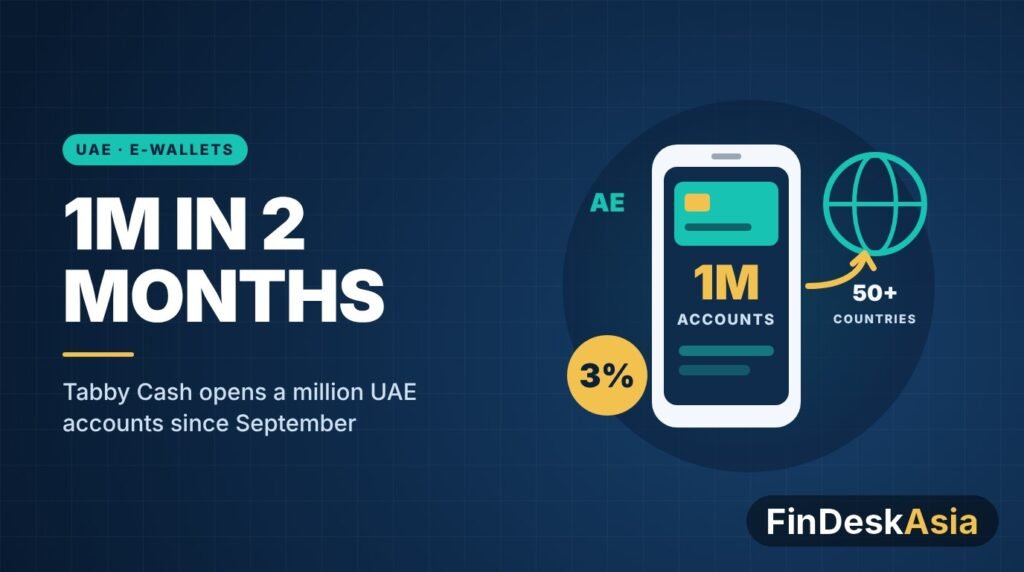
Tabby, the Gulf’s best-known buy now, pay later (BNPL) company, says more than one million people in the United Arab Emirates have opened a Tabby Cash account in about two months. The fee-free spending account opened to all UAE residents on 1 September, and the company calls it the fastest-growing product it has launched.
The milestone shows how a firm known for splitting shopping bills into instalments is now trying to become the place where customers keep, spend and send their own money.
Key facts
- More than 1 million UAE residents have opened Tabby Cash accounts since the product opened to everyone on 1 September 2026.
- Tabby Cash runs under Tabby’s Stored Value Facilities (SVF) licence from the Central Bank of the UAE (CBUAE), the country’s banking regulator.
- There are no account or card fees, and cashback of up to 3% applies to selected spending categories and international purchases.
- Customers can send money to bank accounts in more than 50 countries without a transfer fee, and to wallets such as GCash, JazzCash and Vodafone Cash.
- Telecom, utility and transport bills can be split into up to 12 monthly payments.
What Tabby Cash is, and what it is not
Tabby Cash is not a loan. It works like a digital wallet with a payment card: customers top up their own money, then pay in shops and online, move funds to friends inside the UAE for free, or send money abroad. Tabby’s chief commercial officer, Zarik Nabi, has stressed that the product “isn’t credit” because users spend money they already hold.
An SVF licence is the UAE’s permit for e-money and wallet providers. It lets Tabby hold customer balances, but it is not a banking licence. According to Gulf News, customer money is kept in dedicated accounts with UAE banks, and opening an account needs only an Emirates ID, with no salary certificate or credit check. Asked by Arabian Business whether Tabby would apply for a full digital bank licence, Nabi did not confirm any plan and said the company will keep building within the licences it already holds.
One detail matters for anyone sending money home: while Tabby charges no transfer fee, Gulf News notes that a currency conversion margin still applies. In other words, the cost sits in the exchange rate rather than in a separate fee.
Why it matters
The UAE is one of the world’s biggest sources of remittances, because a large share of its residents are expatriate workers who send money to families in South Asia, Southeast Asia and Africa. The wallets Tabby names point straight at those corridors: GCash is the Philippines’ largest e-wallet, JazzCash is a major Pakistani wallet and Vodafone Cash is widely used in Egypt.
Tabby says the account is being used for everyday spending, not just transfers. Nabi told Arabian Business that nearly half of Tabby Cash card spending goes on groceries and eating out, that four in five payments happen in physical shops rather than online, and that about half of first-time international senders make another transfer the following month. Tabby has not disclosed how much money customers hold or how many accounts are active, so the one million figure measures sign-ups rather than usage.
The move also fits a wider pattern across Asia and the Gulf, where BNPL and e-wallet players are adding accounts, cards and transfers to keep customers in one app. For Tabby, which reported more than 25 million customers across Saudi Arabia, the UAE and Kuwait and a US$6.5 billion valuation after a US$233 million funding round in September, a spending account brings in regular, daily activity that instalment plans alone do not.
The company is also looking beyond consumers. Gulf News reports that Tabby is testing a business account with a small group of merchants that already sell with Tabby, with more details expected soon.
What to watch
- Whether Tabby discloses active users and balances, which would show how many of the one million accounts are used regularly.
- The launch timing and pricing of the business account for small merchants.
- How banks and exchange houses in the UAE respond on remittance pricing as fee-free wallet transfers gain users.
Related on FinDeskAsia: UAE: Visa Platform Now Accepts Jaywan National Cards for Online Payments · Inside Malaysia’s e-wallet war
Sources: Arabian Business (November 2026); Gulf News (November 2026)
