
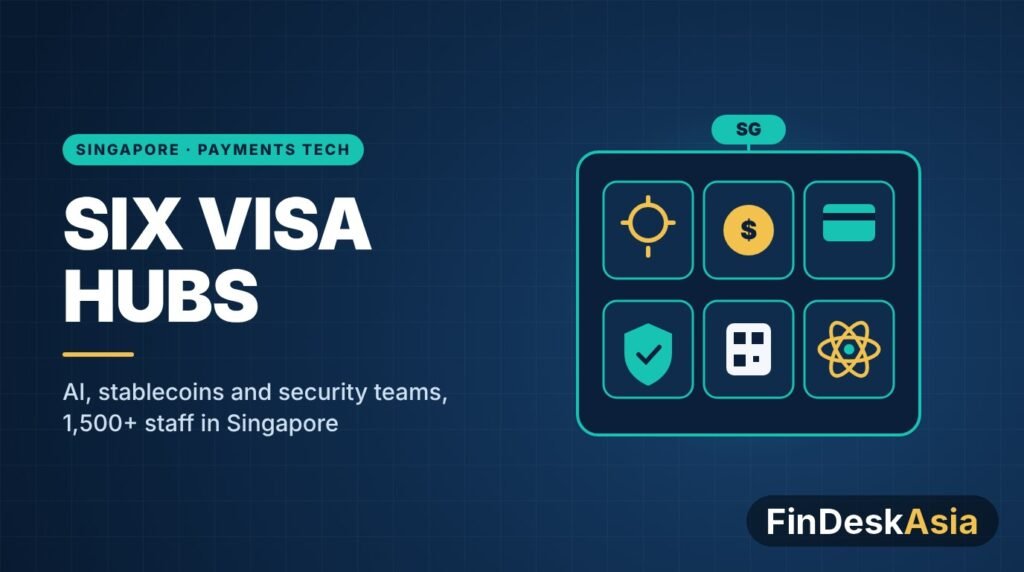
Singapore: Visa Opens Six Global Tech Hubs for AI, Stablecoins and Payment Security
Visa is putting six global technology hubs inside a new Solution Center at Paya Lebar Green in Singapore, with more than 1,500 staff working on artificial intelligence, new forms of digital money and payment security. The card network says the teams will build products for its worldwide business, not just for Singapore, and will work with local banks, fintech firms and researchers.
Key facts
- Visa announced on 5 November 2026 that it is setting up six global capability hubs at its new Solution Center in Paya Lebar Green, Singapore.
- The centre brings together more than 1,500 people across technology, product development, cybersecurity and engineering, and Visa plans to add more research and engineering roles in AI, cybersecurity and quantum computing.
- The six hubs are grouped into three areas: AI and commerce, next-generation payments, and trust, security and resilience.
- Visa named AXS, DBS, DCS, FOMO Pay, Nium and StraitsX among its local ecosystem partners, and said it is taking part in the Monetary Authority of Singapore’s BLOOM initiative.
- Visa did not disclose how much it is investing in the centre.
What the six hubs will do
Two hubs sit under AI and commerce. One will apply AI to payments and fintech products. The other will focus on agentic commerce, a term for AI software “agents” that can search, compare and pay for things on a person’s or company’s behalf. The hard questions here are about trust: how a merchant knows an agent is allowed to pay, and how a cardholder stays in control.
Two more hubs cover next-generation payments. One will research digital money, stablecoins (digital tokens designed to hold a steady value, usually against a currency such as the US dollar) and programmable payments, where money moves automatically when set conditions are met. The other will work on digital wallets and alternative payment methods, such as QR codes and account-to-account transfers, which compete with cards in much of Asia.
The last two hubs handle trust, security and resilience: one on cybersecurity, and one exploring how quantum computing could be used in financial services, including the risk it poses to today’s encryption.
Why it matters
For Singapore, the move adds high-skilled jobs and strengthens its pitch as the region’s base for payments research. Stephen Karpin, Visa’s regional president for Asia Pacific, said many of the hardest questions around digital money, AI and trust are being worked out in the region. Beng Kong Pee of the Singapore Economic Development Board said the hubs would create high-value jobs and support new products in areas such as agentic commerce and quantum.
The partner list is telling. FOMO Pay is a Singapore payment institution, Nium runs cross-border payouts, and StraitsX issues Singapore dollar and US dollar stablecoins. MAS’s BLOOM initiative, short for Borderless, Liquid, Open, Online, Multi-currency, is MAS’s effort to make it easier to settle payments across borders and currencies using new forms of digital money. Visa joining it signals that card networks want a seat at the table as digital money moves from pilots towards real use.
For the wider region, the hubs are a reminder that the big card networks are not standing still while national QR systems and real-time payment links grow across Southeast Asia. By building wallet, stablecoin and AI tools close to these markets, Visa is betting it can stay part of everyday payments even as more transactions skip the card rails.
What to watch
- Product launches from the hubs, especially for agentic commerce and stablecoin settlement, and which banks and fintech firms pilot them first.
- Further detail from Visa at the Singapore FinTech Festival, which runs from 18 to 20 November 2026.
- How Visa’s BLOOM work fits with MAS’s wider plans for tokenised money and cross-border settlement.
Related on FinDeskAsia: ASEAN’s cross-border QR links hit a record and Inside Malaysia’s e-wallet war.
Sources: Fintech News Singapore (November 2026); Visa press release via PR Newswire (November 2026).
