
China: Overseas E-Wallet Payments at Weixin Pay Shops Jump 84%, Saudi Wallet barq Signs On
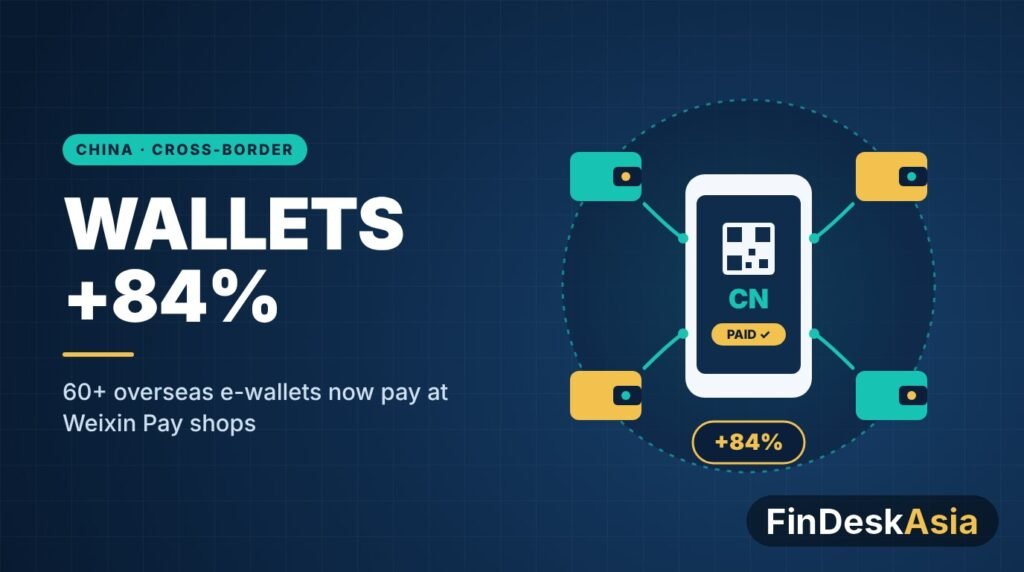
Foreign visitors to mainland China are leaning on their home e-wallets more than ever. Tencent says payments made at Weixin Pay merchants with linked overseas e-wallets rose 84% year on year between January and October 2026, and payments with linked foreign bank cards grew 74%.
The figures were shared at the Singapore FinTech Festival, where Tencent’s cross-border arm, TenPay Global, also signed up Saudi Arabia’s barq as a new wallet and remittance partner.
Key facts
- Transactions through linked overseas e-wallets at Weixin Pay merchants rose 84% year on year from January to October 2026; linked foreign card payments rose 74%.
- More than 60 overseas e-wallets from 16 countries and regions can now pay Weixin Pay merchants through one cross-border QR gateway.
- TenPayGo, launched in September 2026, is Weixin Pay’s first app built for foreign visitors. It signs up with an email address and pays with foreign cards, overseas e-wallets or Apple Pay.
- TenPay Global signed a memorandum of understanding (MOU) with barq, a Riyadh-based wallet licensed by the Saudi Central Bank (SAMA) with more than 15 million users.
What happened
Weixin Pay is the payment service inside Weixin, the Chinese version of the WeChat super app. For years, foreign visitors struggled to use it because it needed a Chinese bank account. Tencent has been steadily opening the door: visitors can now bind cards from seven global networks, including Visa and Mastercard, or simply scan a merchant’s Weixin Pay QR code with the wallet they already use at home.
That second route is what grew fastest this year. Tencent says it has connected more than 60 overseas wallets through TenPay Global and other partners, with 32 of them added in 2026 alone. Named examples include PayPal and Vietnam’s MoMo and ZaloPay. When a tourist scans and pays, the home wallet charges them in their own currency, and the Chinese merchant receives yuan as usual.
The barq deal adds a remittance angle. Under the MOU, barq users would be able to send money to Weixin wallets in mainland China and pay by QR at Weixin Pay shops. SAMA data cited by Fintech News Singapore puts Saudi outbound transfers at about US$33.7 billion in the first nine months of 2026. TenPay says it already works with more than 60 banks and remittance firms, covering transfers into China from more than 150 countries and regions.
Why it matters
China wants more inbound tourism and business travel, and payments have been one of the biggest friction points for visitors. Chinese banks are moving in the same direction: Bank of China says more than 120,000 merchants in its acquiring network accepted foreign bank cards by the end of September 2026.
For the region, the trend shows how “wallet-to-wallet” acceptance is spreading. Instead of every country building a bilateral QR link, a large acceptance network such as Weixin Pay can plug in many foreign wallets at once. That gives Asian wallet providers a selling point for travellers, and it puts pressure on card-based travel spending, since paying with a home wallet can feel simpler and more familiar.
Tencent also used the festival to show early “agentic” payment features, where an AI assistant prepares an order or compares ride-hailing fares and the user confirms the payment. A prepaid AI AgentPay Card caps what an agent can spend at the balance loaded onto it.
What to watch
- Which wallets join next, and whether more Southeast Asian wallets are named among the 60-plus partners.
- When the barq link goes live, and what fees and exchange rates Saudi users will see on transfers to China.
- How regulators treat AI agents that can start payments, as Weixin Pay widens its agent pilots beyond ride-hailing and food orders.
Related on FinDeskAsia: ASEAN’s cross-border QR payments hit a record.
Sources: Fintech News Singapore – Weixin Pay at SFF 2026 (November 2026); Fintech News Singapore – TenPay Global and barq (November 2026); Retail News Asia (November 2026).
