
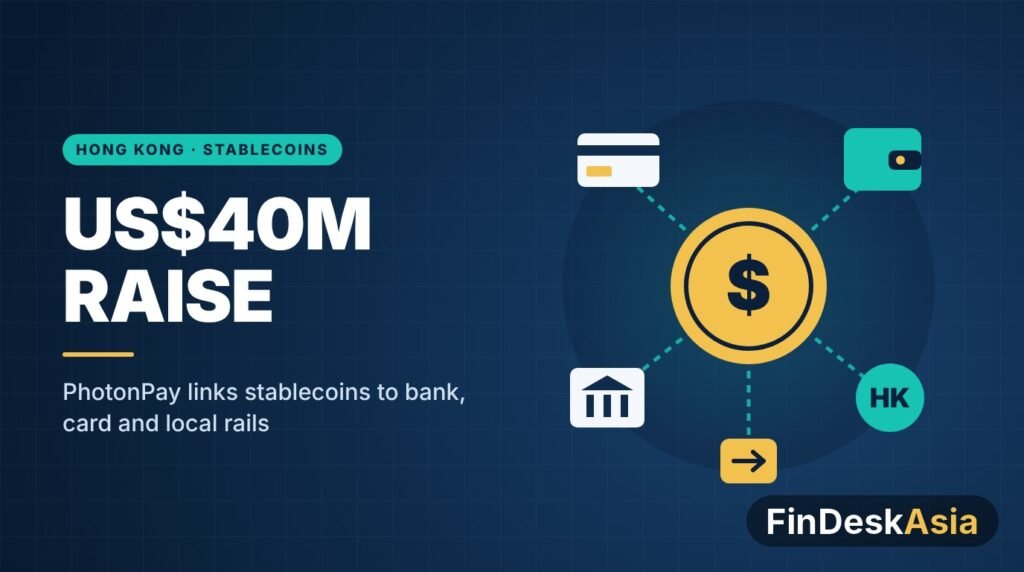
Hong Kong: PhotonPay Raises US$40 Million to Link Stablecoins With Bank and Card Rails
Hong Kong-based PhotonPay has raised US$40 million in a Series C round led by US crypto investor Blockchain Capital, as it pushes to join stablecoin money with the bank, card and local payment rails that businesses already use. The company says the cash will go into wallets, card issuing, local clearing and tools that let AI software make payments within set rules.
Key facts
- PhotonPay announced the US$40 million Series C on 30 October 2026, led by Blockchain Capital, with Japan’s SBI Group joining as a new investor.
- Existing backers IDG Capital, GL Ventures and Lightspeed Faction also put in more money.
- The company reports annualised transaction volume of US$65 billion as of August 2026 and more than 200,000 business customers in over 200 countries and territories.
- It issued 4.4 million cards in the past 12 months, up 275% from a year earlier.
- PhotonPay holds 34 payment and financial licences and regulatory authorisations across the Americas, Europe and Asia.
What PhotonPay does
Founded in 2015, PhotonPay sells what it calls a “Financial OS”, a single platform that small and large firms use to collect, hold, convert and pay out money across borders. Its customers are typically online sellers, platforms and companies that pay suppliers, staff or creators in many countries.
The main pieces are multi-asset wallets (accounts that can hold ordinary currencies and stablecoins side by side), payouts, card issuing (virtual and physical cards that a business can hand to staff or build into its own app) and embedded finance, where a platform offers PhotonPay’s payment features to its own users under its own brand.
A stablecoin is a digital token designed to keep a steady value, usually one US dollar, backed by cash or short-term government debt. Stablecoins can move between countries in minutes, at any hour. The weak point is the “last mile”: a supplier in Brazil or a worker in the Philippines still needs local money in a local bank or e-wallet. PhotonPay’s pitch is that it handles that conversion and local settlement, so a business does not have to stitch together exchanges, banks and card schemes itself.
According to Fintech News Hong Kong, the firm’s Hong Kong entities hold a money service operator licence and Securities and Futures Commission (SFC) licences, and it works with banks including J.P. Morgan, Standard Chartered and DBS.
Why it matters
For Hong Kong, the deal adds weight to the city’s bid to be Asia’s hub for regulated digital money. The Hong Kong Monetary Authority (HKMA), the city’s de facto central bank, began licensing stablecoin issuers this year, and banks are now putting tokens in front of retail users. Firms like PhotonPay sit one layer below the issuers: they are the plumbing that lets those tokens actually pay a bill.
For the region, the funding shows where investors see value. The race is less about creating new coins and more about connecting them to real-world payment systems such as local bank transfers and e-wallets. SBI’s entry is also notable, as the Japanese group is active in yen stablecoin projects and could open doors in North Asia.
The AI angle is early but worth tracking. PhotonPay says it will support the Model Context Protocol (MCP), an open standard that lets AI assistants connect to outside tools, so that approved AI agents can check balances, manage cards and start payments. It says it is building spending limits and approval rules around this, after a live “agentic payment” demonstration with Mastercard in Hong Kong in May 2026.
For businesses across Asia that sell abroad, more competition among cross-border payment providers should mean faster settlement and sharper foreign-exchange pricing, though the usual checks on fees, licensing and customer-fund protection still apply.
What to watch
- Which new markets and licences PhotonPay targets with the fresh capital, and whether more of them are in Southeast Asia.
- Whether HKMA-licensed stablecoins become a payment option on platforms like PhotonPay, and how quickly.
- How regulators treat AI agents that can start payments, especially around consent, limits and liability when something goes wrong.
Related on FinDeskAsia: Hong Kong: HSBC Rolls Out RedCoin Stablecoin to 3.3 Million PayMe Users and Thailand drafts baht stablecoin rules.
Sources: Fintech News Hong Kong (October 2026); FinTech Global (October 2026).
