
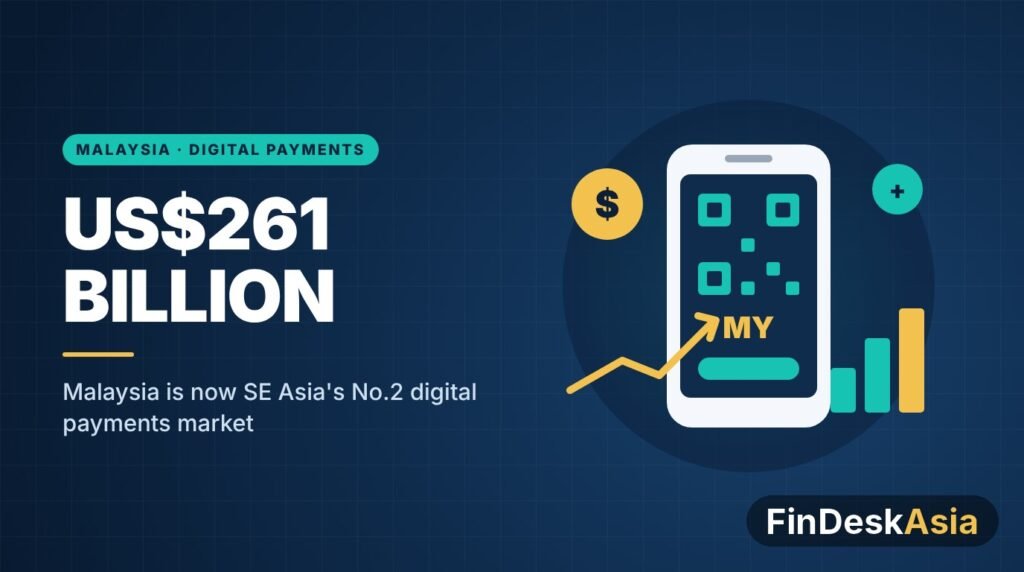
Malaysia’s Digital Payments to Hit US$261 Billion, Second Only to Indonesia in SEA
Malaysians are expected to move about US$261 billion through digital payments in 2026, according to the latest e-Conomy SEA report by Google, Temasek and Bain & Company. That is 17% more than a year ago and makes Malaysia the second-largest digital payments market in Southeast Asia, behind only Indonesia.
The same report says Malaysia’s wider digital economy is growing faster than almost anywhere else in the region, as online shopping, travel bookings and AI use all expand at double-digit rates.
Key facts
- Digital payments in Malaysia are projected to reach US$261 billion in gross transaction value (GTV) in 2026, up 17% year on year.
- Malaysia’s digital economy is projected at US$48 billion (about RM196 billion) in gross merchandise value (GMV), up 20%, tying with Vietnam as the fastest-growing in Southeast Asia.
- E-commerce, the biggest part of that economy, grew 22% to US$25 billion; online travel grew 15% to US$12 billion.
- About 17 million Malaysians, or 68% of the working population, now use generative AI tools.
- Across Southeast Asia, the digital economy is set to reach US$368 billion in 2026 and is on track for US$1 trillion by 2035.
Payments are the biggest number in the room
The report uses two different measures, and the gap between them explains why payments stand out. Gross merchandise value (GMV) counts what people spend on digital services such as e-commerce, ride-hailing, food delivery, online media and travel. Gross transaction value (GTV) counts the money that flows through digital payment channels, including bank transfers, QR payments, cards and e-wallets, whether the purchase happened online or in a shop.
That is why Malaysia’s payments figure is far larger than its US$48 billion digital economy. Every time someone pays a hawker by DuitNow QR, splits a bill by instant transfer or tops up an e-wallet, it adds to the payments total. DuitNow is the national real-time payment and QR service run by PayNet, the payments network owned by Bank Negara Malaysia (BNM, the central bank) and local banks.
Being second only to Indonesia is notable because Indonesia has a population several times larger than Malaysia’s. The ranking suggests Malaysians use digital payments heavily for their size, helped by widespread smartphone banking and a single national QR standard that works across banks and e-wallets.
What it means for Malaysians
- Consumers: More everyday spending is going digital, which brings convenience but also makes scam awareness and app security more important. Checking the name of the recipient before confirming a transfer remains a simple, useful habit.
- Merchants and SMEs: With e-commerce up 22%, small businesses that accept QR payments and sell online are tapping into the fastest-growing part of the economy. Digital records of sales can also help when applying for financing.
- Banks and e-wallets: Growth in transaction volume means more competition for everyday payments. Providers are likely to compete on rewards, cross-border features and tools for small merchants rather than on basic transfers alone.
A regional race
Malaysia’s 20% growth ties with Vietnam for the top spot in the six largest Southeast Asian economies covered by the report: Indonesia, Malaysia, the Philippines, Singapore, Thailand and Vietnam. Region-wide, Temasek says digital financial services handled about US$1,650 billion in transaction value, up 16%, while digital lending balances rose 22% to US$116 billion.
This year’s edition, the 11th, is titled “Building the Intelligent Economy” and puts heavy weight on artificial intelligence. It notes that Malaysia ranks second in the region for both AI adoption and depth of use, and that enterprise workloads make up roughly 45% to 50% of AI usage in the country. For payments firms, that points to more AI in fraud detection, customer service and credit checks.
What to watch
- Whether BNM’s own payment statistics show a similar pace of growth in DuitNow transfers and QR transactions.
- How fast cross-border QR links, now live in more overseas markets, add to Malaysian payment volumes.
- Whether rising AI use by banks and e-wallets translates into fewer successful scams.
Read more: How Malaysia’s payment system works and DuitNow explained.
Sources: The Sun Malaysia (October 2026); The Stoly via Newswav (October 2026); Temasek (October 2026).
