
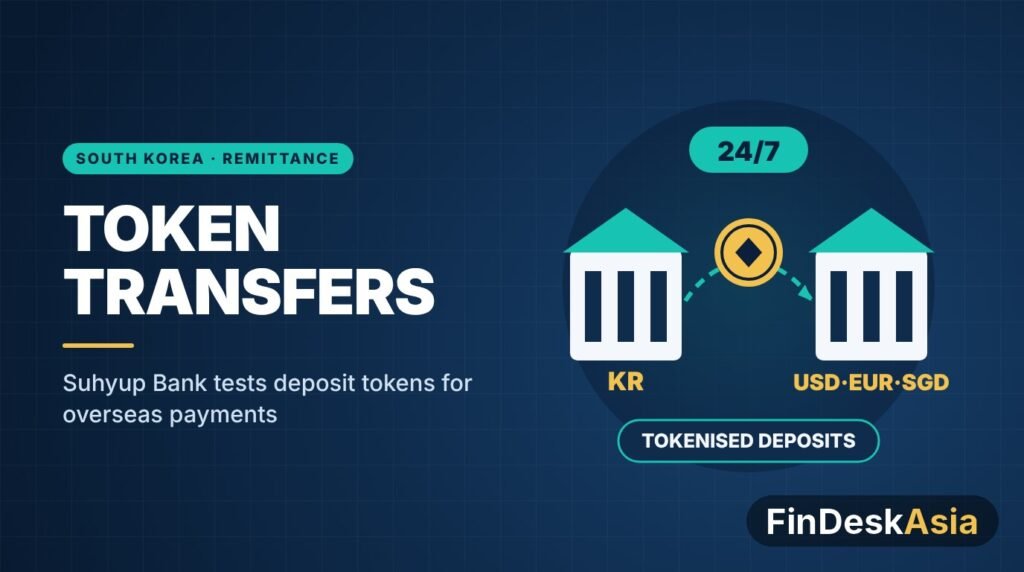
South Korea: Suhyup Bank Tests Overseas Transfers With Tokenised Deposits on Partior
A South Korean lender is testing whether bank deposits turned into digital tokens can carry money across borders faster than today’s correspondent-banking chain. Suhyup Bank has joined the second phase of Project Namsan, run by Seoul-based digital asset infrastructure firm SOOHO.IO, and will trial overseas remittances on Partior, a Singapore-based settlement network backed by some of the world’s largest banks.
The work is a proof of concept, not a live service, but it is the first time a Korean bank’s own foreign exchange and remittance teams will run tokenised deposit payments end to end on a network that already settles real commercial volumes.
Key facts
- Who: Suhyup Bank is the first Korean bank in Phase 2 of Project Namsan, run by SOOHO.IO. Other Korean financial institutions are reported to be in talks to join.
- Where: The tests run on Partior’s live network, which settles payments using tokenised commercial bank deposits. Partior is backed by DBS Bank, J.P. Morgan, Standard Chartered, Temasek, Deutsche Bank and others.
- What: Suhyup’s teams will run cross-border payments from initiation to final settlement, including the exceptions that come up in daily operations.
- Currencies: Partior currently settles in US dollars, euros and Singapore dollars. The Korean won is not yet live on the network, so no won-based remittance service is being offered for now.
- Background: Phase 1 of Project Namsan covered domestic payments and settlement. Phase 2 moves to cross-border remittance.
What is a tokenised deposit?
A tokenised deposit is ordinary money held at a licensed bank, recorded as a digital token on a shared ledger. Unlike a stablecoin, which is issued by a separate company and backed by reserves, a tokenised deposit stays a normal bank liability. It is covered by the same rules and protections as any other deposit at that bank.
Partior uses these tokens as the settlement asset itself. When a payment moves between banks on its network, the money and the payment message travel together, which allows settlement around the clock instead of only during banking hours. The network is built on ISO 20022, the global messaging standard banks are moving to for payments, so it can plug into existing foreign exchange back offices.
Partior’s chief executive, Humphrey Valenbreder, said the trial lets Suhyup Bank test “24/7 tokenised deposit settlement” on infrastructure that already handles live volumes. SOOHO.IO’s chief executive, Park Ji-su, said the aim is for Korean institutions to experience the new rail first and prepare for it.
Why it matters
Most overseas transfers today pass through a chain of correspondent banks, each adding time, cost and cut-off hours. Tokenised deposit networks promise to shorten that chain, but banks have been slow to move beyond pilots. A hands-on trial by a bank’s own operations teams, rather than a simulated test, is a step towards real adoption.
For South Korea, the trial fills a gap. The Bank of Korea’s own deposit token project, Project Hangang, is in its second phase but has focused on small-value domestic payments rather than international interbank settlement. Project Namsan gives Korean lenders a way to learn about cross-border use of the same idea, and the participants want to build evidence that could support future regulatory changes.
For the wider region, it adds another market to the list exploring 24/7 bank-to-bank settlement. Singapore, Hong Kong and other Asian financial centres are already testing similar models, and the more banks that join shared networks, the more useful they become for trade and remittance flows across Asia.
What to watch
- Whether more Korean banks sign up for Phase 2, as SOOHO.IO says several are in talks.
- Whether the Korean won is added to Partior, which would allow won-based remittances on the network.
- How Korean regulators respond to the evidence from the trial, and whether it shapes the Bank of Korea’s own deposit token plans.
Related on FinDeskAsia: ASEAN’s cross-border QR payments and how Malaysia’s payment system works.
Sources: Fintech News Hong Kong (November 2026); CFOtech Asia (November 2026); Digital Today (November 2026).
