
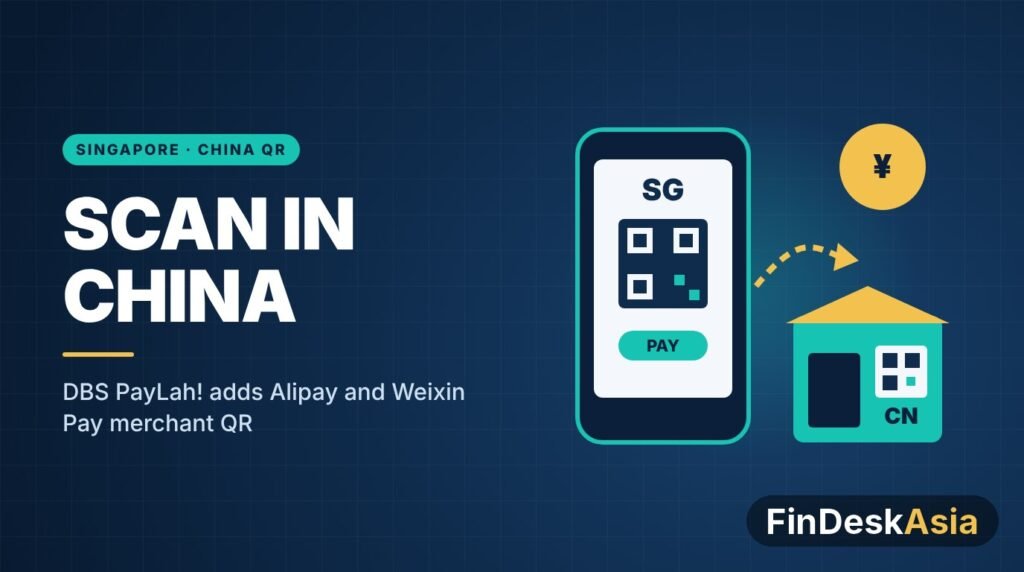
Singapore: DBS PayLah! Opens Over 100 Million Alipay and Weixin Pay Shops in China
Singapore’s largest bank, DBS, has widened what its PayLah! mobile wallet can do in mainland China. From this week, its users can scan and pay at merchants that accept Alipay and Weixin Pay, adding to the UnionPay QR payments the app already supported. DBS says that opens more than 100 million Chinese merchants to over three million PayLah! users, with no extra transaction fee.
Key facts
- DBS PayLah! now supports merchant QR payments on both the Alipay and Weixin Pay (WeChat Pay) networks across mainland China.
- More than three million PayLah! users can pay at over 100 million partner merchants, either by scanning the shop’s QR code or by showing their own code for the cashier to scan.
- Before confirming, users see the amount in Chinese yuan (CNY), the exchange rate and the Singapore dollar (S$) equivalent. DBS says no additional transaction fee is charged.
- The service runs through DBS’s partnerships with Ant International, which operates Alipay+, and TenPay Global, which supports Weixin Pay.
- Together with its existing UnionPay QR link, DBS describes itself as the first and only bank in Singapore to cover all three of China’s major QR payment ecosystems.
How it works for travellers
China is one of the most QR-heavy payment markets in the world. Many shops, food stalls and taxis expect customers to pay with Alipay or Weixin Pay, and visitors without a Chinese bank account have often struggled to set these apps up or link a foreign card. DBS’s approach avoids that step. Travellers stay inside the PayLah! app they already use at home, and the Chinese merchant is paid through its usual network. DBS says merchants do not need to change anything at the counter.
The bank also points to its DBS Remit service for payments to individuals, such as tour guides or very small sellers who only show a personal QR code. Customers can send money to their own Alipay or Weixin Pay account and pay from there. Transfers to Weixin Pay wallets registered with foreign passports were added in June 2026.
To push take-up, DBS is running cashback offers from 16 November 2026 to 31 January 2027. Users who have not made an overseas QR payment on PayLah! in the past 12 months can get up to S$3 back on their first eligible transaction, and a separate S$3 offer applies to a first Alipay+ QR payment of at least S$6, subject to redemption limits.
Why it matters
Cross-border QR payments are becoming a key battleground for Asian banks and wallets. Instead of every traveller opening a foreign wallet, networks such as Alipay+ and UnionPay let a home app talk to merchants abroad. For banks, keeping customers inside their own app when they travel protects spending data and foreign exchange revenue that might otherwise go to card schemes or rival wallets.
Travel demand gives the move weight. According to China’s National Immigration Administration, foreign nationals made 11.6 million trips into the country in July to September 2026, up 15.6% from a year earlier, and Singapore was among the top 10 source countries.
DBS says PayLah! already supports QR payments in Malaysia, Thailand, Indonesia and Taiwan, and its wider network covers more than 70 million Alipay+ and UnionPay QR merchants worldwide. For the region, the China expansion is another sign that the “scan with your home app” model, which ASEAN central banks have built through bilateral QR links, is being extended by private networks to Asia’s biggest QR market.
What to watch
- Whether other Singapore banks and wallets follow with full Alipay and Weixin Pay merchant coverage in China.
- How DBS’s exchange rates compare with card payments and with travellers loading Alipay or Weixin Pay directly.
- Usage numbers after the cashback period ends on 31 January 2027.
Related on FinDeskAsia: ASEAN’s cross-border QR payments hit a record and how Malaysia’s payment system works.
Sources: Fintech News Singapore (November 2026); TNGlobal (November 2026).
