
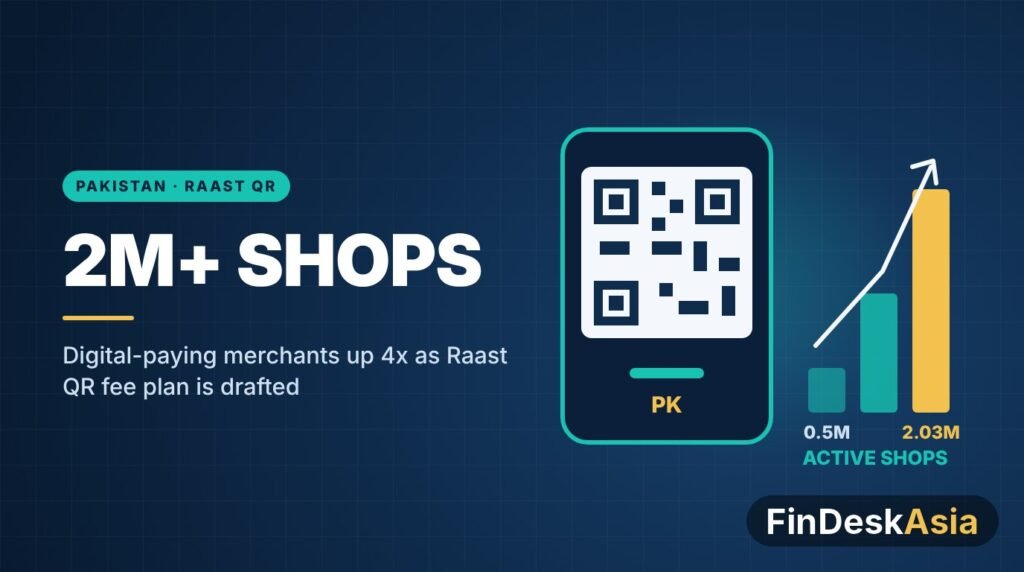
Pakistan: Digital-Paying Shops Quadruple to 2.03 Million as Raast QR Fee Plan Is Drafted
Pakistan now has about 2.03 million active merchants taking digital payments, up from roughly 500,000, according to the country’s Finance Division. At a follow-up “Cashless Pakistan” meeting in Islamabad this week, officials also said total digital payment volume has doubled in a year. They asked the central bank to draft a fee scheme for Raast QR payments at shops.
Key facts
- Active merchants accepting digital payments rose from about 0.5 million to 2.03 million under the government’s Cashless Pakistan drive, roughly four times as many.
- The overall volume of digital payments in Pakistan has doubled within one year, the Finance Division said.
- Minister of State for Finance Bilal Azhar Kayani told the State Bank of Pakistan (SBP) to prepare a working paper so a Raast QR merchant discount rate (MDR) scheme can be approved.
- Raast QR codes now appear on more than 45 million gas and electricity bills, and every NADRA (national ID authority) centre accepts Raast QR payments.
- A national dashboard will track the value of digital payments and the number of unique account users, not just transaction counts.
What was decided
Raast is Pakistan’s instant payment system, run by the SBP, the central bank. It lets people send money between bank accounts and mobile wallets in seconds and pay shops by scanning a QR code. The meeting focused on the merchant discount rate, the fee a shop pays on each card or QR sale. How this fee is set, and who pays it, decides whether small shops find QR payments worth accepting. The SBP must now write up a framework for approval. The meeting did not announce any fee level or timeline.
Kayani also asked the SBP to look at broader measures of progress, such as the ratio of large-value RTGS (real-time gross settlement) payments to the size of the economy. He plans to meet the heads of commercial banks in Karachi to push digital payments further. Representatives from Easypaisa, JazzCash, Bank Alfalah, JS Bank, NADRA, the IT ministry and development finance group Karandaaz attended the meeting.
The meeting follows a Prime Minister’s review earlier this month that ordered a roadmap towards fully digital payments. As part of that plan, payments from government Asaan Assignment Accounts move onto Raast from 16 November, and officials said disbursing officers have already been trained.
Why it matters
Pakistan has long been a cash-heavy economy, so getting shops to accept digital payments is the hard part. Putting QR codes on tens of millions of utility bills and at ID offices gives people everyday reasons to use Raast. Bringing merchants on board is what lets that money stay digital instead of being withdrawn as cash.
- For shops: a clear, low MDR could make QR payments cheaper than handling cash. A fee that is too high could slow sign-ups or push merchants back to cash.
- For banks and wallets: the MDR is how they earn money from QR payments. Its design will shape how hard Easypaisa, JazzCash and banks compete to sign up merchants.
- For the region: Pakistan is following a path similar to India’s UPI, Indonesia’s QRIS and Malaysia’s DuitNow QR. In each case, a state-backed instant payment rail plus a single national QR code helped digital payments take off. Pricing for merchants has been a recurring debate in each of those markets.
What to watch
- The SBP’s working paper on the Raast QR MDR: the fee level, any caps for small merchants, and how the fee is split between banks and wallets.
- Whether the new dashboard publishes payment values and unique users. That would show whether the extra merchants are actually busy, not just registered.
- The outcome of Kayani’s meeting with bank chiefs in Karachi, and how smoothly government payments move to Raast after 16 November.
Related on FinDeskAsia: Pakistan Ends Cheques for Government Payments, Moves Them to Raast From 16 November and Pakistan: Banks to Spend Rs100 Billion of Their Own Money to Keep Remittances Cheap.
Sources: APP (November 2026), TechJuice (November 2026), Minute Mirror (November 2026).
