
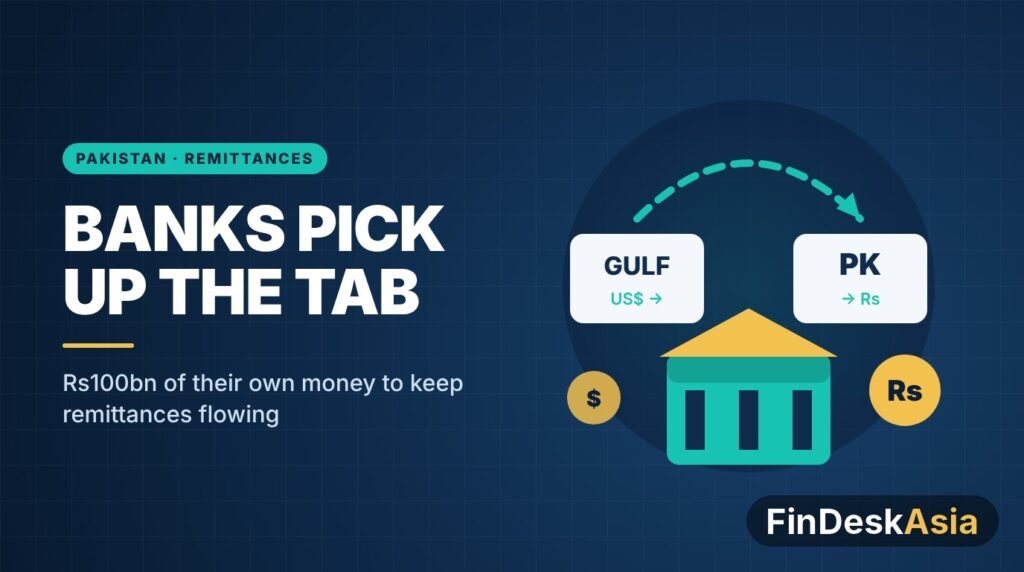
Pakistan: Banks to Spend Rs100 Billion of Their Own Money to Keep Remittances Cheap
Pakistan’s commercial banks say they will use about Rs100 billion of their own money in the 2026-27 financial year to keep overseas workers sending money home through official channels. The pledge, made by the Pakistan Banks Association (PBA) this week, follows the end of the government-funded incentives that used to cover much of the cost of these transfers.
The move matters because remittances, the money Pakistanis abroad send to their families, are one of the country’s biggest sources of US dollars, bringing in roughly US$40 billion a year.
Key facts
- The PBA says banks will spend around Rs100 billion (Pakistani rupees) from their own profits in FY2026-27 to attract remittances and lower the cost of sending money to Pakistan.
- The State Bank of Pakistan (SBP), the central bank, ended two state-funded schemes, the Telegraphic Transfer Charges Incentive Scheme and the Sohni Dharti Remittance Programme, from 1 July 2026.
- Banks are also paying for the new Pasban Remittance Reward Scheme, with about Rs16 billion in prizes a year for families who receive money from abroad.
- Each quarterly Pasban draw shares Rs4 billion among 2,521 winners. The first draw is set for 15 January 2027.
Why the banks are stepping in
For years, Pakistan’s government helped pay the fees that local banks owe to foreign banks and money transfer firms for handling incoming remittances. That support made it cheaper for a worker in Dubai, Riyadh or London to send money through a bank instead of an informal broker, known locally as hundi or hawala. Pakistani banks have been paying around US$800 million a year in such fees to overseas partners.
The subsidies grew so large that they reportedly drew criticism from the International Monetary Fund, and the SBP stopped them at the start of July. The SBP told banks to keep the main features of the transfer-fee scheme running at their own cost. Bankers warned at the time that the change would hurt their profits, while some analysts argued the impact would be manageable given the sector’s strong earnings.
The PBA’s new Rs100 billion commitment is the industry’s answer: banks will absorb the charges from their profits so that the cost is not passed on to the people sending money home. PBA chairman Zafar Masud presented the plan at a media meeting in Karachi, alongside other measures for housing, exporters and farmers.
How the reward scheme works
The Pasban scheme, launched by SBP Governor Jameel Ahmad in September, works like a prize draw. A family in Pakistan is entered automatically if it receives at least US$100 into an eligible bank account or mobile wallet in each month of a quarter. Bigger and more frequent transfers earn more entries.
- Each draw has one Rs100 million top prize, plus thousands of smaller prizes down to Rs1 million.
- Prizes other than the top one are split by where the money came from, with half reserved for transfers from the Gulf states.
- Cash collected over the counter does not qualify, which pushes families towards accounts and wallets.
- The draws are run by 1LINK, Pakistan’s national payment switch, with independent audits.
Why it matters
For Pakistan, keeping remittances in the formal banking system helps the central bank build its dollar reserves and gives regulators a clearer view of money flows. If transfer fees rose after the subsidy ended, some senders could drift back to informal brokers, which are cheaper but harder to monitor. The PBA says its aim is to hold annual inflows at around US$41 billion.
The approach also shows a wider shift across emerging Asia: instead of the state paying for incentives, banks are being asked to fund them, betting that more customers with digital accounts and wallets will pay off in the long run. Rewarding money sent into accounts, rather than cash pick-up, also supports Pakistan’s push towards digital payments through its instant payment system, Raast.
What to watch
- Whether remittance inflows stay near the US$41 billion target now that banks, not the government, carry the cost.
- The first Pasban draw on 15 January 2027 and how many families qualify through accounts and wallets.
- Any sign that higher costs push banks to raise fees for senders, or push money back to informal channels.
Related on FinDeskAsia: ASEAN’s cross-border QR payments record and Pakistan ends cheques for government payments, moves them to Raast.
Sources: TechJuice (November 2026), ProPakistani (November 2026), Dawn (September 2026), Dawn (July 2026), PakBanker (August 2026).
