
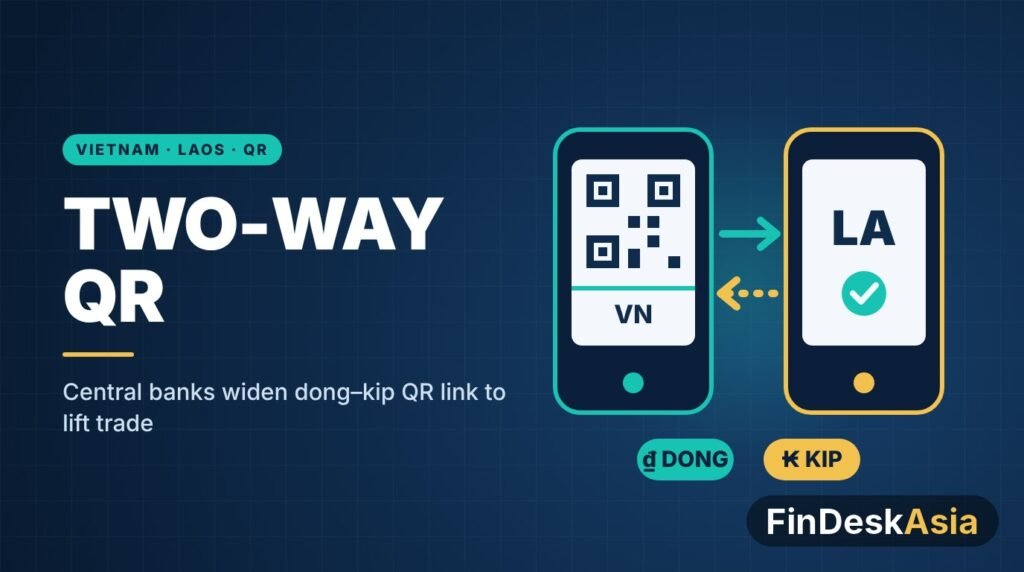
Vietnam and Laos Widen Cross-Border QR Payments in Dong and Kip, Eye US$10bn Trade
Vietnam and Laos want more of their trade, travel and everyday spending to move through QR codes and their own currencies. At their annual meeting in early November, the two countries’ central banks agreed to widen the cross-border QR payment link they opened in January 2025, as part of a push towards US$10 billion in two-way trade in the coming years.
Key facts
- The State Bank of Vietnam (SBV) and the Bank of the Lao PDR (BOL) held their 2026 annual meeting in early November, co-chaired by SBV Governor Pham Duc An and BOL Governor Bounkham Volachith.
- They agreed that 2027 priorities are expanding two-way QR payments and encouraging the use of the Vietnamese dong and the Lao kip in cross-border deals.
- The QR link launched in Vientiane on 9 January 2025 and had handled more than 25,000 transactions by October 2026, according to figures released on 5 November.
- The wider aim is to support bilateral trade worth US$10 billion in the coming years.
How the link works today
In its first phase, the service mainly worked in one direction. Customers of participating Vietnamese banks could open their mobile banking app in Laos, scan a local merchant’s QR code and pay for goods and services. The link was built by the two central banks with the national payment operators on each side: the National Payment Corporation of Vietnam and the Lao National Payment Network.
The key design choice is the currency. Payments are settled in dong or kip rather than being converted through a third currency such as the US dollar. For a Vietnamese tourist or trader, that means fewer conversion steps and, in principle, lower costs than paying by international card or carrying cash.
The next step is to make the link properly two-way. The central banks plan to grow the network of merchants that accept these payments so that Lao citizens can also pay by QR when they visit Vietnam for tourism, study, medical treatment or business.
Why it matters
The usage numbers are still small. Just over 25,000 transactions since the January 2025 launch is a modest start for two neighbours with deep economic ties. That is why the central banks are now focusing on reach: more merchants, more banks and more use cases, rather than only on the technical connection.
For Laos, the local-currency angle is especially important. Paying in kip and dong reduces the need to hold US dollars for regional trade and can cut transaction costs for small businesses near the border. For Vietnam, the link supports the many Vietnamese companies, banks and visitors active in Laos. At the meeting, both sides also met Vietnamese commercial banks operating in Laos and recognised their role in lending, banking services and digital payments there.
Vietnam also promised technical help, including advice from senior banking experts and postgraduate training for Lao central bank staff. That support could matter as Laos builds out its own payment systems.
The deal fits a wider trend across Southeast Asia. Central banks have been joining up their national QR systems in a web of bilateral links, so that a phone payment app from one country works at shops in another. The early lesson from these links is the same one Vietnam and Laos now face: switching the connection on is the easy part, and getting merchants and users to adopt it takes longer.
What to watch
- When Lao users can scan QR codes in Vietnam, and which Vietnamese merchants and cities join first.
- Whether transaction numbers rise quickly in 2027 once the link works both ways.
- How far dong and kip settlement spreads beyond retail payments into trade and business transfers.
Related: ASEAN’s cross-border QR payments record and China’s digital yuan now pays at 17 Lao banks and wallets.
Sources: VOV (November 2026), VietnamPlus / VNA (November 2026), Fintech News Singapore (January 2025).
