
Vietnam: AI Payments Above VND10 Million Now High-Risk Under New Central Bank Rules
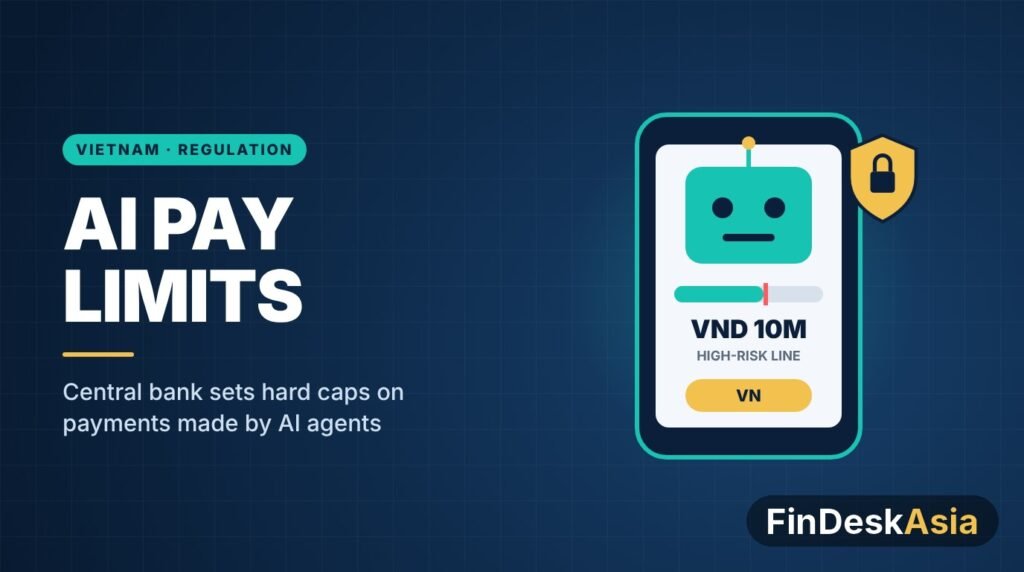
Vietnam has put hard limits on how much money an artificial intelligence (AI) system can move on a customer’s behalf. Under new rules from the State Bank of Vietnam (SBV), the country’s central bank, any AI that pays out more than VND10 million (about US$380) in a single transaction for an individual is now treated as “high-risk”, and must meet strict safeguards.
The rules, set out in Circular 53/2026, took effect on 15 November. They arrive as banks and payment apps around the region test “agentic” AI tools that can shop, pay bills or move money with little human input.
Key facts
- Circular 53/2026/TT-NHNN was issued by the SBV on 30 September 2026 and took effect on 15 November 2026.
- For individuals, an AI system that makes payments automatically is high-risk if it handles more than VND10 million (about US$380) per transaction or more than VND20 million (about US$760) a day.
- For businesses and other organisations, the high-risk line is VND50 million (about US$1,900) per transaction or VND100 million (about US$3,800) a day.
- AI-executed payments are capped at VND100 million a day for an individual and VND500 million (about US$19,000) a day for an organisation, or lower if the bank sets a tighter internal limit.
- AI systems already running before 15 November have until 1 March 2027 to comply.
What the rules ask of banks
Before an AI tool can pay on a customer’s behalf, the bank must sign an agreement with that customer. The agreement has to spell out which kinds of transactions are allowed, the limit per transaction and per day, how long the permission lasts and when it can be paused. Banks must check that the person signing is the account holder or a legal representative. If the agreement is signed online, the bank must use biometric checks, such as face matching, plus at least one other form of authentication.
Customers keep control. Banks must give them tools to pause or cancel the AI’s authority to pay at any time, and a request to end the agreement must be handled straight away.
The circular also covers lending. An AI system that decides on its own to grant credit of VND50 million or more is classed as high-risk. For high-risk systems, banks must test cybersecurity before launch and again after major changes, keep activity logs, prepare incident response plans and run a “three lines of defence” model, meaning separate checks by business teams, risk control and internal audit. Banks must also file a dossier with the authorities before putting such systems into use.
Two principles run through the rules. First, a human must be able to step in, adjust, pause or shut down an AI system in an emergency. Second, when a customer complains about a decision made by AI, a person at the bank must review it, and that review is the final word on the complaint. Banks stay legally responsible for AI decisions, even if the model was built or supplied by a third party.
Why it matters
Vietnam is one of Southeast Asia’s busiest digital payment markets, and its banks already use AI for credit scoring, loan checks, fraud detection, automated advice and eKYC, the online identity checks used to open accounts. The SBV has said AI “does not replace human authority or responsibility”, and the new rules turn that idea into firm numbers.
For the wider region, the rules stand out because they put exact money limits on AI that pays on a customer’s behalf, rather than only setting broad principles. By drawing lines in dong, the SBV gives banks and fintechs a clear rulebook for testing AI shopping assistants and bill-paying agents, while keeping larger sums under closer watch. Card networks and tech firms that are building “agent pay” tools for Asia will need to design around these caps if they want to launch in Vietnam.
The thresholds are also modest. Below VND10 million per transaction, everyday spending such as groceries, top-ups and utility bills can still be automated, while larger transfers, which are a common target for scams, fall into the tightly controlled tier.
What to watch
- Whether Vietnamese banks and e-wallets launch AI payment features before the 1 March 2027 deadline for existing systems, and how they handle the customer agreements.
- Whether other central banks in the region follow with similar money limits for AI agents that pay on a customer’s behalf.
- How the SBV reviews the dossiers banks must file before deploying high-risk AI systems.
Related on FinDeskAsia: Vietnam: NAPAS handles 12.4 billion payments in 10 months and Hong Kong: Deutsche Bank and Ant Digital set rules for AI agents that move company money.
Sources: Tuoi Tre News (November 2026); Thị trường Tài chính Tiền tệ (November 2026); Vietnam Banks Association (October 2026); LuatVietnam (October 2026).
