
Vietnam: NAPAS Handles 12.4 Billion Payments in 10 Months, Up Nearly 32%
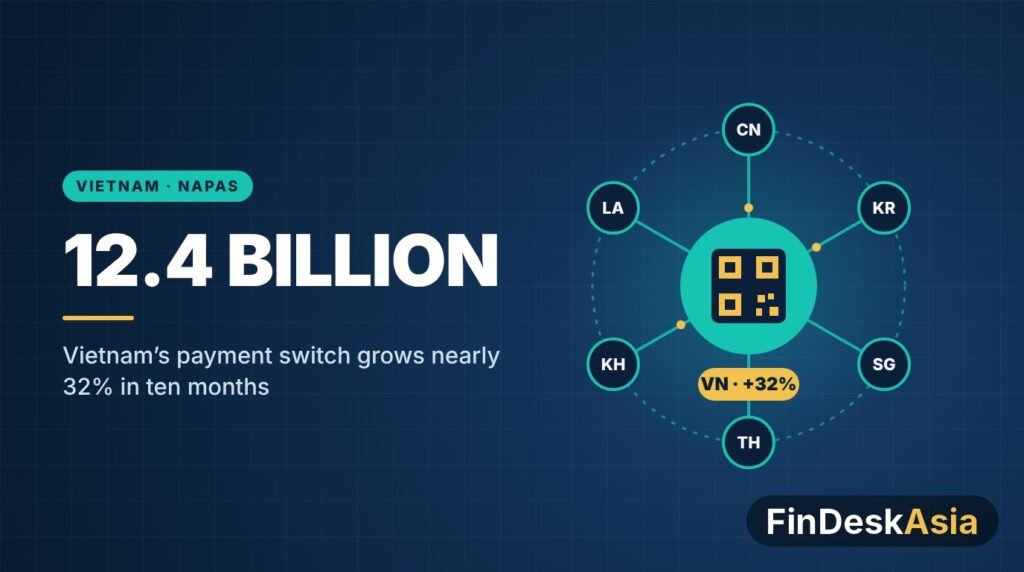
Vietnam’s national payment switch handled 12.4 billion transactions in the first ten months of 2026, nearly 32% more than in the same period last year. NAPAS shared the figure at its annual conference for member banks, alongside updates on QR payments, fraud monitoring and new links with payment systems abroad.
Key facts
- NAPAS processed 12.4 billion transactions up to October 2026, up nearly 32% year on year.
- On its busiest day, the system handled more than 50 million transactions worth over VND334,761 billion.
- System availability reached 99.99%, above what NAPAS promises its members.
- The NAPAS247 instant transfer service moved to technical standard 2.0 and was connected to SIMO, as directed by the State Bank of Vietnam.
- Cross-border links with China were completed this year; links with South Korea and Singapore were widened, and work on India and Taiwan is under way.
What NAPAS does, and what changed
NAPAS, the National Payment Corporation of Vietnam, is the switch that sits between banks. When someone sends money from one bank to another, pays with a domestic card or scans a VietQR code, the transaction usually runs through NAPAS. Its 24/7 transfer service, NAPAS247, is the backbone of the instant transfers that Vietnamese consumers now use for everything from rent to street food.
The figures were shared at the NAPAS Member Organisation Conference 2026, held on 12–13 November in Khanh Hoa province. More than 60 member organisations, including banks and finance companies, attended, along with Pham Anh Tuan, director of the central bank’s Payment Department.
Beyond volume, the upgrades are about resilience and safety. NAPAS said it now runs an active-active model, meaning two sites process traffic at the same time so one can take over instantly if the other fails. It has also tightened monitoring to spot unusual transactions early. Linking NAPAS247 to SIMO, the State Bank of Vietnam’s system for tracking accounts and transactions suspected of fraud, is part of the regulator’s push against scams that use bank transfers.
The growth is in line with the wider market. Industry data cited by the Vietnam Banks Association in October showed non-cash payments in Vietnam topped 21 billion transactions in the first eight months of 2026, with volume up 34.56% on a year earlier. QR payment volume has grown 20 times over five years.
Why it matters
For Vietnam, the numbers show that instant transfers and QR codes have become everyday habits, not niche tools. NAPAS now wants to move people from typing in account numbers to scanning QR codes at the till through its VietQRPay network, which makes payments faster for shoppers and easier to reconcile for merchants. It is also building VietQRMe, where the customer shows a QR code on their phone for the shop to scan, and NAPAS DPP, a digital payment platform that gives members one standard connection for new services.
For the region, NAPAS is Vietnam’s gateway to other countries’ payment systems. Under its VietQRGlobal programme, two-way QR payments are already live with Thailand, Laos, Cambodia, China and Singapore, according to NAPAS’s October update, and the Korea link currently serves Vietnamese people paying in South Korea. Adding India and Taiwan would cover two of Vietnam’s important sources of tourists, workers and investment.
NAPAS chairman Nguyen Quang Hung said the opportunities were large, but warned that cybersecurity, data protection and regulatory compliance were growing challenges that would push the industry to keep improving.
What to watch
- Full-year 2026 figures, and whether growth stays near 32% as volumes get larger.
- When the India and Taiwan QR links go live, and whether they work in both directions.
- How quickly VietQRPay and VietQRMe shift everyday shopping from transfers to QR payments.
Related on FinDeskAsia: ASEAN’s cross-border QR record and how Malaysia’s payment system works.
Sources: Thoi bao Ngan hang (November 2026); Thoi bao Tai chinh Viet Nam (November 2026); Vietnam Banks Association (October 2026).
