
Hong Kong: Deutsche Bank and Ant Digital Set Rules for AI Agents That Move Company Money
Deutsche Bank and Ant Digital Technologies, the technology arm of China’s Ant Group, have published a joint white paper on how AI “agents” could run parts of big-company payments. The paper, released in Hong Kong, argues that software agents can do useful work in treasury, cross-border transfers and trade finance, but only inside tight, bank-set limits.
Key facts
- The paper is called Agentic Payments in Wholesale Finance and was published jointly by Deutsche Bank and Ant Digital Technologies on 9 November 2026.
- It looks at three uses: treasury and cash management, choosing routes for cross-border payments, and checking documents in trade finance.
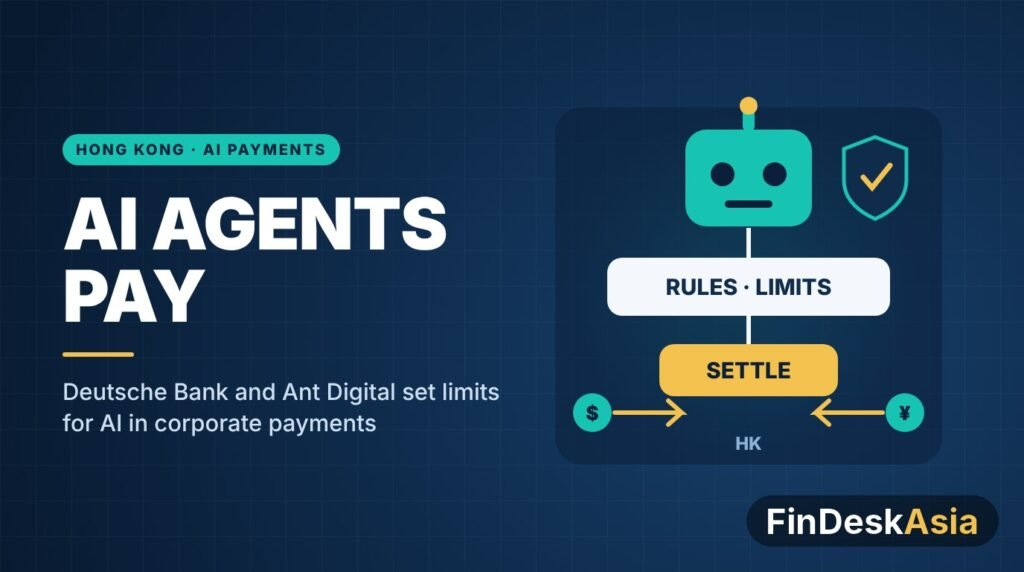
- It recommends “bounded” agents rather than fully independent ones, using a three-layer design drawn from the International Monetary Fund (IMF) that keeps AI decisions apart from payment approval and final settlement.
- Ant Digital’s own agent platform, Anvita Flow, is used as a case study.
- The full paper can be downloaded from both companies’ websites.
What the paper proposes
An AI agent is software that can look at information, weigh options and then take an action, not just answer a question. In wholesale finance, which means payments between banks, large companies and institutions rather than shoppers, the paper sees three early jobs for such agents.
In treasury, an agent could watch a company’s cash across accounts, spot a coming shortfall or surplus, and propose or carry out a permitted step such as a transfer, a short-term investment, a loan draw or a currency trade. In cross-border payments, it could compare exchange rates, fees, payment networks and timing to find the best balance of cost, speed and compliance. In trade finance, it could read shipping and invoice documents, flag mismatches and prepare the payment or financing instruction once all checks and approvals are in place.
The authors are careful not to oversell. Fintech News Hong Kong noted that the paper presents these gains as possible, and that they still have to be proven in real use.
Why it matters
Most talk about “agentic commerce” so far has focused on consumers, for example an AI assistant that books and pays for a trip. This paper shifts the focus to the much larger flows that move between companies and banks, where a single mistake can be very costly.
The core idea is separation. The paper’s three layers are: intent and orchestration, where the agent reasons and plans; control and authorisation, where fixed, rule-based limits decide what the agent is allowed to do; and settlement, where the money actually moves. The agent can suggest and prepare, but a separate system checks every instruction against the institution’s rules, and people still sign off on high-value, high-risk or unusual cases.
Identity is the other big theme. In her foreword, Ant Digital Technologies president Zhuoqun Bian wrote that agents need a verifiable identity tied to an owner who is accountable for them, with authority that is explicit, limited and can be taken away. The paper calls this “Know Your Agent” (KYA), a counterpart to the familiar “Know Your Customer” checks. Deutsche Bank’s Sabih Behzad, who leads the bank’s digital assets and currencies transformation, wrote that the real value goes beyond automatic payments to better decisions, coordination and control.
For Asia, where Hong Kong’s regulators are actively studying agent-based finance and many companies juggle several currencies, a shared set of design rules from a global bank and a major Chinese fintech could shape how banks across the region test these tools. In Malaysia too, payment firms have started asking for clear consent rules before AI agents are allowed to pay on people’s behalf.
What to watch
- Whether Deutsche Bank or Ant Digital move from the paper to live pilots with corporate clients, and in which markets.
- How regulators, including the Hong Kong Monetary Authority (HKMA), treat agent identity and “Know Your Agent” checks in future guidance.
- Whether other banks adopt the same split between AI decisions, rule-based approval and settlement.
Related on FinDeskAsia: Malaysia needs consent rules before AI agents pay for us · Ant International settles tokenised deposits across 3 Hong Kong banks within 5 minutes
Sources: Fintech News Hong Kong (November 2026) · Deutsche Bank and Ant Digital Technologies via PR Newswire (November 2026)
