
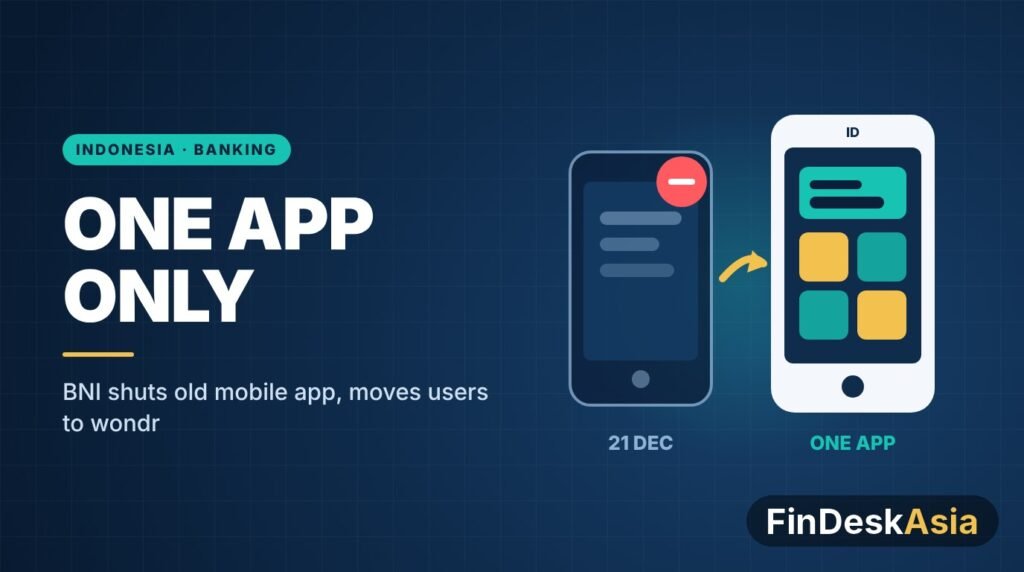
Indonesia: BNI to Shut Old Mobile Banking App on 21 December, Moves Users to wondr
Indonesia’s state-owned Bank Negara Indonesia (BNI) is switching off its old BNI Mobile Banking app. Access is being closed in stages until 30 November 2026, and the app will be shut down for good on 21 December 2026, leaving its newer wondr by BNI app as the bank’s main channel for everyday customers.
Key facts
- BNI told the Indonesia Stock Exchange on 9 November 2026 that user access to BNI Mobile Banking is being closed gradually until 30 November 2026.
- The app will be fully discontinued on 21 December 2026, subject to regulator approval.
- Customers are being directed to wondr by BNI, which had 16.6 million users at end-September 2026, up 58% from a year earlier.
- Transactions on wondr reached Rp1,774 trillion (Indonesian rupiah) by September 2026, up 25% year on year.
- BNI says the change will have no material impact on its operations, finances or business continuity.
A long, staged goodbye
The shutdown is not a surprise move. BNI says it first told customers about the plan on 2 June 2025 and updated the notice on 20 October 2026 through its website and other official channels. The bank says the notice follows the consumer protection rules of the Financial Services Authority (OJK, Indonesia’s financial regulator), set out in OJK Regulation No. 22 of 2023.
The mobile app is the last major piece of BNI’s older retail digital set-up to go. Earlier this year the bank closed its internet banking service: access was restricted for some customers from 21 April 2026 and the service ended completely on 4 May 2026. Retail users were moved to wondr, while business and corporate clients were moved to BNIdirect, the bank’s platform for companies.
Corporate Secretary Okki Rushartomo described the latest step as part of the bank’s strategy to optimise its digital banking services, while keeping customers’ transactions running through wondr.
Why it matters
Running two consumer apps side by side is costly for a bank. Each one needs its own security updates, testing, fraud monitoring and customer support. By folding everything into a single app, BNI can focus its spending on one platform and release new features faster. It also gives customers one clear place to go, which matters at a time when scammers often lure people with fake “updated” banking apps.
The numbers suggest most users have already moved. wondr’s user base has grown by more than half in a year, and BNI’s wider digital push is showing up in its results: low-cost deposits, such as current and savings accounts, rose 19.6% year on year in the third quarter, and the bank links that growth to more customers banking with it day to day through its digital channels.
For customers who still use the old app, the practical message is simple: install the official wondr by BNI app from a trusted app store and sign in before access is cut. Once the old app is closed, it can no longer be used for transfers, bill payments or balance checks.
Across Southeast Asia, banks are making the same kind of shift, retiring older apps and moving users to a single “super app” that combines payments, savings, investments and lending. Indonesia, with its fast-growing use of digital payments and the national QR standard QRIS, is one of the region’s busiest markets for this competition, where banks also face pressure from e-wallets and digital-only banks.
What to watch
- Whether the final 21 December switch-off goes smoothly, especially for older or less tech-savvy customers who have not yet moved.
- Further growth in wondr users and transaction value when BNI reports its full-year 2026 results.
- Whether other large Indonesian banks follow with their own app consolidations.
Related: Indonesia’s plan for free bank accounts for 25 million low-income adults · ASEAN cross-border QR payments hit a record
Sources: Kontan (November 2026) · Emitennews (November 2026) · Kontan (October 2026) · Stabilitas (October 2026) · Antara (April 2026)
