
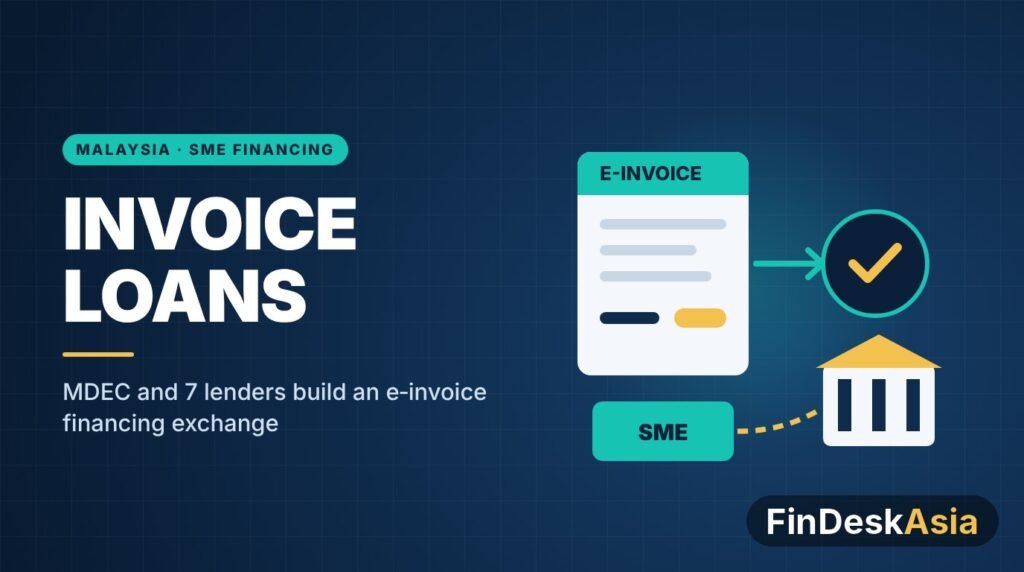
MDEC Signs 7 Lenders for NEFX, an E-Invoice Exchange to Help SMEs Get Financing
Malaysia’s digital economy agency wants small businesses to be able to borrow against the invoices they already issue. The Malaysia Digital Economy Corporation (MDEC) on 11 November signed agreements with seven lenders to build the National E-Invoice Financing Exchange (NEFX), an online marketplace that lets banks and fintech lenders look at a company’s verified e-invoice records before deciding whether to lend.
Key facts
- MDEC signed memorandums of understanding (MoUs) with seven financing partners: CIMB Bank, CIMB Islamic Bank, AFFIN Bank, Alliance Bank, Funding Societies, CapBay and Bettr.
- NEFX will use authenticated e-invoice data sent over the Peppol network, plus other business data that SMEs choose to share with their consent.
- Planned pilot features are data assessment, prevention of double financing, loan tracking and consent management.
- Lenders keep full control of credit approvals, disbursements and collections. MDEC chairman Ganesh Kumar Bangah said NEFX “is not about relaxing lending standards”.
- MyDigital ID, CGC Digital and five Peppol-ready software providers, including Xero Software Malaysia and QNE Software Malaysia, were named as ecosystem partners.
How the exchange is meant to work
An e-invoice is a digital bill issued in a standard, machine-readable format instead of on paper or as a PDF. Peppol is an international network and set of rules that lets different accounting and billing systems send these invoices to each other securely. MDEC acts as Malaysia’s Peppol Authority, the body that oversees how the network runs locally.
Because each e-invoice moves through this network, it leaves a trusted digital trail of who sold what to whom. NEFX plans to turn that trail into lending information. With the business owner’s permission, a lender on the exchange could see a firm’s actual sales and payment patterns, and MDEC says AI tools will help analyse them. The “double financing” check matters here: it is designed to stop the same invoice being pledged to two different lenders, a known risk in invoice financing.
MDEC’s acting chief executive Azlan Sharom described NEFX as an open, secure and AI-enabled financing marketplace. It is still being built. The seven partners will help shape the data requirements, lending processes and system connections before a wider rollout, and a NEFX Founding Members Advisory Panel has been proposed to guide that work.
What it means for Malaysians
For SME owners: the exchange is aimed squarely at firms that struggle to get bank loans today because they have a short credit history, little collateral or thin financial records. A café supplier or a small contractor that bills big customers regularly could, in future, use that billing record to show it is a safe borrower, instead of relying only on property or personal guarantees. Cash-flow loans against unpaid invoices are often what keeps such businesses running between payments.
For lenders: the mix of partners is notable. It includes established banks, CIMB’s Islamic banking arm and three fintech lenders: Funding Societies, CapBay and Bettr. A shared, verified data source could lower the cost of checking small borrowers, which is one reason banks often avoid them.
For accounting software users: businesses that already send e-invoices through Peppol-ready systems such as Xero or QNE may be first in line, since their data is already in the right format. The involvement of MyDigital ID, the national digital identity, and CGC Digital, the digital arm of the government’s credit guarantee agency, hints at easier identity checks and possible guarantee support, though no details have been given.
No financing amounts, pricing or launch date were announced. The agreements are MoUs, which set out intent rather than binding terms. MDEC is also building a sister platform, the National AI Compute Exchange (NACX), to widen access to AI computing power for local businesses, as part of the national goal of becoming an “AI Nation” by 2030.
What to watch
- When the NEFX pilot opens to SMEs, and which lenders make the first loans through it.
- Whether more banks, Islamic lenders and accounting software providers join the exchange.
- How consent and data-sharing rules are set, and whether CGC Digital adds guarantees for borrowers on the platform.
Related on FinDeskAsia: CIMB launches OCTO Collect for SMEs · How Malaysia’s payment system works
Sources: The Star (November 2026) · The Sun (November 2026)
