
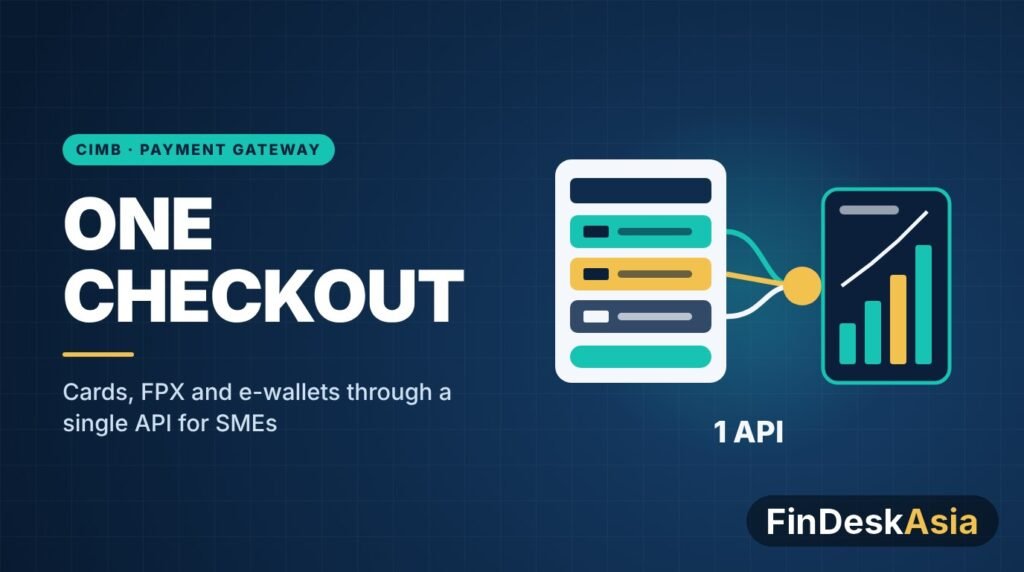
CIMB Launches OCTO Collect, Putting Cards, FPX and E-Wallets Behind One API for SMEs
CIMB Bank has introduced OCTO Collect, a payment collection service that lets Malaysian merchants accept cards, online banking and e-wallets through one connection instead of several. The bank showcased it at the last stop of its OCTOFest 2026 tour at LaLaport Bukit Bintang City Centre in Kuala Lumpur, aiming squarely at micro, small and medium enterprises (MSMEs) that sell both online and in person.
Key facts
- OCTO Collect bundles debit and credit cards, FPX online banking and several e-wallets behind a single API, the software link a merchant’s website or app uses to take payments.
- Customers see one consistent checkout screen and pick how they want to pay.
- Merchants get an integrated sales dashboard showing incoming payments and transaction status in real time, plus month-to-date performance.
- CIMB says it targets one to three months for a business to be fully onboarded and live.
- The service was introduced during OCTOFest 2026, a four-city tour across Penang, Kuantan, Johor Bahru and Kuala Lumpur that involved more than 255 MSME vendors.
What OCTO Collect does
Today, a small online seller in Malaysia that wants to offer every popular way to pay often ends up stitching together several services: a card acquirer, an FPX connection, and separate set-ups with individual e-wallet providers. FPX, short for Financial Process Exchange, is the online banking checkout run by PayNet, Malaysia’s national payments network, and it remains one of the most common ways Malaysians pay online.
OCTO Collect is CIMB’s attempt to fold all of that into one relationship with the bank. The merchant integrates once, and the bank handles the different payment methods behind the scenes. Because every payment lands in the same place, the dashboard can show a single view of sales across methods, so business owners do not have to match reports from different platforms by hand at the end of the day or month.
CIMB also pitches the single provider set-up as a way to cut paperwork. Instead of onboarding separately with several payment companies, a merchant goes through one onboarding and one technical set-up. CIMB has not published the pricing or merchant fees for OCTO Collect.
What it means for Malaysians
- For SMEs and online sellers: one integration and one dashboard could make it simpler to add cards, FPX and e-wallets at once, which matters as shoppers expect to pay their own way. Merchants should still compare fees, settlement times and contract terms with other payment gateways in Malaysia before switching.
- For shoppers: a consistent checkout across more small merchants means fewer abandoned carts and fewer moments where a preferred payment method is missing.
- For the industry: the launch puts a large bank directly into a space crowded by independent gateways and fintech players. Banks can bundle payment collection with business accounts and financing, which gives them an edge with customers who already bank with them.
The OCTOFest tour itself showed the bank’s approach. CIMB set up digital payments for participating vendors so they could take cashless payments at the events, while the OCTO app ran rewards missions for visitors. The festival is part of CIMB’s wider push to grow its MSME base outside the Klang Valley, with stops in three other states this year.
What to watch
- Whether CIMB publishes OCTO Collect’s fees and settlement terms, and how they compare with established gateways.
- Which e-wallets are included at launch, and whether DuitNow QR for in-store payments is folded into the same dashboard.
- Whether other large banks respond with their own all-in-one merchant collection products for SMEs.
Related on FinDeskAsia: Payment gateways in Malaysia explained · How Malaysia’s payment system works
Sources: SoyaCincau (November 2026) · Malaysia SME (November 2026) · Ringgit (October 2026)
