
Japan: Singapore Travellers Can Now Pay by QR at JPQR Global Shops via RoamQR
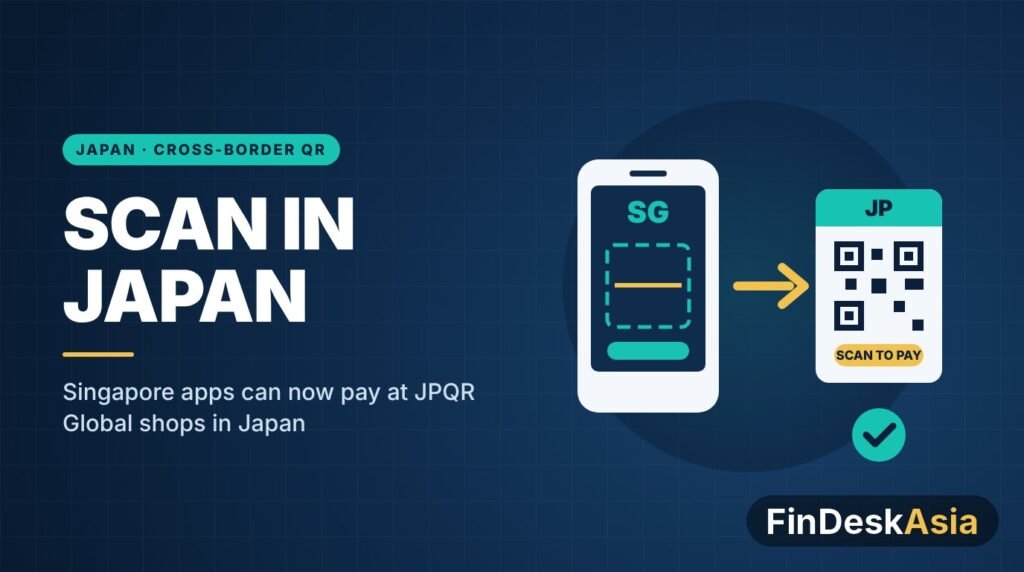
Travellers from Singapore can now pay at participating shops in Japan by scanning a local QR code with the payment app they already use at home. Singapore payments firm Liquid Group and Tokyo-based gateway NETSTARS announced the link on 18 November 2026 at the Singapore FinTech Festival, connecting Liquid Group’s RoamQR network to JPQR Global, Japan’s cross-border QR framework.
Singapore becomes the third country plugged into JPQR Global, after Cambodia and Indonesia, as Japan works to make its push towards cashless payments easier for the millions of tourists it receives.
Key facts
- Users of participating Singapore payment apps can scan QR codes carrying the JPQR Global mark at enabled merchants in Japan, with no need to download a Japanese app.
- The link joins Liquid Group’s RoamQR network with JPQR Global through NETSTARS, which the Payments Japan Association (PJA) has designated as the operator of JPQR’s switching system.
- JPQR Global launched in July 2025 at Expo 2025 Osaka, Kansai, and already accepts Cambodia’s KHQR and Indonesia’s QRIS for inbound payments.
- NETSTARS’ own StarPay service runs at about 700,000 merchant locations across Japan.
- The partners did not name the Singapore apps taking part; travellers are pointed to roamqr.com for the current list.
How the link works
Japan’s payment scene is crowded. Shops may accept cards, transport cards, and a long list of QR wallets. To tidy this up, the PJA, an industry body that promotes cashless payments, created JPQR in 2019 as a single QR standard that many domestic payment brands can share. JPQR Global extends that idea across borders by matching JPQR with the national QR standards of partner countries.
The technical work happens in the middle. NETSTARS acts as the “switch” on the Japanese side, routing payment messages between Japanese merchants and foreign networks. Liquid Group’s RoamQR does the same job on the other side, describing itself as a “network of networks” that connects wallets, banks and merchant acquirers in different markets through shared connectivity, clearing and settlement.
The practical result for a shopper is simple: open the home app, scan the code at the till, and pay. Behind the scenes the payment is converted and settled between the networks, so the merchant in Japan is paid through its usual channel.
Why it matters
For Japan, inbound tourism is a major source of consumer spending, and many small shops have been slow to take foreign cards. A shared QR standard lets a merchant add new groups of foreign customers without signing separate deals with each overseas wallet. Each new partner country makes the JPQR Global mark more valuable on shop counters.
For Singapore payment providers, the model avoids building a separate integration for every overseas market. A wallet that connects once to RoamQR can reach merchants in partner countries while keeping its own app, customer relationships and domestic systems.
The deal also fits a wider regional trend. Across Asia, central banks and payment networks are linking national QR systems so that people can spend abroad with their local apps, and Japan is now building its own set of these corridors, starting with Southeast Asia. Both the PJA and NETSTARS also say they want to go the other way, letting users of Japanese apps pay when they travel overseas.
What to watch
- Which apps go live: the partners have not yet named the Singapore wallets or banks taking part, which will decide how many travellers can actually use the link.
- Merchant coverage: no count of JPQR Global merchants was given; the PJA says sign-ups are growing, mainly in tourist areas.
- Outbound payments: whether Japanese app users gain the ability to pay by QR in Singapore, Cambodia and Indonesia, and which partner country joins next.
Related on FinDeskAsia: ASEAN’s cross-border QR record and DuitNow explained.
Sources: Voice of ASEAN (November 2026); PR TIMES / NETSTARS (November 2026); Zaikei (November 2026).
