
Singapore: Visa Lets Asia-Pacific Firms Fund Cross-Border Payouts With Stablecoins
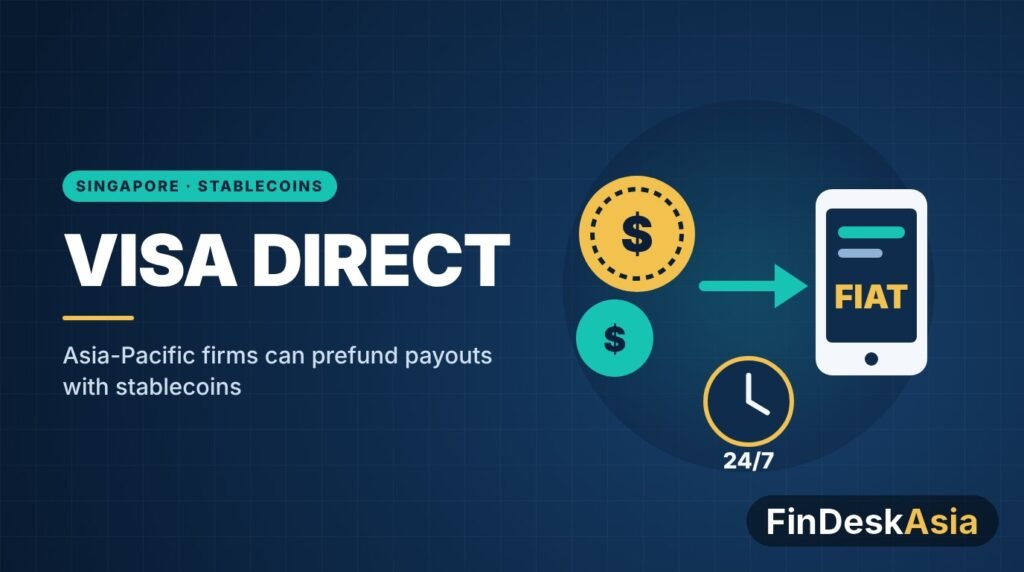
Visa will let eligible business clients in Asia-Pacific pay for cross-border payouts using stablecoins, while the people receiving the money still get ordinary local currency. The first pilot partner is dtcpay, a Singapore-based digital payments firm, with stablecoin specialist Triple-A handling the conversion behind the scenes. Visa announced the move on 18 November, during the Singapore FinTech Festival week.
Key facts
- What changes: eligible Visa Direct clients in Asia-Pacific can use supported stablecoins to prefund cross-border payouts. Recipients are paid in fiat (regular government-issued) currency.
- First pilot: dtcpay, a digital payments company based in Singapore.
- The plumbing: Triple-A converts the stablecoins, runs compliance screening and settles the funds. Visa says a licensed partner, not Visa itself, provides the regulated digital asset services.
- Reach: Visa Direct, Visa’s real-time money movement platform, connects to more than 18 billion endpoints such as cards, bank accounts and wallets.
- Track record: Visa first piloted stablecoin prefunding in 2025, and the service went live commercially in the United States with Inyo Global in October 2026.
What prefunding means, in plain terms
When a payment company sends money abroad through a network like Visa Direct, it usually has to park money with the network in advance so payouts can go out instantly. This is called prefunding. Traditionally, that top-up moves through bank transfers, which only run during banking hours and can be slow across time zones and public holidays.
Stablecoins are digital tokens designed to hold a steady value, usually pegged one-to-one to a currency such as the US dollar. Because they move on blockchains that run around the clock, a firm can top up its payout balance at night or on a weekend. Under Visa’s model, Triple-A turns those tokens into the money Visa needs, checks the transaction for compliance risks, and settles it. The end recipient, whether a freelancer, a supplier or a family member, simply receives local currency and never touches crypto.
Visa did not say which stablecoins are supported in Asia-Pacific or which markets beyond the Singapore pilot will get access first. It said availability depends on each client’s eligibility and location.
Why it matters
Asia-Pacific accounts for nearly a third of global cross-border payment flows, according to Triple-A chief executive Eric Barbier, and he expects that share to grow. Yet moving money across the region still means juggling many currencies, banking systems and time zones. For remittance firms and payment providers that pay out in several countries, being able to fund balances outside office hours could mean less cash sitting idle and fewer delays for recipients.
The move also shows how large card networks are folding stablecoins into existing rails rather than replacing them. Visa’s global head of Visa Direct, Vira Platonova, described it as a step from experimentation towards practical use. Starting in Singapore makes sense: the city-state has one of Asia’s clearest licensing regimes for digital payment token services, overseen by the Monetary Authority of Singapore (MAS).
The model is aimed at businesses, not consumers. Retail users will not pay with stablecoins through this service; the change sits in the back office of the companies that send money across borders.
What to watch
- Which stablecoins Visa approves for Asia-Pacific prefunding, and whether non-US-dollar tokens are included.
- Which other payment and remittance firms join after the dtcpay pilot, and in which markets.
- How regulators across the region treat stablecoin-funded payouts as their own stablecoin rules take shape.
Related on FinDeskAsia: ASEAN’s cross-border QR record · How Malaysia’s payment system works
Sources: Visa via PR Newswire (November 2026) · The Block (November 2026) · Triple-A via Global Fintech Series (November 2026)
