
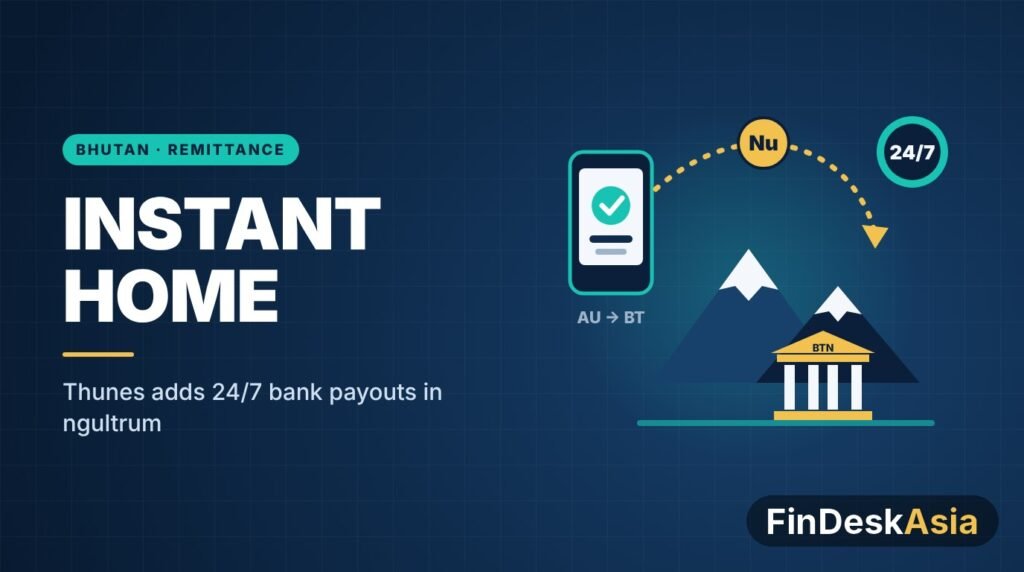
Bhutan: Thunes Opens 24/7 Instant Bank Payouts as Remittances Climb 69%
Bhutanese working abroad can now send money straight into any licensed bank account back home in seconds, at any hour, through banks and money transfer firms that use Singapore-based payments network Thunes. The company announced on 16 November that it has connected Bhutan’s banking sector to its Direct Global Network, with payouts made in the local currency, the ngultrum. The move comes as money sent home by Bhutan’s fast-growing diaspora has become a bigger part of the small Himalayan economy.
Key facts
- What launched: Thunes’ network members, including digital banks, money transfer operators and remittance providers, can now make real-time person-to-person payouts to accounts at all licensed banks in Bhutan.
- Currency and timing: Payouts arrive in Bhutanese ngultrum (BTN), 24 hours a day, seven days a week, without waiting for batch processing.
- Fewer failed transfers: The service checks recipient account details automatically and standardises sender information before money moves.
- Remittance growth: Inward remittances rose 69% between Bhutan’s 2023-24 and 2024-25 financial years, according to the annual report of the Royal Monetary Authority (RMA), the central bank.
- Economic weight: Personal remittances are equal to about 3% to 4% of Bhutan’s GDP, and more than 70,000 Bhutanese, close to 10% of the population, live abroad.
How the new route works
Thunes does not deal with the public directly. It runs the plumbing behind the scenes: a remittance app, bank or money transfer company in, say, Australia plugs into Thunes once, and can then pay out to many countries through it. With Bhutan added, those partners can credit a recipient’s bank account in Thimphu or elsewhere in the country almost instantly, instead of waiting for slower, batched bank transfers.
Thunes said the automated account checks and cleaner sender data are designed to cut the number of payments that bounce back because of a wrong account number or incomplete details. Failed transfers are a common pain in remittances, as they delay funds and can add fees for the sender. The company did not disclose pricing, transfer limits or which Bhutanese banks are already receiving payments through the link.
Why it matters
For a small country where close to one in ten citizens lives abroad, remittances are becoming an important source of household income and foreign currency. Bhutan has seen a steady outflow of young, skilled workers in recent years, many of them heading to Australia, which local reports say is now by far the largest source of money sent home. Thunes also pointed to a growing Bhutanese community in Southeast Asia.
The RMA has been pushing families to use formal channels instead of informal money carriers, including through its Remit Bhutan scheme and tie-ups between local banks and Australian financial institutions. Bhutanese reporting has credited formal banking channels and better digital remittance platforms for the recent jump in inflows. Instant, round-the-clock payouts through a large global network fit that push: when the official route is fast and reliable, there is less reason to send cash through unofficial means, and more of the foreign currency is recorded in the banking system.
For the wider region, the deal is another sign of how payment networks are reaching smaller, less-served corridors in South Asia. Big remittance markets such as India, the Philippines and Pakistan have long had many fast options, while smaller countries have often been left with fewer, slower and more expensive routes. Adding a market like Bhutan gives app-based remittance firms one more destination to offer customers without building local bank links themselves.
What to watch
- Which consumer remittance apps and banks, especially in Australia, switch on the Bhutan route, and what fees and exchange rates they charge.
- Whether the RMA’s next figures show further growth in remittances through formal bank channels.
- Whether Thunes extends Bhutan payouts beyond bank accounts, for example to mobile wallets.
Related: Pakistan: Banks to Spend Rs100 Billion to Keep Remittances Cheap · ASEAN’s cross-border QR payment links
Sources: Thunes (November 2026); Fintech News Singapore (November 2026); PR Newswire (November 2026); Kuensel via Asia News Network (March 2026)
