
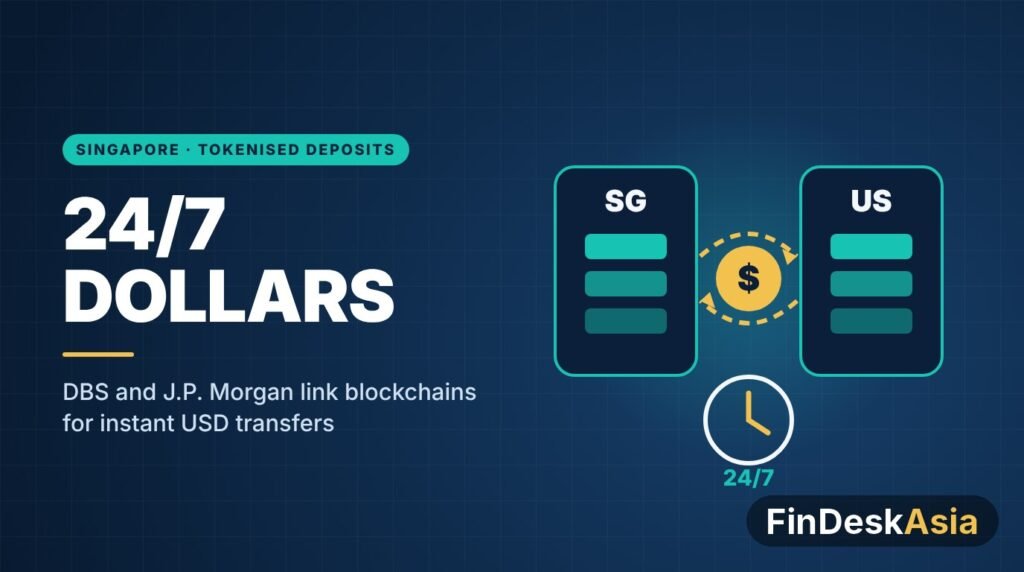
Singapore: DBS and J.P. Morgan Link Blockchains for 24/7 Dollar Transfers, Ant First Client
Singapore’s DBS Bank and Kinexys, the blockchain payments unit of J.P. Morgan, have linked their networks so that companies can move US dollars between Singapore and the United States instantly, at any hour and on weekends. Ant International, the global payments group, is the first client to use the service.
Key facts
- The new link connects DBS Token Services with Kinexys’ Blockchain Deposit Account network, letting institutions make instant USD transfers between blockchain-based accounts in Singapore and the US.
- Settlement between the two banks is coordinated by Partior, a shared ledger platform for clearing and settlement in which DBS and J.P. Morgan are founding shareholders.
- Ant International is the first client, using it to manage cash and liquidity across its companies in both markets in real time.
- The launch puts into use an interoperability framework the two banks announced in November 2025.
- Moving money between the blockchain network and ordinary bank accounts still pauses for three hours every Saturday (3pm to 6pm US Eastern time); the banks say a fix is being built.
What the banks have built
Both banks already offer tokenised deposits: normal bank deposits recorded as digital tokens on a private, permissioned blockchain run by the bank. Unlike stablecoins, which are issued by separate companies, tokenised deposits remain a claim on a regulated bank, so corporate treasurers can use them without leaving the banking system.
Until now, each bank’s tokens mostly moved inside its own network. A company holding dollars on DBS’ platform in Singapore and needing them in a J.P. Morgan account in New York would usually fall back on traditional correspondent banking, which runs on banking hours and can take a day or more. The new link lets the two networks talk to each other, so a transfer can settle in seconds, even late on a Friday night in Singapore.
DBS said the work also supports Project BLOOM, an industry initiative led by the Monetary Authority of Singapore (MAS), the city-state’s central bank and financial regulator. DBS and Kinexys co-lead its working group on making different token systems compatible.
Why it matters
For large companies that operate across time zones, idle cash is a cost. Ant International said it needs quick access to funds to serve customers around the clock, and the round-the-clock link means money no longer sits waiting for a bank to open on Monday. Rachel Chew, chief operating officer and co-head of digital assets for DBS’ global transaction services, said tokenised money is moving from experiments to delivering live value for clients.
The bigger significance is interoperability. Many banks across Asia have built their own token platforms, but separate islands limit their usefulness. A working, client-facing link between a major Singapore bank and J.P. Morgan shows how these networks can be joined without a single central platform. DBS cited Money20/20 and FXC Intelligence estimates that Asia’s outbound cross-border payments could reach about US$24 trillion by 2033, nearly double the 2025 level of US$13.5 trillion.
The service is for institutions, not consumers. Individuals sending money abroad will not see a change for now, but the same plumbing could, over time, speed up the wholesale flows that sit behind remittance and merchant payment services across the region.
What to watch
- Whether more corporate clients beyond Ant International sign up, and whether other currencies are added after the US dollar.
- When the banks remove the three-hour Saturday pause between blockchain and ordinary accounts.
- Whether other Asian banks connect their token platforms through Partior or MAS’ Project BLOOM.
Related on FinDeskAsia: ASEAN’s cross-border QR payments record and Singapore’s Wong proposes an ASEAN-wide network of payment links.
Sources: Fintech News Singapore (November 2026); DBS and Kinexys by J.P. Morgan announcement via MarketScreener (November 2026).
