
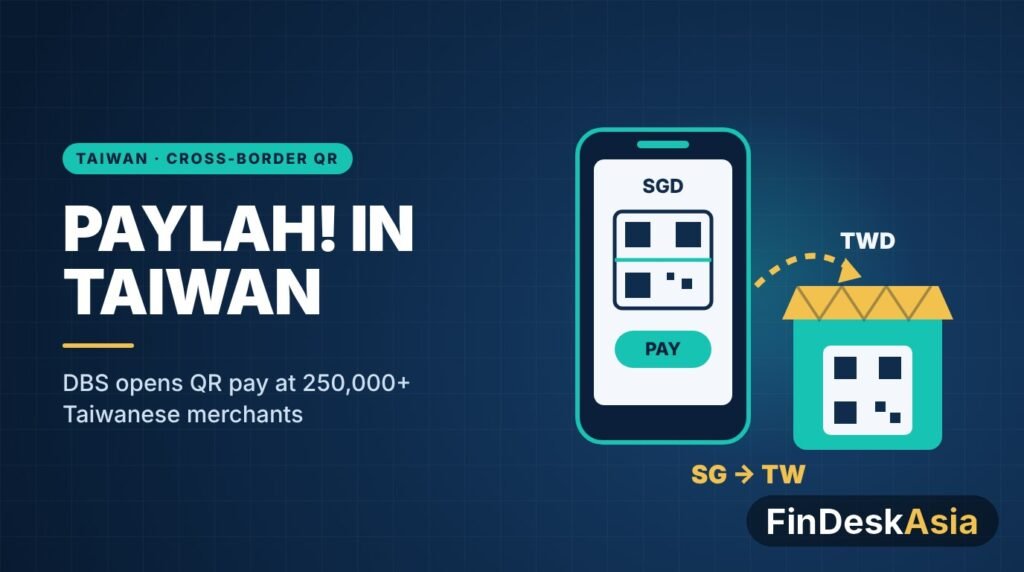
Taiwan: DBS PayLah! Now Works at 250,000 Merchants via TWQR Link With Singapore’s NETS
Singaporeans heading to Taiwan can now leave more of their cash at home. DBS Bank has switched on QR payments in Taiwan for its PayLah! e-wallet, letting users scan and pay at more than 250,000 Taiwanese merchants, from night-market stalls to restaurants and shops.
The link runs through TWQR, Taiwan’s national QR payment standard, and is the first time a Singapore bank has connected its customers to that network.
Key facts
- DBS announced the service on 21 October 2026. PayLah! now works at more than 250,000 merchants in Taiwan, roughly two-thirds of the TWQR merchant base.
- More than 3 million PayLah! users are eligible. They need the latest version of the app.
- The connection builds on a cross-border QR tie-up agreed in April 2026 between NETS, Singapore’s domestic payments network, and Taiwan’s Financial Information Service Co (FISC), which runs TWQR.
- DBS Bank Taiwan acts as the settlement bank for the NETS–TWQR link.
- DBS says its cross-border QR transaction volumes grew 2.5 times year on year, while the number of unique users doubled.
How it works
A traveller looks for the TWQR acceptance mark or a TWQR-labelled QR code at the counter, scans it in PayLah!, and checks the screen before confirming. The app shows the price in New Taiwan dollars (TWD), the exchange rate, and the final amount in Singapore dollars (SGD) that will be deducted. The currency is converted once, at DBS’s own rate.
Merchants do not need to sign up for anything new. Shops that already display a TWQR code through participating providers such as Taiwan Pay, iPass Money, PXPay Plus or Easy Wallet can accept the payment.
DBS is also running a launch offer: from 16 November 2026 to 31 January 2027, customers using PayLah!’s overseas QR service for the first time can earn cashback of up to S$3 with no minimum spend. The offer also covers QR payments in Malaysia, Thailand and Indonesia.
Why it matters
Taiwan’s night markets and small eateries are a big part of the trip for many Singaporean visitors, and small vendors often prefer cash or local QR codes to international cards. Scan-to-pay with a home e-wallet removes the need to change money, and it shows the cost in Singapore dollars before the traveller pays.
For the region, the deal shows how QR linkages are spreading beyond the ASEAN core. Until now, PayLah!’s overseas QR coverage was mostly in Southeast Asia: QRIS in Indonesia, PromptPay in Thailand and DuitNow QR in Malaysia, plus UnionPay worldwide. Taiwan adds a North Asian destination to that list.
Malaysians already see the other side of this model. PayLah! users can pay at DuitNow QR merchants in Malaysia through the Singapore–Malaysia QR link, and the same network-to-network approach is how Malaysian wallets and banks reach shops abroad. Each new corridor raises the pressure on card schemes and money changers that have long dominated travel spending.
For Taiwan, the NETS link gives local merchants a route to Singaporean visitors’ spending through the QR codes they already display.
What to watch
- Full coverage in 2027: DBS expects PayLah! to work across the whole participating TWQR network next year, including merchants that use JKO Pay.
- Two-way payments: DBS plans a merchant-scan option for large Taiwanese retailers, and will let DBS customers in Taiwan pay at SGQR merchants in Singapore through the digibank app.
- Pricing: neither DBS nor its partners have spelled out fees or exchange-rate margins in detail, which will decide how travellers compare QR with cards.
Related on FinDeskAsia: ASEAN’s cross-border QR record and DuitNow explained.
Sources: Fintech News Hong Kong (October 2026); HardwareZone Singapore (October 2026).
