
Pakistan: Islamabad Must Go Cashless by 31 December, Offices Drop Cash From 30 November
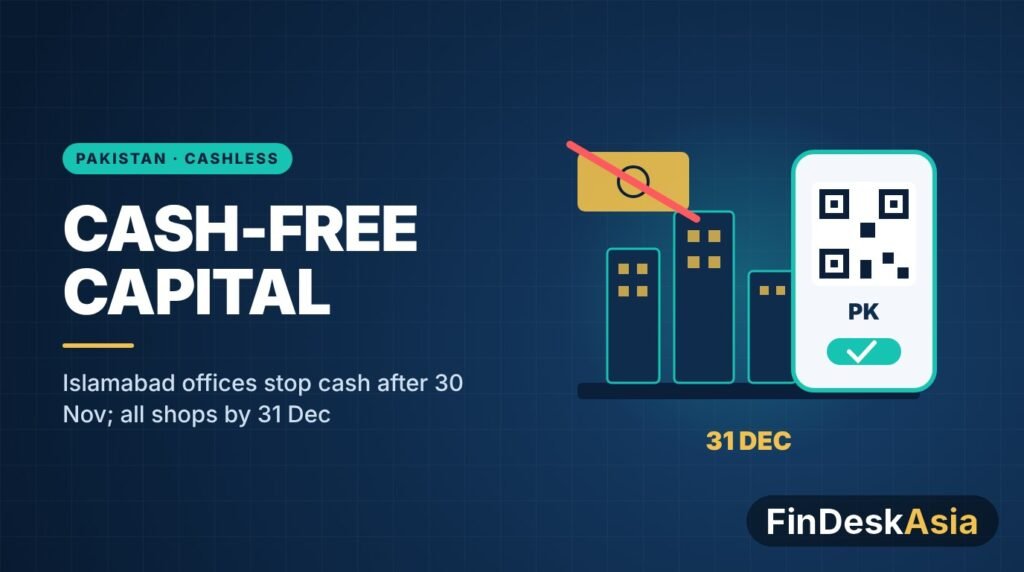
Pakistan has given its capital a hard deadline to stop using cash. At a meeting on 13 November, the federal government decided that Islamabad should become the country’s first fully cashless city by 31 December 2026, with government offices in the capital refusing cash even earlier, from 30 November.
Key facts
- The decision came at a “Cashless Capital” meeting chaired by Minister of State for Interior Talal Chaudhry, attended by the chairman of the Capital Development Authority (CDA), Sohail Ashraf, and representatives of the banking sector.
- After 30 November, no department of the CDA or the Islamabad Capital Territory (ICT) administration will accept cash payments.
- All merchants in Islamabad are to be brought into the digital payment system by 31 December.
- About 26,000 merchants in the city are already connected to digital payments, according to Chaudhry.
- Nationally, merchants accepting digital payments have risen fourfold under the Cashless Pakistan drive, from 0.5 million to 2.03 million.
What is changing in Islamabad
The plan has two stages. The first is inside government. The CDA, which runs the city’s planning, property and many civic services, and the ICT administration, which handles district-level services, will both stop taking cash after 30 November. Residents paying fees, charges or fines at these offices will need to use a digital channel instead, such as a bank app, a mobile wallet or a QR code.
The second stage is the wider economy. The government wants digital payments to be available “at every level”, from street vendors and small shops to large commercial centres, by the end of the year. Banks at the meeting pledged to cooperate. Chaudhry said the shift would bring more financial transparency, better tax monitoring and smoother transactions, and stressed that suggestions from all stakeholders would be needed for it to work.
The project follows instructions from Prime Minister Shehbaz Sharif and Interior Minister Mohsin Naqvi. According to Chaudhry, Naqvi had promised the prime minister that Islamabad would become Pakistan’s first cashless city and the world’s first cashless federal capital.
Why it matters
Pakistan is still a heavily cash-based economy, and the government sees digital payments as a way to widen the tax net and cut the cost of handling notes. Islamabad is a logical test case: it is smaller and more planned than Karachi or Lahore, and a large share of its residents deal directly with federal offices.
The capital push sits inside a broader national effort built on Raast, the free instant payment system run by the State Bank of Pakistan (SBP), the central bank. Raast QR codes have been printed on more than 45 million gas and electricity bills, and all offices of NADRA, the national identity authority, now accept Raast QR. The government has also asked the SBP to prepare a paper on a merchant discount rate (MDR) for Raast QR, meaning a small fee that shops would pay on each digital payment, and wants its tracking dashboard to show transaction values and unique users, not just volumes. Officials say overall digital payment volume has doubled in a year.
Moving 26,000 connected merchants to every merchant in the city in about seven weeks is a big jump. The test will be whether small traders, who often work on thin margins and prefer cash, find digital payments cheap and reliable enough to adopt willingly. For other countries in the region weighing cashless targets for their capitals or civil services, Islamabad will be a useful real-world example of what a hard deadline can and cannot achieve.
What to watch
- How the CDA and ICT handle residents who cannot pay digitally once cash is refused after 30 November.
- Whether the government sets out rules or penalties for private merchants who miss the 31 December target.
- The final design of the Raast QR merchant fee, which will shape how attractive QR payments are for small shops.
Related: Pakistan: Digital-paying shops quadruple to 2.03 million as Raast QR fee plan is drafted and Pakistan ends cheques for government payments, moves them to Raast.
Sources: Dawn (November 2026); Business Recorder (November 2026); Business Recorder (November 2026); Digital Pakistan (November 2026).
