
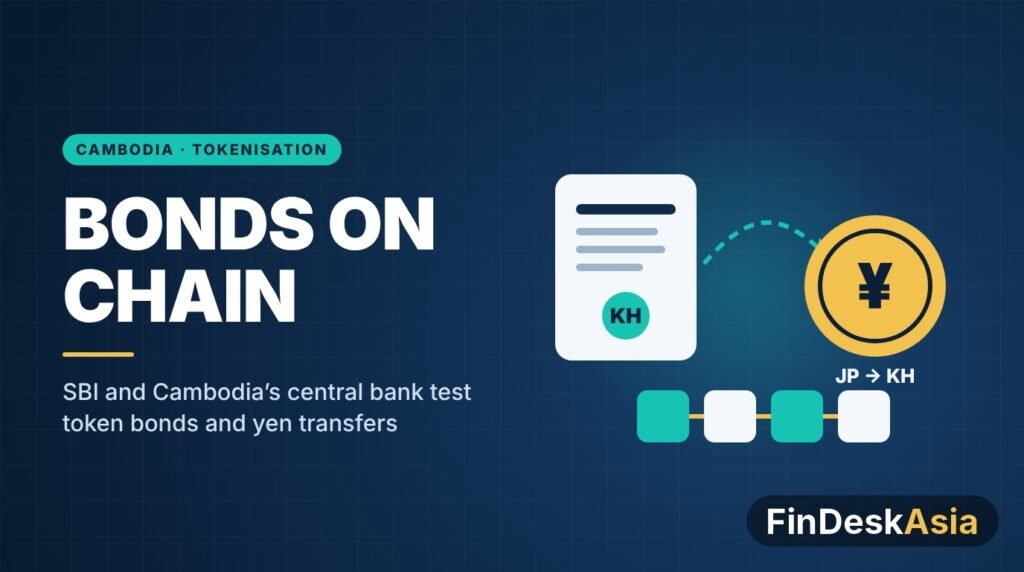
Cambodia: SBI and Central Bank Test Tokenised Bonds and Yen Stablecoin Transfers
Japan’s SBI Holdings has agreed with the National Bank of Cambodia (NBC), the country’s central bank, to run two blockchain trials: one that turns Cambodian government bonds into digital tokens, and one that uses a yen stablecoin to move money between Japan and Cambodia. Early results are due to be shown at the Black Swan Summit in Phnom Penh on 15–16 November.
Key facts
- SBI Holdings said on 13 November that it had signed memoranda of understanding (MOUs) with the NBC for two proofs of concept, or small-scale technical trials.
- The first trial puts Cambodian government bonds on the Canton Network, a blockchain built for financial institutions, so that ordinary people could buy them in small amounts through local financial institutions.
- The second trial uses JPYSC, a yen-pegged stablecoin from SBI Group, as a settlement layer between banks for Japan–Cambodia transfers, in a closed setting with a limited number of participants.
- SBI Bank (Cambodia), SBI’s local bank and a member of Cambodia’s Bakong payment system, will act as the settlement bank on the Cambodian side.
- No launch date, volumes or fees have been announced. Service details and timing will be decided later.
Two trials, two problems
Cambodia’s government bond market is young and mostly held and traded by banks. In the bond trial, the NBC would keep the official register of bondholders, while SBI builds and runs the system. Putting the bonds on a blockchain is meant to automate ownership records, interest payments and repayments at maturity, which could make it cheaper to sell bonds in small pieces to the public. The trial will test whether the set-up works, and whether it is efficient, secure and transparent.
The remittance trial targets a different pain point. A transfer from Japan to Cambodia today often passes through several correspondent banks (banks that hold accounts for each other and relay payments across borders), which adds time and cost. In the trial, JPYSC would sit between the banks as the settlement asset. Customers would not hold the stablecoin themselves; they would send and receive normal money at each end. The NBC will give regulatory guidance and watch the trial, while both sides assess the rules, the systems and whether the model can pay its way.
According to reports on the announcement, the project is framed as a complement to Bakong, the NBC’s own blockchain-based payment system, rather than a replacement, and as a way to support use of the riel, Cambodia’s currency. Reported uses include money sent home by Cambodians working in Japan and payments by Japanese companies operating in Cambodia.
Why it matters
Cambodia has been one of Asia’s most active central banks in payments, from Bakong to QR links with its neighbours. These trials push into two newer areas: tokenised government debt for retail savers, and regulated stablecoins as a bank-to-bank bridge instead of a consumer product. Both are areas where many Asian regulators are still writing the rules.
For Japan, the trial gives a yen stablecoin a real cross-border job. Most stablecoin settlement today runs through US dollar tokens, so a working yen-to-Cambodia corridor would test whether a non-dollar stablecoin can carry remittance flows under a central bank’s eye. For SBI, which bought a Cambodian bank in 2025, it is also a test of whether on-chain finance can become a real business.
Some questions remain open. The reports say there is no confirmed plan yet to let investors buy the tokenised bonds with JPYSC, to settle bonds and stablecoin at the same moment, or to connect the Canton Network directly to Bakong.
What to watch
- The interim results and demonstrations at the Black Swan Summit in Phnom Penh on 15–16 November.
- Whether the NBC sets a timeline, minimum ticket size or channels for selling tokenised bonds to the public.
- Whether the JPYSC corridor grows beyond a closed trial, and what it costs compared with today’s Japan–Cambodia transfers.
Related: Cambodia and Philippines central banks move to link their QR payment systems · Thailand: tourists can now pay at PromptPay shops with stablecoins
Sources: BigGo Finance (November 2026) · Coin Edition (November 2026) · Genfinity (November 2026) · The Block (June 2026)
