
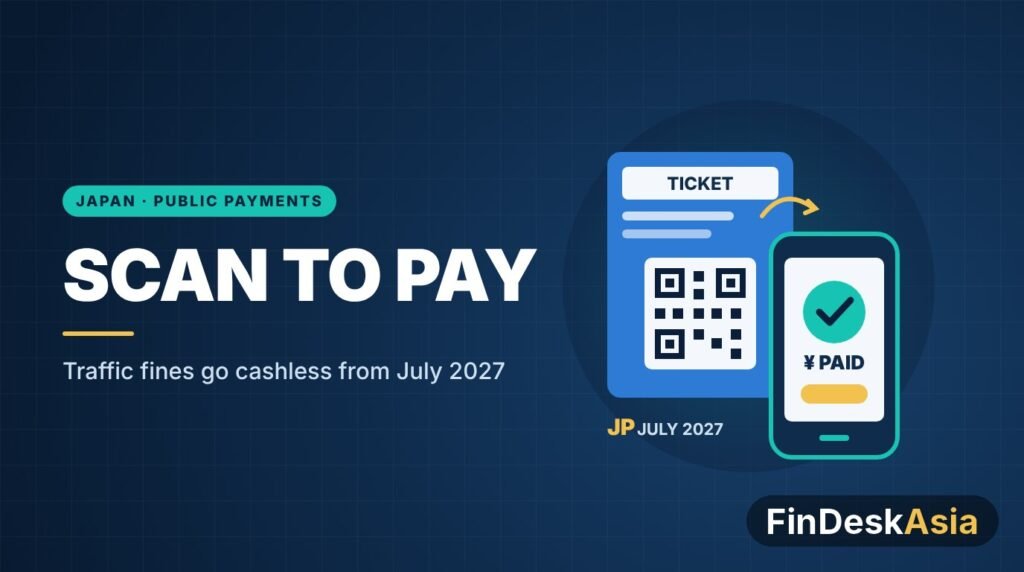
Japan Will Let Drivers and Cyclists Pay Traffic Fines by Card and App From July 2027
Japan is about to make one of its most old-fashioned payment chores digital. The National Police Agency (NPA) says that from July 2027, people who get a ticket for a minor traffic offence will be able to pay the fine by credit card, smartphone app or online banking, instead of queuing at a bank or post office counter during office hours.
Key facts
- The NPA plans to roll out cashless payment of minor traffic fines nationwide, in phases, starting in July 2027.
- Traffic violation notices, known as “blue tickets”, will carry a QR code that opens a payment website.
- Accepted options are expected to include credit cards, smartphone payment apps, convenience store payment and online banking. Cyclists who are fined can use the system too.
- Paying cashless will carry a processing fee of a few hundred yen. Paying in person at a bank or post office stays free.
- In fiscal 2025, Japan collected about 3.85 million traffic fines worth roughly 38 billion yen.
How the new system will work
Today, a driver or cyclist caught for a minor offence such as speeding receives a blue ticket. Paying it settles the matter without a criminal case, but the fine can only be paid at a bank or post office counter, which closes outside business hours. For many working people, that means taking time off just to hand over cash.
Under the new plan, the paper notice stays, but it gets a QR code. The offender scans it with a phone, lands on a payment website, types in the details handwritten on the ticket (including the amount due), picks a payment method and pays. A confirmation is then sent by email or a similar channel.
According to the Jiji Press news agency, the NPA will put the payment processing and system operation out to tender, and could pick a contractor as early as the end of 2026. That choice will decide which card networks, wallets and convenience store chains end up connected to the system.
Why it matters
Japan has long been known as a cash-loving country, but that is changing fast. Japan’s Ministry of Economy, Trade and Industry (METI) says cashless payments made up 42.8% of consumer spending in 2024, worth 141 trillion yen. That beat the government’s target of about 40% by June 2025. The longer-term goal is 80%.
Government payments have been one of the slowest areas to change. Moving traffic fines online is a visible step, because millions of ordinary people deal with them every year. The police say the change is meant to make life easier for the public, reduce the workload on banks that handle the cash, and support the government’s wider push to digitise administrative procedures. A higher payment rate would also mean fewer reminders sent to people who forget to pay.
For the payments industry, the project is a sizeable piece of public-sector business. A system handling close to four million payments a year, with a per-transaction fee, will be attractive to payment processors, QR wallet operators and convenience store payment networks. It is also a test of how well Japan’s many payment brands can be brought together behind a single government QR code.
There is a trade-off. The fee of a few hundred yen means paying online will cost a little more than walking into a bank. Officials are betting that most people will happily pay that small premium for the convenience, while the free counter option stays available for those who prefer cash.
For the wider region, Japan’s move adds to a trend seen across Asia, where governments are shifting fines, taxes and other public payments onto QR codes and mobile wallets so that citizens can pay any time, from anywhere.
What to watch
- Which company wins the contract to run the payment system, and which wallets and card networks are supported on day one.
- The exact size of the processing fee, and whether it is the same for every payment method.
- How fast the phased rollout reaches every prefecture after July 2027, and whether other police services, such as licence fees, follow.
Related on FinDeskAsia: Japan’s Megabanks Complete Joint Yen Stablecoin Pilot for Cross-Border Payments and How Malaysia’s payment system works.
Sources: Jiji Press via Nippon.com (October 2026); The Japan Times (October 2026); METI (March 2025); Impress Watch (March 2025).
