
Kyrgyzstan: New Elpay System Brings One QR Code and Phone-Number Transfers to All Banks
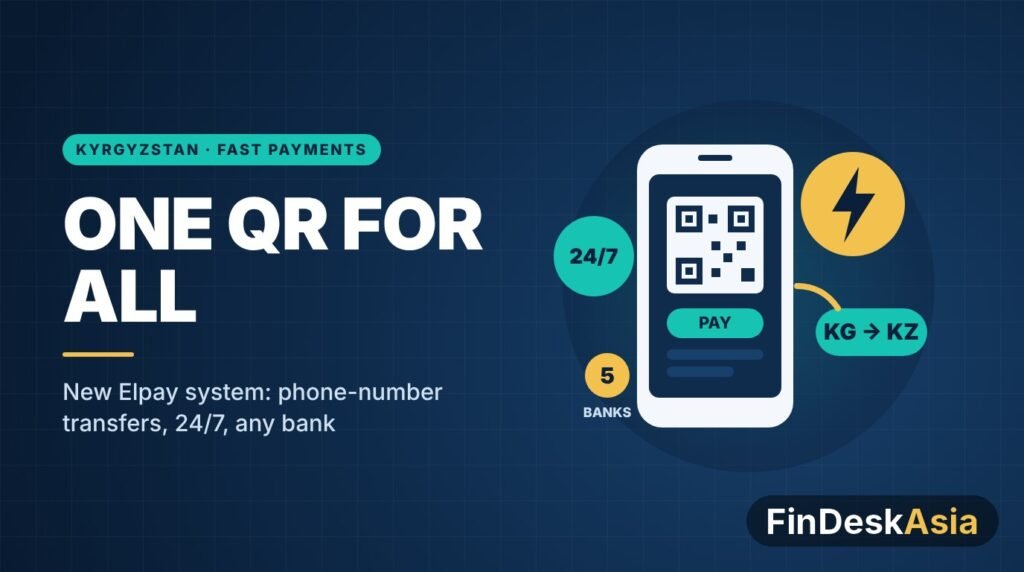
Kyrgyzstan has unveiled Elpay, a new national fast payment system that lets people send money to a phone number and pay any shop with a single QR code, whichever bank they use. The system was presented on 6 November 2026 by the country’s Interbank Processing Center at FinConference 2026 in Bishkek, and five commercial banks are already moving onto it.
Key facts
- Who runs it: the Interbank Processing Center (IPC), a subsidiary of the National Bank of the Kyrgyz Republic that operates the country’s national payment system and the Elcard card and wallet brand.
- What it does: transfers to a phone number, one universal QR code for paying for goods and services, and instant payments between companies.
- Speed and hours: payments go through in a few seconds, 24 hours a day, including weekends and public holidays.
- Who is joining: five commercial banks are moving to Elpay’s live (production) environment, and the IPC plans to add more participants.
- Next step abroad: by the end of 2026, the IPC aims to finish work with Kazakhstan’s National Payment Corporation so each country’s QR codes are accepted in the other.
How Elpay works
Elpay brings three everyday uses onto one set of rails. The first is phone-number transfers. Before sending money, the user sees the recipient’s name and picks the recipient’s bank, a simple check that helps stop money going to the wrong person or to a scammer using a look-alike account.
The second is a universal QR code. Today, shoppers in many markets still meet a counter covered in different QR stickers, one per bank or wallet. With Elpay, a merchant can show one code, and customers of any participating bank or payment provider can scan it. The IPC says users will no longer need to look for a specific bank’s or payment system’s code.
The third is instant payments between companies, which can help businesses settle bills with suppliers without waiting for the next banking day. IPC board chairman Altymysh Turatbekov said the system was built using suggestions from banks and payment firms, as well as feedback from users.
The IPC has not yet published fees, transaction limits, the names of the five banks or a date for full public roll-out.
Why it matters
Kyrgyzstan is a small Central Asian economy that uses the som as its currency. Like many emerging markets, it has a crowded mix of banks and e-wallets that did not always talk to each other. A shared instant payment switch, run by the central bank’s own processing arm, is the same model behind PromptPay in Thailand, QRIS in Indonesia and UPI in India: one public network that every bank and wallet can plug into, so smaller players are not shut out and consumers do not need several apps.
Elpay also fits a wider push to link Kyrgyzstan’s payments with its neighbours. In June 2026, the IPC connected its Elcard Mobile wallet to Alipay+, the cross-border wallet gateway from Ant International, so Kyrgyz users can pay by QR code at Alipay+ merchants abroad. The planned QR link with Kazakhstan, the region’s largest economy, would be the next step, and the IPC says it is also developing payment links with Uzbekistan and Turkey.
For the region, this matters because Central Asia is closely tied by trade, travel and migrant work. If national QR systems can read each other’s codes, a traveller or trader could pay in a neighbouring country with the app they already use at home, instead of carrying cash or paying card and exchange fees. Southeast Asia has followed the same path, linking national QR systems one country pair at a time.
What to watch
- When Elpay opens fully to the public, and how many banks and e-wallets join beyond the first five.
- Whether the IPC sets clear fees and limits for consumers and merchants, especially small shops.
- Progress on the QR link with Kazakhstan before the end of 2026, and any timeline for Uzbekistan and Turkey.
Related: How cross-border QR links are spreading across ASEAN · DuitNow explained: Malaysia’s own phone-number and QR payment system
Sources: Akchabar (November 2026) · Economist.kg (November 2026) · The Tech (November 2026) · FX News Group (June 2026)
