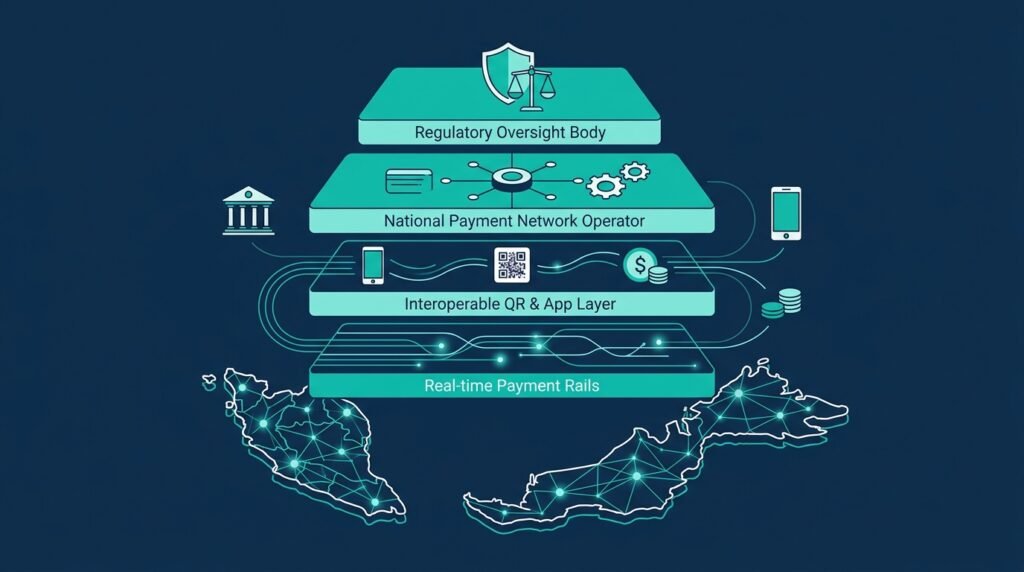
Malaysia’s Payment Infrastructure: A Country Profile
Asia Payment Infrastructure Series — Malaysia
Malaysia has quietly become one of Southeast Asia’s most advanced cashless economies. For anyone new to the region’s fintech scene, here’s a plain-English profile of how the country’s payment infrastructure is put together — the institutions, the rails, and the tools people use every day.
The regulator: Bank Negara Malaysia
At the top sits Bank Negara Malaysia (BNM), the central bank. BNM writes the rules, licenses payment operators and e-money issuers, and safeguards the stability and security of the whole system. Its Financial Sector Blueprint 2022–2026 set national targets for digital adoption, financial inclusion, and universal payment acceptance — the policy engine driving Malaysia’s shift away from cash.
The operator: PayNet
Where BNM regulates, Payments Network Malaysia (PayNet) builds and runs the actual machinery. PayNet is the national payments network, jointly owned by BNM (its largest shareholder) and the country’s major banks. Importantly, it operates on a developmental, non-profit basis — surplus is reinvested into the infrastructure rather than paid out as dividends. PayNet operates the core systems: DuitNow, FPX, JomPAY, MyDebit, Interbank GIRO, and the large-value RENTAS settlement system.
The instant-payment rails: RPP
The backbone is the Real-time Retail Payments Platform (RPP) — the infrastructure that moves money instantly, 24/7, between any bank or e-wallet. Built on the modern ISO 20022 messaging standard, it turned interbank transfers from an hours-long process into a seconds-long one.
The consumer face: DuitNow
Riding on the RPP is DuitNow, the brand Malaysians actually interact with. It comes in three main forms:
– DuitNow Transfer — send money using a mobile number, NRIC, passport, or business registration number instead of an account number.
– DuitNow QR — the single national QR standard that works across all banks and e-wallets.
– DuitNow AutoDebit — recurring payments (bills, subscriptions, instalments) with a one-time consent.
Alongside these, FPX powers “pay via online banking” at e-commerce checkouts, and JomPAY standardises bill payments.
The QR standard
DuitNow QR is the unified national QR code. Instead of a wall of separate e-wallet stickers, a merchant displays one code that accepts payment from virtually any Malaysian app. Adoption has been rapid, with millions of registered merchant touchpoints and QR volumes now measured in the billions of transactions a year.
The e-wallets
Malaysia is firmly a digital-wallet nation. The major players include:
– Touch ‘n Go eWallet — the dominant leader, tied into tolls, parking, and transit.
– MAE by Maybank — the bank-backed challenger.
– GrabPay — riding the Grab super-app ecosystem.
– ShopeePay — strong in e-commerce.
– Boost — an early home-grown wallet now expanding into digital banking.
Cross-border connections
Malaysia is deeply plugged into regional payment integration. Through cross-border QR linkages, Malaysians travelling abroad can scan and pay in local currency in countries like Thailand, Singapore, Indonesia, China, and Cambodia — and visitors from those countries can do the same at Malaysian merchants. These links, part of broader ASEAN payment connectivity efforts, are steadily turning the region into a single scan-and-pay zone.
The direction of travel
Malaysia’s trajectory is clear: more digital, more inclusive, more connected. With BNM setting ambitious targets, PayNet expanding the rails (including 24/7 large-value settlement and enhanced fraud protection), and cross-border links multiplying, the country is positioning itself as a model for interoperable, real-time, low-cost payments in Asia.
The takeaway
Malaysia’s payment infrastructure is a clean, layered stack: BNM regulates, PayNet operates, the RPP moves money instantly, and DuitNow is the everyday face. For newcomers to the region, it’s one of the clearest examples of how a national payment system can be built for speed, interoperability, and financial inclusion.
FinDeskAsia — explaining the money behind Asia’s fintech.
