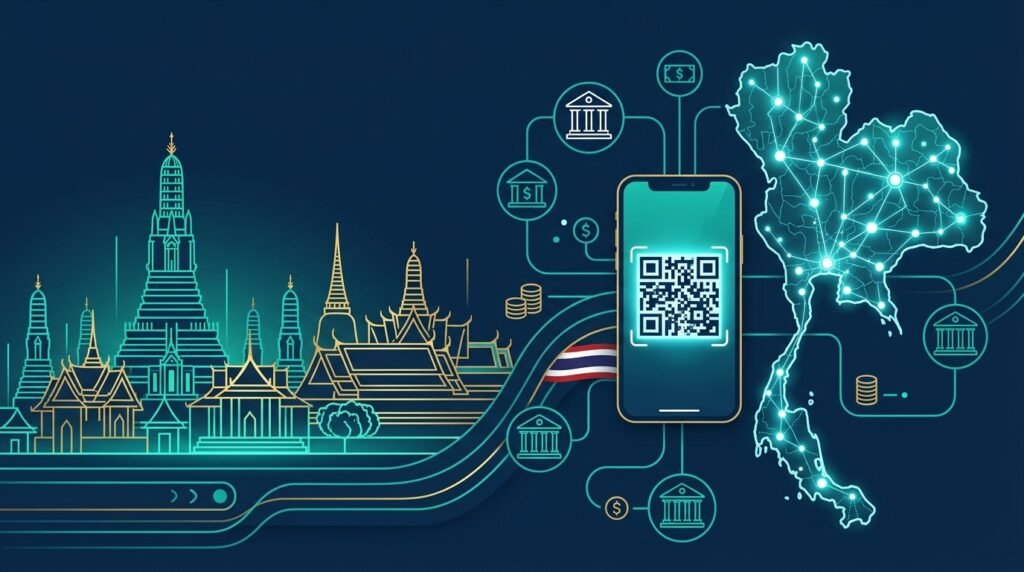
Thailand’s Payment Infrastructure: A Country Profile
Asia Payment Infrastructure Series — Thailand
Thailand is one of Asia’s digital-payment success stories. Anchored by the wildly popular PromptPay system, the country has built infrastructure that now handles billions of transactions and increasingly reaches across borders. Here’s a general profile of how it all fits together.
The regulator: Bank of Thailand
The Bank of Thailand (BOT) is the central bank and the architect of the country’s payment strategy. It supervises the payment ecosystem, sets standards, and has driven a long-running national push toward a cashless society. The BOT also operates BAHTNET, the large-value system where interbank settlement is finalised.
The backbone: PromptPay
The heart of Thailand’s retail payments is PromptPay, launched in 2016 and supervised by the BOT. It’s a real-time payment service that lets people send and receive money instantly, 24/7, using simple identifiers like a mobile number or national ID card number — no account numbers required. PromptPay has become deeply embedded in daily life, with tens of millions of registered users and billions of transactions flowing through it, making it one of the most successful instant-payment systems in the region.
The operator: National ITMX
Behind PromptPay sits National ITMX, a consortium owned by Thai commercial banks that serves as the country’s main payments operator and clearing house. National ITMX develops and runs Thailand’s electronic payment infrastructure across channels — ATMs, card terminals (EDC), internet, and mobile. A developing initiative, PromptBiz, aims to extend this into a unified platform for digital business-to-business (B2B) payments and trade-document exchange.
The QR standard: Thai QR Payment
Thailand’s unified QR standard is Thai QR Payment, built on the international EMVCo QR specification and linked to PromptPay. Like Malaysia’s DuitNow QR, it lets a single QR code accept payments across banks and apps, and it has become ubiquitous — from street-food stalls to shopping malls. Its EMVCo foundation also makes it well-suited to interoperating with other countries’ systems.
The e-wallets
Beyond bank apps, Thailand has a lively e-wallet scene. Prominent players include:
– TrueMoney Wallet — one of the most widely used, with a broad merchant and top-up network.
– Rabbit LINE Pay — integrated with the LINE messaging ecosystem and transit.
– ShopeePay — tied to e-commerce.
These sit alongside PromptPay and card networks as everyday payment options.
Cross-border connections
Thailand has positioned itself as a regional cross-border payment hub. Through the ASEAN Payment Connectivity initiative and bilateral linkages, tourists from countries such as Malaysia, Singapore, Indonesia, Vietnam, Cambodia, Laos, Hong Kong, China, and Japan can use their home apps to pay via Thai QR — and Thais can scan and pay abroad. Thailand has also opened Thai QR acceptance to major international providers, allowing inbound travellers (Chinese visitors in particular) to pay Thai merchants easily. Cross-border QR volumes have been climbing sharply as tourism rebounds.
CBDC and digital-money exploration
The BOT has been an active, if cautious, explorer of Central Bank Digital Currency (CBDC). On the wholesale side, it pioneered Project Inthanon and participates in the multi-country mBridge project for cross-border settlement. On the retail side, it ran a pilot but has signalled no rush to a full-scale retail CBDC. More recently, the BOT has leaned into a programmable payment sandbox to test baht-backed stablecoins and programmable payments — favouring public-private interoperability over a state-issued retail currency for now. Using digital assets directly as a means of payment remains restricted.
The direction of travel
Thailand’s payment infrastructure keeps expanding outward — deeper cross-border links, richer business payments through PromptBiz, and careful experimentation with programmable money. The through-line is a state-led, interoperability-first model that has made everyday digital payments second nature for Thais and easy for visitors.
The takeaway
Thailand’s system rests on a simple, powerful foundation: the BOT sets the direction, National ITMX runs the plumbing, PromptPay delivers instant payments, and Thai QR ties it together — increasingly across borders. It’s one of Asia’s clearest examples of how a national real-time payment rail can transform an economy’s relationship with cash.
FinDeskAsia — explaining the money behind Asia’s fintech.
