
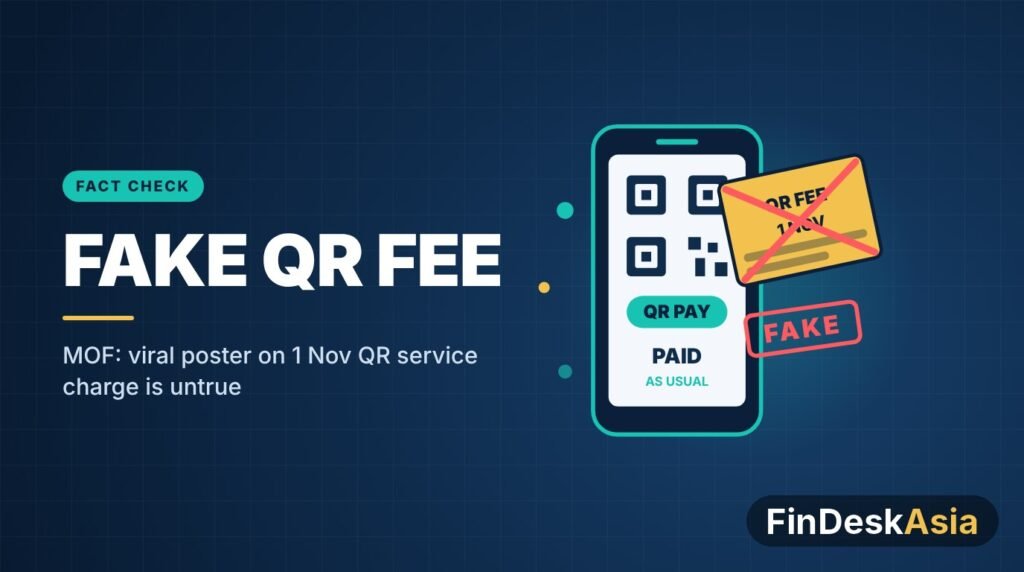
MOF Says Viral Poster on QR Payment Service Charge From 1 November Is Fake
A poster claiming that QR code payments in Malaysia will carry a “service charge” from 1 November 2026 is fake, the Ministry of Finance (MOF) said on 18 October. The ministry said no official announcement on any such charge has been made, and asked the public not to believe or forward the poster. With QR now a daily habit for paying at stalls, shops and food courts, the rumour had real potential to confuse both shoppers and small traders.
Key facts
- The poster, styled as a “top news today” alert, said a service charge on QR payments would start on 1 November 2026.
- MOF called the information untrue in a Facebook post on 18 October 2026, saying there is no official announcement on QR service charges.
- The poster had spread widely on Facebook and Threads and drew mixed reactions, according to Bernama.
- MOF urged the public to check information through its official channels before sharing anything.
Why a “1 November” QR fee rumour sounds familiar
Part of the reason the poster gained traction is that Malaysians have heard a version of this story before. In September 2023, reports that DuitNow QR payments would attract fees from 1 November of that year caused a similar stir. PayNet, the national payments network that runs DuitNow, stepped in at the time to explain what was actually changing.
Its explanation is still a useful guide to how QR costs work. When you pay a merchant by QR, any cost sits on the merchant’s side, in the form of a merchant discount rate (MDR): a small percentage of each sale that the merchant’s bank or payment provider keeps before passing on the rest. Card payments have always worked this way. For DuitNow QR, the MDR had been waived since the 2019 launch and extended through the pandemic, with the waiver ending on 1 October 2023.
PayNet stressed then that this was not a new fee for shoppers. It also said it would set up a reserve fund from the MDR it collects to encourage banks and acquirers not to charge smaller businesses, and several banks said they would defer or absorb the cost for small merchants. A separate RM0.50 fee applies only to person-to-person DuitNow QR transfers above RM5,000, not to everyday purchases at a shop.
What it means for Malaysians
For consumers: nothing changes on 1 November. Scanning a QR code to pay at a kopitiam or a pasar malam stall does not carry an official “service charge”, and MOF has said none has been announced. If a merchant suddenly adds a “QR fee” at the counter and cites a new government rule, you can politely point out that no such rule exists.
For merchants and SMEs: the real cost of accepting QR depends on the agreement you have with your bank or payment provider, not on viral posters. If you are unsure whether you pay an MDR on QR sales, check your merchant statement or ask your acquirer directly. That is also the right moment to compare rates across providers.
For banks and payment firms: episodes like this show how quickly a single image can dent trust in digital payments. Clear, plain-language notices to customers whenever pricing genuinely changes remain the best defence.
How to spot a fake payments notice
- Look for the source. Real policy changes come from MOF, Bank Negara Malaysia, PayNet or your own bank, and appear on their official websites and verified social accounts.
- Be wary of generic headers such as “top news today” with no publisher name, date or link.
- Check whether major news outlets are reporting it. A genuine nationwide fee would be widely covered, and your bank would notify you in advance.
What to watch
- Any official pricing notices from banks or PayNet ahead of 1 November, which would be the only reliable signal of a change.
- Whether authorities step up public warnings as more payments-related misinformation circulates on social media.
- Progress on BNM’s plan to make DuitNow QR the single national QR standard by 2028, which will shape how merchants accept QR in future.
Read more: DuitNow Explained: QR, Transfers, AutoDebit and Cross-Border Pay and PayNet & the Regulators.
Sources: Malay Mail (October 2026); Bernama (October 2026); New Straits Times (October 2026); PayNet (September 2023); Malay Mail (September 2023).
