
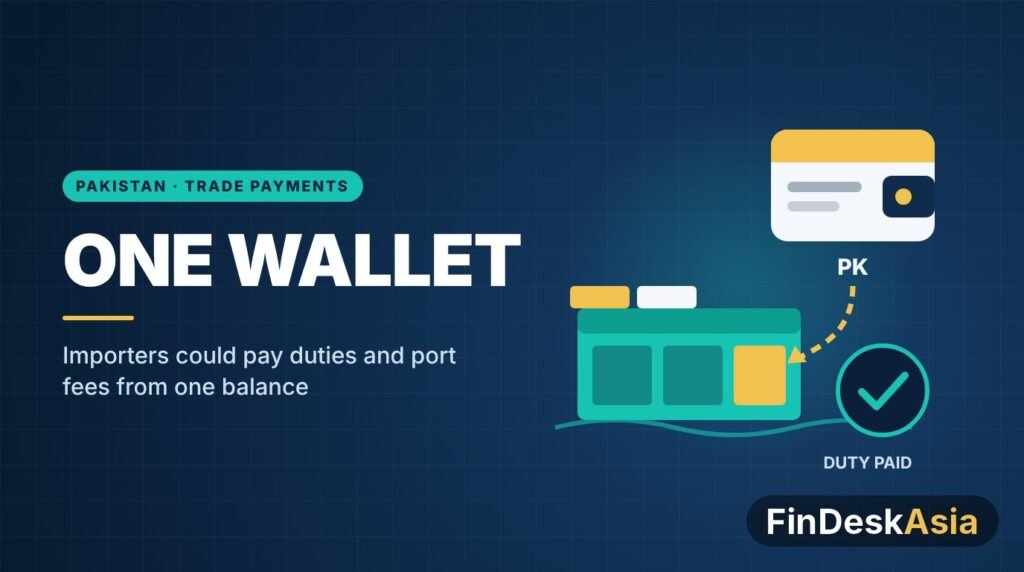
Pakistan: Single Window Plans Pre-Funded Wallet for Customs Duties and Trade Charges
Pakistan’s importers and exporters may soon be able to pay customs duties, taxes and other trade charges from a single pre-funded digital wallet. Pakistan Single Window (PSW), the government’s online platform for trade paperwork and clearance, is planning a new Unified Payment System (UPS) to make this possible.
The wallet would be run by a licensed bank or fintech company, not by PSW itself, and would sit alongside the payment methods traders already use.
Key facts
- PSW plans a Unified Payment System built around a pre-funded digital wallet for customs duties, taxes and other trade-related charges.
- A licensed bank or fintech will operate the wallet under a structure permitted by the State Bank of Pakistan (SBP), the country’s central bank.
- Traders can top up through interbank transfers, Raast (SBP’s instant payment system), banking apps and portals, or over-the-counter deposits, and can withdraw funds remotely.
- PSW will not hold or settle customer money; the wallet provider handles custody, refunds, reversals, settlement and anti-money laundering checks.
- The wallet is an extra option: existing Pre-Deposit (PD) accounts stay in place and will not be migrated.
How the wallet would work
Today, trade payments inside the PSW system go through Pre-Deposit accounts or through bank and payment-gateway channels. Under the plan, a trader could park money in the wallet in advance and keep a reusable balance in Pakistani rupees, then pay several charges from that one balance as they come up.
Each payment would be made against a “payment advice”, the official notice of what is owed, generated inside the PSW ecosystem. That covers the main PSW platform plus linked services such as the Maritime Single Window and Port Community System, the Air Community System and the Customs Clearance System. In plain terms, the same wallet could pay for a shipment’s port, air cargo and customs steps.
The wallet would connect to PSW only through the new UPS layer. That design lets PSW add more payment providers later without major changes to its own system, which opens the door to competition between banks and fintechs for this business.
Why it matters
For traders, the main gains are convenience and visibility. Instead of arranging separate payments for each charge, a business could fund one balance, pay as it goes and track every transaction through to settlement and reconciliation. That should mean fewer delays at the border caused by a payment that has not cleared.
The structure also reflects a common regulatory principle: the government platform that issues the bill does not touch the money. Keeping customer funds with a licensed, SBP-supervised provider puts know-your-customer and anti-money laundering duties with an institution already set up to handle them.
For Pakistan’s payments sector, the plan is another use case for Raast, the instant payment rail the central bank has been pushing into government and business payments. Allowing top-ups through Raast means traders could move money into the wallet in real time.
Across Asia, governments are wiring payments directly into their trade platforms so that paperwork and payment move together. Pakistan’s approach, using a licensed private operator rather than building a new state-run payment system, follows that trend.
Note: PSW has not published a launch date, fees or the name of the wallet operator. The details here come from the plan as reported by Pakistani media.
What to watch
- Which bank or fintech is selected to run the wallet, and whether more providers are added later.
- Whether any fees apply for top-ups, withdrawals or refunds, and how quickly refunds are processed.
- A launch date, and how many traders choose the wallet over existing Pre-Deposit accounts.
Related on FinDeskAsia: How Malaysia’s payment system works and ASEAN’s cross-border QR payments record.
Sources: ProPakistani (November 2026); TechJuice (November 2026).
