
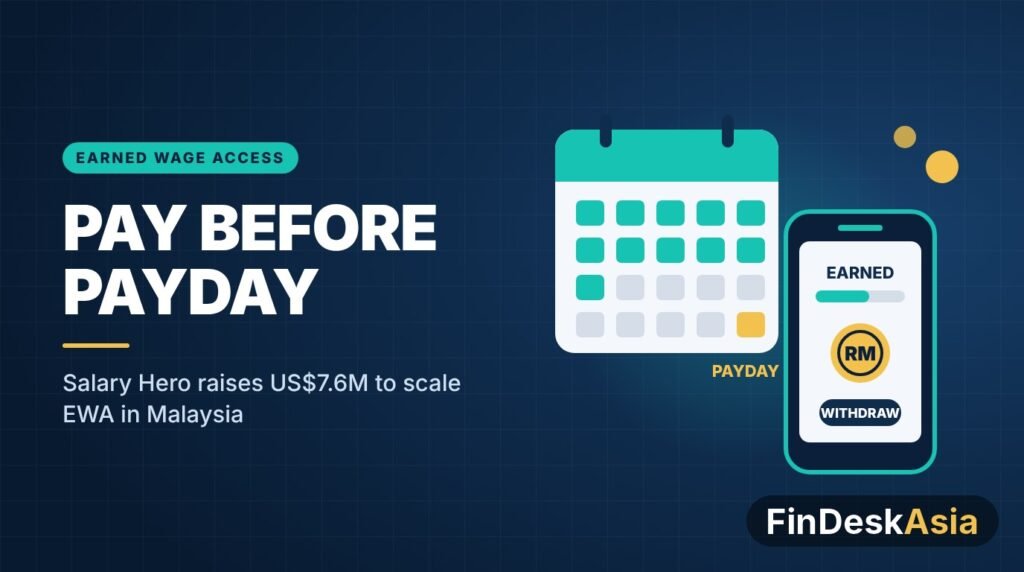
Salary Hero Brings Earned Wage Access to Malaysia After US$7.6 Million Series A
Thailand-based fintech Salary Hero has closed a US$7.6 million Series A round to grow its earned wage access (EWA) service in Malaysia, where it began operating in the second quarter of 2026. The deal puts another regional player into a fast-forming Malaysian market for payroll-linked financial tools, which let workers draw on pay they have already earned instead of turning to costly short-term credit.
The deal in brief
The round was led by Cento Ventures, with Malaysia’s Kairous Capital and M Venture Partners also taking part. Alongside the equity, the company said it has enlarged its credit facility with regional lenders to US$10 million. That facility matters because EWA providers typically advance money to workers before the employer’s payroll date, so they need ready capital to fund withdrawals.
- Round: US$7.6 million Series A, led by Cento Ventures
- Other investors: Kairous Capital and M Venture Partners
- Debt funding: credit facility raised to US$10 million
- Malaysia goal: 50 corporate partners by the end of 2027
How earned wage access works
EWA is not a loan in the usual sense. The service connects to an employer’s HR and payroll system and tracks how many days an employee has worked in the current pay cycle. The worker can then withdraw part of those accrued wages early through an app, and the amount is settled when the regular salary is paid out.
Salary Hero says it plugs into payroll through more than 25 enterprise HR partners, and pairs the wage-access feature with budgeting tools and financial education content. It also offers employers an AI-based dashboard that uses anonymised workforce data to flag where staff turnover risk is building.
In its home market of Thailand, the company reports serving more than 100 companies and over 300,000 employees, mostly in manufacturing, logistics, hospitality and retail, sectors with large hourly and shift-based workforces.
Why it matters for Malaysia
The pitch rests on a familiar gap in household finances. Citing a 2024 Bank Negara Malaysia survey, Salary Hero noted that 61% of Malaysians said they would struggle to come up with RM1,000 in an emergency, compared with 47% in 2021. For workers in that position, a mid-month shortfall can push them towards informal moneylenders or high-interest credit.
The company claims its users in the region have avoided an estimated US$150 million in loans from predatory lenders, and that client employers have seen frontline turnover fall by 15% to 25%. These are company-reported figures, and the methodology behind them has not been published, so they are best read as indicative rather than proven.
For Malaysian employers, especially factories, retailers and logistics firms, the appeal is mainly retention. Offering flexible pay access is a low-cost benefit compared with wage increases, and it can be a differentiator in tight labour markets.
Open questions for workers and employers
The announcement leaves some practical details unclear, and these are worth checking before signing up:
- Fees: the company has not disclosed what workers pay per withdrawal, or how costs are shared with employers.
- Limits: how much of earned pay can be drawn, and how often, shapes whether EWA helps or simply shifts a cash crunch to the next payday.
- Regulation: EWA sits between payroll services and consumer credit, and regulators in several markets have looked closely at frequent small fees. Malaysia has not set out EWA-specific rules.
What to watch
Salary Hero enters a crowded field, with local and regional EWA providers already courting Malaysian employers. Key markers will be how quickly it reaches its 50-partner target, which payroll and HR platforms it integrates with locally, and whether policymakers move to clarify how EWA fits alongside Malaysia’s newer rules on buy now, pay later and consumer credit.
Related on FinDeskAsia: How Malaysia’s Payment System Works: A Plain-English Guide and PayNet & the Regulators.
Sources: Fintech News Malaysia (October 2026); e27 (October 2026); People Matters SEA (October 2026).
