
Singapore: Tazapay Revenue Jumps 71% as Losses Widen Ahead of US$400 Million Circle Deal
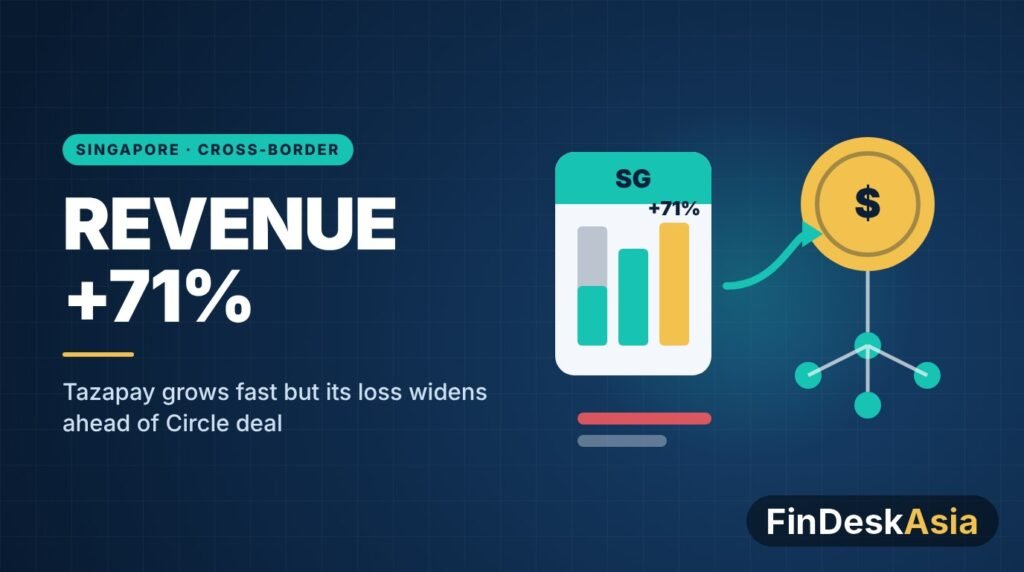
Singapore cross-border payments firm Tazapay grew its revenue by 71% in the financial year that ended on 31 March 2026, according to audited accounts filed with the city-state’s company registry. Its net loss also widened as it hired more staff and spent more on legal and professional work, all while it waits for US stablecoin issuer Circle to complete a US$400 million takeover.
Key facts
- Tazapay’s revenue rose 71% year on year in FY2026, the 12 months to 31 March 2026, while its net loss grew larger than the year before.
- Most of its revenue comes from transaction fees, and Singapore remains its main source of income, the filings show.
- Circle, the New York-listed issuer of the USDC stablecoin, agreed in September to buy Tazapay in an all-stock deal valued at US$400 million.
- The deal is expected to close in 2027 and needs regulatory approvals, including from the Monetary Authority of Singapore (MAS), the city-state’s central bank and financial regulator.
- Earlier this year, Circle Ventures led an extension of Tazapay’s Series B funding round, taking the round to US$36 million.
What Tazapay does
Tazapay is a business-to-business (B2B) payments company. It does not serve shoppers directly. Instead, it gives other payment firms and financial institutions the “plumbing” to collect and pay out money in other countries. It says it works with more than 60 banking and fintech partners and offers local payout rails in over 100 markets. A payout rail is a local route for delivering money, such as a domestic bank transfer network, so that a supplier abroad receives funds in its own currency without waiting on a long chain of correspondent banks.
The filings, first reported by DealStreetAsia, show a company that is growing fast but still spending ahead of its income. Operating costs climbed alongside revenue, driven by higher staff costs, share-based payments and legal and professional fees. The new funding also left Tazapay with a much larger cash cushion at the end of the year than twelve months earlier.
Why it matters
The numbers give a rare look inside one of the smaller firms that large stablecoin players are now buying to reach real-world payment users. A stablecoin is a digital token designed to hold a steady value, usually one US dollar. Circle wants to use Tazapay’s bank links and local payout networks so that money sent in USDC can be turned into local currency at the other end, quickly and around the clock.
For Asia, the deal shows that regulated stablecoin payments are moving from pilots into ordinary business flows such as paying overseas suppliers. It also tests how MAS treats a foreign stablecoin issuer taking over a Singapore-based payments firm. Singapore has positioned itself as a hub for both cross-border payments and digital assets, so the approval process will be watched closely by other firms in the region that may become takeover targets.
Circle has told Tazapay’s customers they should not expect disruption to existing services, APIs, pricing or customer support while the deal is pending.
What to watch
- Whether MAS and other regulators approve the takeover, and whether any conditions come attached to it.
- How quickly Tazapay’s losses narrow once it becomes part of Circle and its costs are shared with a larger group.
- Whether other stablecoin issuers move to buy Asian payout and payment-licence businesses of their own.
Related on FinDeskAsia: ASEAN’s cross-border QR payments record and Visa opens six tech hubs in Singapore for AI, stablecoins and payment security.
Sources: Fintech News Singapore (Nov 2026); DealStreetAsia (Nov 2026); YourStory (Sep 2026); The Defiant (Sep 2026); FF News (Mar 2026).
