
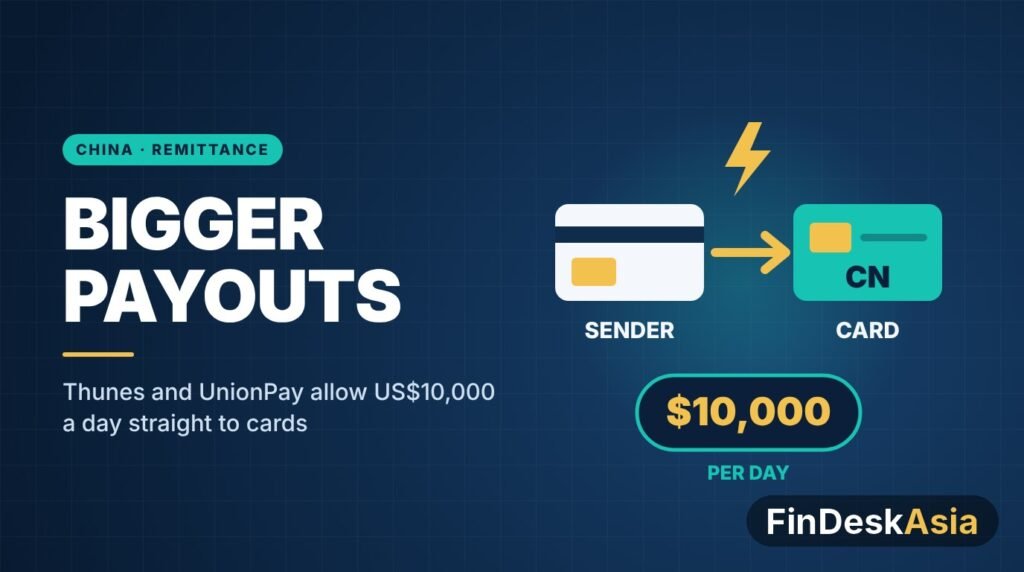
China: Thunes and UnionPay Raise Instant Card Payouts to US$10,000 a Day
Sending money to someone in mainland China has long meant working around low daily caps and splitting larger amounts across several days. Cross-border payments firm Thunes and UnionPay International have now raised the ceiling: banks, payment firms and money transfer operators on the Thunes network can push up to US$10,000 per recipient per day straight onto UnionPay cards in China, in a single instant transfer.
Key facts
- Thunes and UnionPay International (UPI), the overseas arm of China’s UnionPay card network, announced the expanded partnership on 2 November 2026.
- Payouts of up to US$10,000 per recipient cardholder per day can now be sent as one transaction instead of several smaller ones.
- Funds land directly on UnionPay cards issued by 79 Chinese banks, including ICBC, Bank of China, China Construction Bank, Agricultural Bank of China, Bank of Communications and China Merchants Bank.
- The companies named Indonesia, Thailand, Australia, New Zealand, Africa and the United States as key corridors for the expansion.
- The deal builds on a direct technical link between the two firms set up in January 2026, which members reach through a single API (application programming interface).
What changes for senders and businesses
A “payout” is the last leg of a cross-border transfer: the moment money actually reaches the recipient’s account or card. For China, that last leg has often been the bottleneck. Inbound remittances into the mainland have historically faced low daily transaction caps, so a family sending a larger sum home, or a small firm paying a Chinese supplier, often had to break one payment into several and wait days for it all to arrive.
With the higher limit, a sender’s bank or e-wallet that uses Thunes can move the full amount in one go. According to the two companies, this cuts the number of steps, reduces settlement delays and removes the need for manual processing of larger transfers. For businesses, it means bigger volumes can move through what Thunes calls a “Pay-to-Card” route, where money is credited straight to a UnionPay debit card rather than through a traditional bank wire.
Thunes is an officially recognised strategic partner of UnionPay International. The companies say the direct connection reduces the risk of outages, unauthorised routing and service disruptions that can come with longer chains of intermediaries.
Why it matters for Asia
China is one of the world’s biggest destinations for both remittances and trade payments, and many of the senders are in Asia. Indonesia and Thailand, two of the corridors highlighted in the announcement, have large Chinese-linked trading communities and deep supplier ties with the mainland. Faster, larger payouts make it easier for small importers in these markets to settle invoices without relying on costly bank wires or informal channels.
The move also shows how cross-border payments in the region are being rebuilt around networks rather than one-to-one bank relationships. Instead of every remittance company or digital bank negotiating its own link into China, they plug into Thunes once and reach UnionPay cardholders at dozens of banks. Thunes deputy chief executive Chloé Mayenobe described the higher limits as a way to help members grow and let financial institutions scale their flows into China.
For smaller payment providers in Southeast Asia that lack the scale to build their own China connections, this kind of plug-in access lowers the barrier to offering competitive China transfers to their customers.
What to watch
- Which banks, e-wallets and remittance firms in Indonesia, Thailand and the wider region switch on the higher limit first, and whether they pass on lower fees.
- Whether rival networks respond with similar caps for payouts into China, putting pressure on pricing.
- How Chinese rules on inbound foreign currency flows shape the use of larger card payouts over time.
Related on FinDeskAsia: ASEAN’s cross-border QR record and PhotonPay raises US$40 million to link stablecoins with bank and card rails.
Sources: Fintech News Singapore (November 2026); The Paypers (November 2026); Crowdfund Insider (January 2026).
