
Bangladesh: Bangla QR Opens Person-to-Person Transfers Across Banks and Wallets
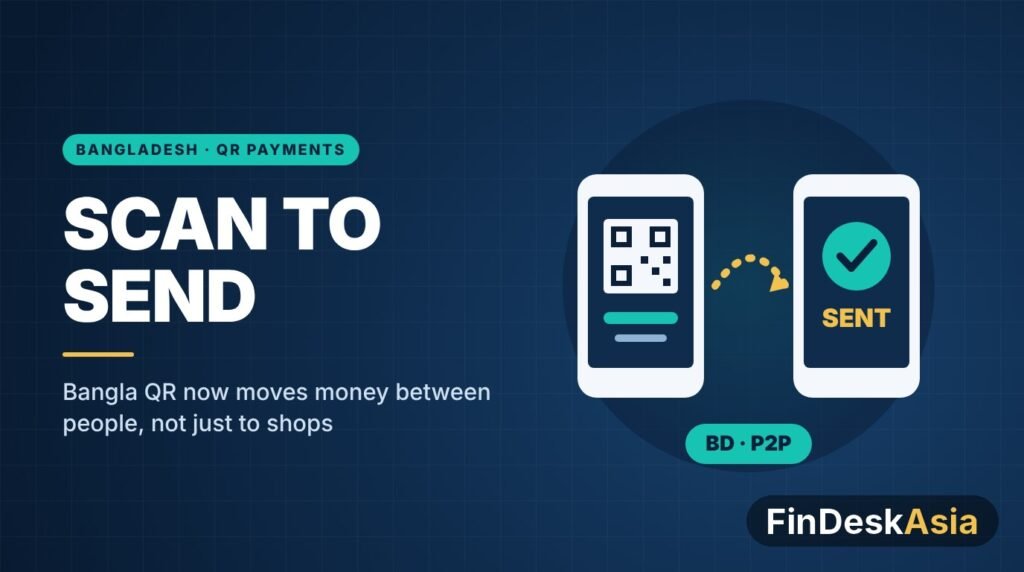
Bangladesh’s central bank has switched on person-to-person (P2P) payments on Bangla QR, the country’s national QR code standard. Since 1 November 2026, people can send money to friends, family or a small trader by scanning the recipient’s QR code, instead of typing a mobile wallet or bank account number.
The move takes a system that was built for paying shops and turns it into an everyday transfer tool, after a year in which Bangladesh Bank made the code mandatory and cut the fees around it.
Key facts
- Launch date: Bangladesh Bank, the central bank, started Bangla QR P2P transfers on 1 November 2026, its assistant spokesperson Shahriar Siddique confirmed in a press release.
- How it works: the sender scans the recipient’s Bangla QR code, checks the name and details shown on screen, and confirms. No account or phone number needs to be typed.
- Interoperable: the service is designed to work between banks and mobile financial services (MFS) such as bKash and Nagad, in every direction: bank to bank, wallet to wallet, and bank to wallet.
- Scale: about 3.9 million merchants accept Bangla QR, and average daily transactions rose from about 100,000 to about 350,000 after the code became mandatory on 1 July 2026.
From shop payments to sending money
Until now, Bangla QR was used only for customer-to-merchant payments. One code at the till lets a shop accept payments from many banks, payment service providers and mobile wallets, with transactions routed through the National Payment Switch Bangladesh (NPSB), the central bank’s interbank switch.
The P2P feature extends the same logic to individuals. Each user can generate a personal QR code in their banking or wallet app. Anyone with a compatible app can scan it to send money, and the central bank says the code can also be uploaded as an image. Bangladesh Bank spokesperson Arief Hossain Khan told reporters in August that a single QR code removes the risk of a mistyped digit sending money to the wrong person, a common problem when users key in long account or phone numbers.
The launch follows several policy steps. Bangla QR became compulsory for banks and MFS providers on 1 July 2026. From 1 October, the central bank withdrew the minimum 1% merchant discount rate (the fee a merchant pays on each card or QR sale), set the interchange fee for issuers to zero, and made merchant payments credit instantly. It also introduced small incentives paid to banks and wallets for Bangla QR payments of up to Tk 2,000 (the taka is Bangladesh’s currency) processed through the NPSB.
Usage has jumped since then. According to figures Bangladesh Bank shared on 30 September, average daily transaction value climbed from over Tk 28 crore to more than Tk 140 crore within about three months, nearly a fivefold increase.
Why it matters
Bangladesh still runs largely on cash, and its mobile wallet market has long been split between providers that do not easily talk to each other. A national, interoperable QR code for transfers lowers that wall: a farmer with one wallet can pay a supplier who banks elsewhere with a single scan.
For the central bank, the aim is a cash-light economy with better data. Khan has said every financial transaction should leave a digital footprint, and the bank estimates the informal economy at US$750–800 billion. Moving small, everyday transfers onto a traceable national rail supports tax collection, anti-money-laundering checks and, over time, credit scoring for people without a formal borrowing history.
The rollout also fits a wider pattern across Asia, where central banks are building one national QR standard on top of an instant-payment switch, then layering on new uses. India’s UPI, Thailand’s PromptPay and Malaysia’s DuitNow followed a similar path from merchant payments to everyday transfers. For Bangladesh, the next steps already flagged include school fees, healthcare bills and QR-based tolls.
Bangladesh Bank has also faced questions over whether a free, state-run QR rail could hurt the business models of banks and wallets. Khan has described Bangla QR as a government initiative and rejected the idea that it would damage their businesses.
What to watch
- App readiness: how quickly all banks and MFS providers add P2P scanning and personal QR codes to their apps, and whether users see any fees.
- Fraud controls: whether the name-check step and the dispute-resolution guidelines issued in September are enough to stop QR-swap scams as volumes grow.
- New uses: progress on Bangla QR for school fees, hospitals, transport tolls and tax payments.
Related on FinDeskAsia: DuitNow explained: how Malaysia’s national QR and transfer system works and how cross-border QR links are spreading across Asia.
Sources: The Business Standard (November 2026); UNB (November 2026); The Business Daily (October 2026); Daily Waadaa (September 2026); The Financial Express (August 2026).
